

This mathematics problem involves applying core mathematical principles and formulas. Below you will find a complete step-by-step solution with detailed explanations for each step, helping you understand not just the answer but the method behind it.
ScanSolve AI Answer
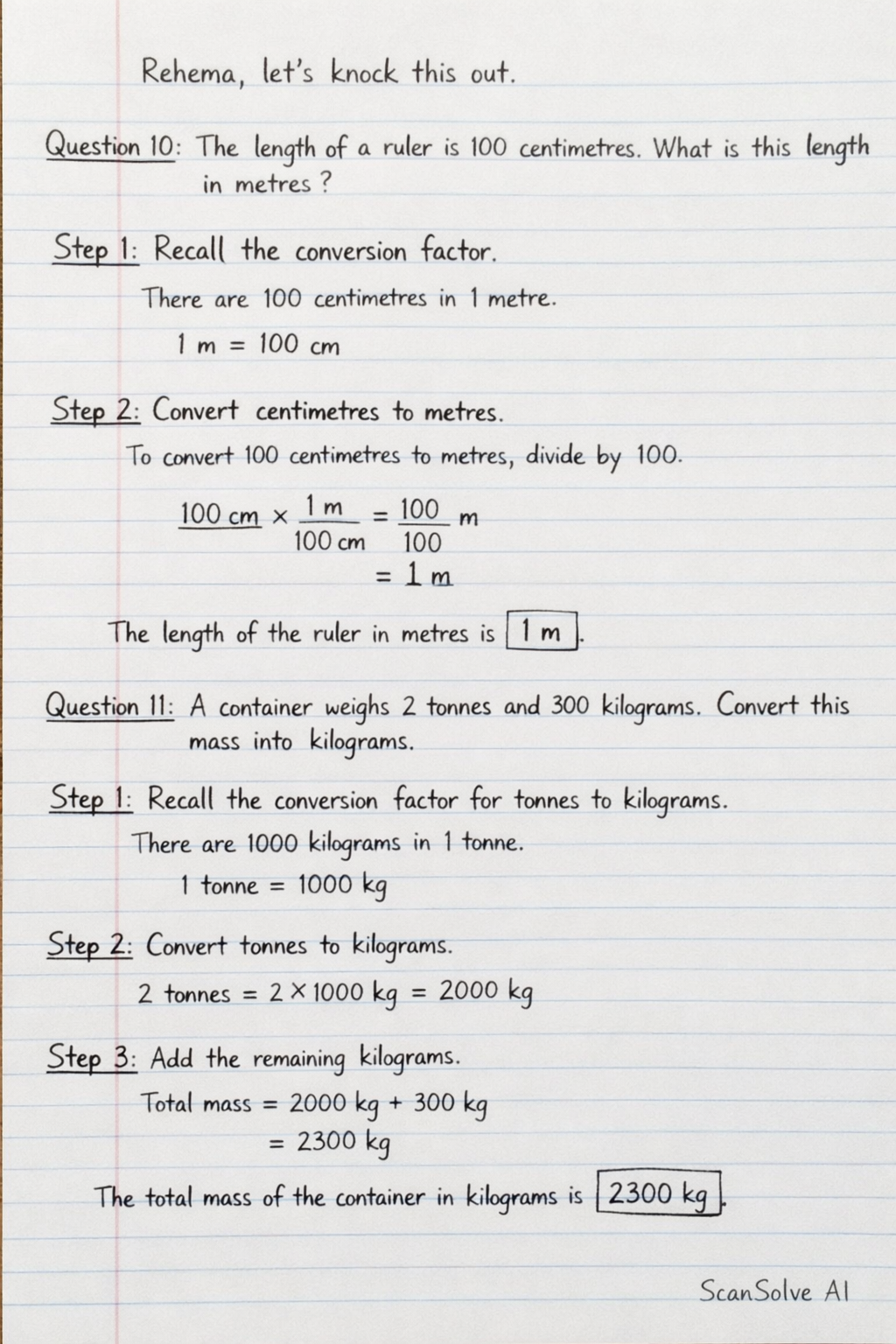
Rehema, let's knock this out. Question 10: The length of a ruler is 100 centimetres. What is this length in metres? Step 1: Recall the conversion factor. There are 100 centimetres in 1 metre. 1 m = 100 cm Step 2: Convert centimetres to metres. To convert 100 centimetres to metres, divide by 100. 100 cm × 1 m100 cm = (100)/(100) m = 1 m The length of the ruler in metres is 1 m. Question 11: A container weighs 2 tonnes and 300 kilograms. Convert this mass into kilograms. Step 1: Recall the conversion factor for tonnes to kilograms. There are 1000 kilograms in 1 tonne. 1 tonne = 1000 kg Step 2: Convert tonnes to kilograms. 2 tonnes = 2 × 1000 kg = 2000 kg Step 3: Add the remaining kilograms. Total mass = 2000 kg + 300 kg = 2300 kg The total mass of the container in kilograms is 2300 kg. Question 12: A factory produces 345 litres of sunflower oil every day. How many millilitres of oil will the factory produce in one week? Step 1: Recall the conversion factor for litres to millilitres. There are 1000 millilitres in 1 litre. 1 L = 1000 mL Step 2: Calculate daily production in millilitres. 345 L = 345 × 1000 mL = 345000 mL Step 3: Calculate weekly production. There are 7 days in a week. Weekly production = Daily production in mL × 7 days = 345000 mL/day × 7 days = 2415000 mL The factory will produce 2415000 mL of oil in one week. Question 13: A maize sack weighs 18250 grams. Convert this mass into kilograms. Step 1: Recall the conversion factor for grams to kilograms. There are 1000 grams in 1 kilogram. 1 kg = 1000 g Step 2: Convert grams to kilograms. To convert grams to kilograms, divide by 1000. 18250 g × 1 kg1000 g = (18250)/(1000) kg = 18.25 kg The mass of the maize sack in kilograms is 18.25 kg. Question 14: Two cows produce milk as follows: the first cow produces 2 litres and 353 millilitres and the second cow produces 5 litres and 452 millilitres. Find the total volume of milk produced by the two cows. Step 1: Convert all volumes to a common unit (millilitres). Recall that 1 L = 1000 mL. First cow's production: 2 L = 2 × 1000 mL = 2000 mL Total for first cow = 2000 mL + 353 mL = 2353 mL Second cow's production: 5 L = 5 × 1000 mL = 5000 mL Total for second cow = 5000 mL + 452 mL = 5452 mL Step 2: Add the total volumes from both cows. Total volume = 2353 mL + 5452 mL = 7805 mL Alternatively, we can add litres and millilitres separately: Total litres = 2 L + 5 L = 7 L Total millilitres = 353 mL + 452 mL = 805 mL Total volume = 7 L 805 mL The total volume of milk produced by the two cows is 7805 mL or 7 L 805 mL. Question 15: Which measurement is the largest among 7500 grams, 3 tonnes, 4000 kilograms, and 2350 milligrams? Give reasons for your answer. Step 1: Convert all measurements to a common unit, such as kilograms (kg). Recall the conversion factors: 1 kg = 1000 g 1 tonne = 1000 kg 1 g = 1000 mg (so 1 kg = 1000 × 1000 mg = 1000000 mg) 7500 grams (g) to kilograms (kg): 7500 g × 1 kg1000 g = 7.5 kg 3 tonnes to kilograms (kg): 3 tonnes × 1000 kg1 tonne = 3000 kg 4000 kilograms (kg): This is already in kilograms. 4000 kg 2350 milligrams (mg) to kilograms (kg): 2350 mg × 1 g1000 mg × 1 kg1000 g = (2350)/(1000000) kg = 0.00235 kg Step 2: Compare the values in kilograms. We have: 7.5 kg 3000 kg 4000 kg 0.00235 kg Step 3: Identify the largest measurement. Comparing these values, 4000 kg is the largest. The largest measurement is 4000 kilograms. Reason: When all measurements are converted to a common unit (kilograms), 4000 kg is the largest value (7.5 kg, 3000 kg, 4000 kg, 0.00235 kg). Question 16: A bucket of water has a volume of 10 litres. If 5534 millilitres of water have been added to the bucket, how many millilitres of water are needed to fill the bucket? Step 1: Convert the total volume of the bucket to millilitres. Recall that 1 L = 1000 mL. Total bucket volume = 10 L = 10 × 1000 mL = 10000 mL Step 2: Subtract the amount of water already added from the total volume. Water needed = Total bucket volume - Water added = 10000 mL - 5534 mL = 4466 mL 4466 mL of water are needed to fill the bucket. Question 17: A trader purchased products with the following masses: 76320 grams of flour, 61000 grams of rice, and 72000 grams of salt. What is the total mass of the products purchased? Step 1: Add the masses of all the products. All masses are already in grams, so we can add them directly. Total mass = Mass of flour + Mass of rice + Mass of salt = 76320 g + 61000 g + 72000 g = 209320 g The total mass of the products purchased is 209320 g. What's next?