The mean age of a second year class of a school is 18 2/5. At the end of the promotion examination, 3 students aged 20, 19 and 19 years were repeated. The new mean age of the class became 18 1/3. Calculate the number of students who were in the class before the promotion examination.

Mathematics
The mean age of a second year class of a school is 18 2/5. At the end of the promotion examination, 3 students aged 20, 19 and 19 years were repeated. The new mean age of the class became 18 1/3. Calculate the number of students who were in the class before the promotion examination.

ScanSolve AI Answer

Answer

30\text{30}^\circ

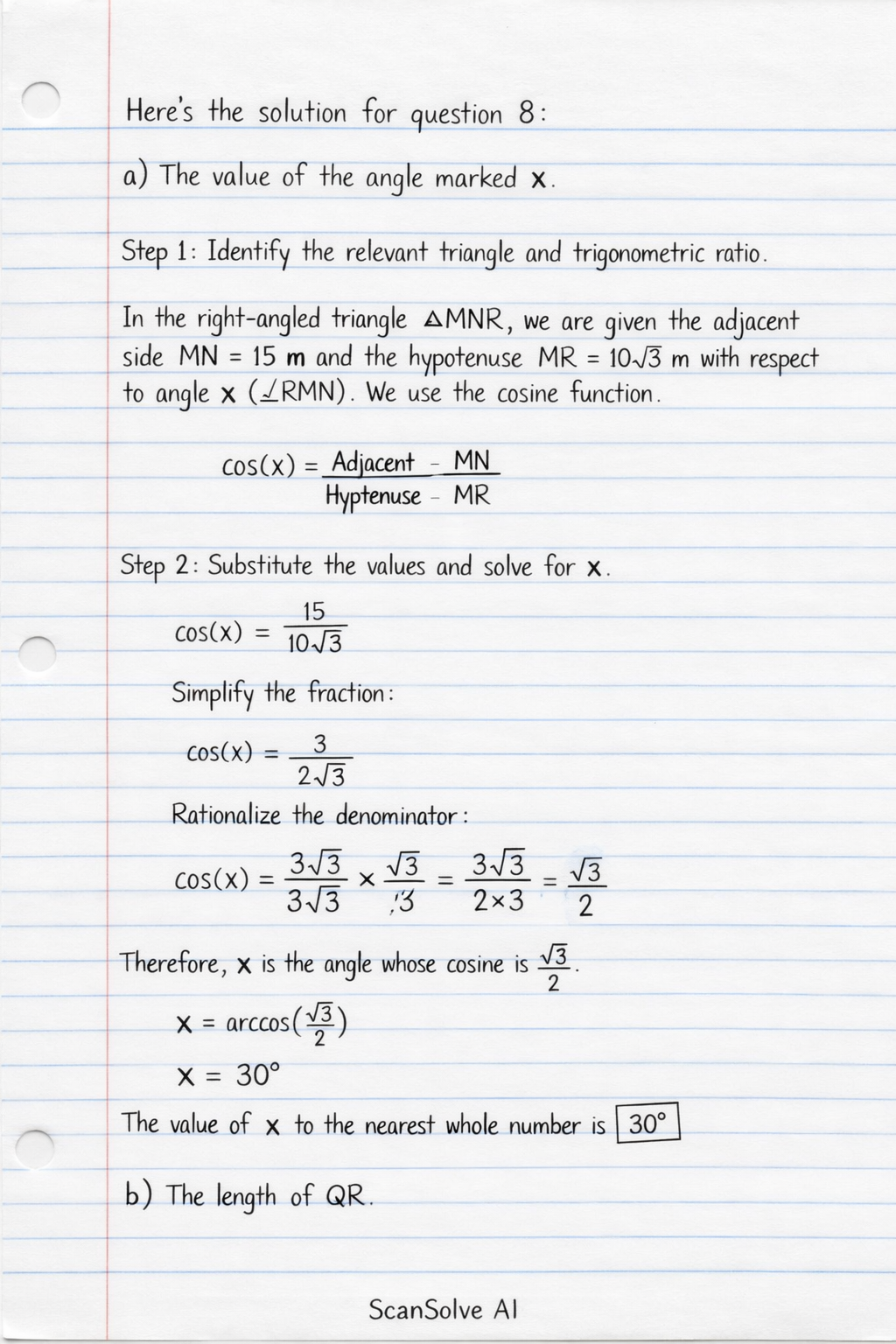
Here's the solution for question 8:

a) The value of the angle marked xx.

Step 1: Identify the relevant triangle and trigonometric ratio. In the right-angled triangle MNR\triangle MNR, we are given the adjacent side MN=15MN = 15 m and the hypotenuse MR=103MR = 10\sqrt{3} m with respect to angle xx (which is RMN\angle RMN). We use the cosine function. cos(x)=AdjacentHypotenuse=MNMR\cos(x) = \frac{Adjacent}{Hypotenuse} = \frac{MN}{MR}

Step 2: Substitute the values and solve for xx. cos(x)=15103\cos(x) = \frac{15}{10\sqrt{3}} Simplify the fraction: cos(x)=323\cos(x) = \frac{3}{2\sqrt{3}} Rationalize the denominator: cos(x)=3323×3=332×3=32\cos(x) = \frac{3\sqrt{3}}{2\sqrt{3} \times \sqrt{3}} = \frac{3\sqrt{3}}{2 \times 3} = \frac{\sqrt{3}}{2} Therefore, xx is the angle whose cosine is 32\frac{\sqrt{3}}{2}. x=arccos(32)x = \arccos\left(\frac{\sqrt{3}}{2}\right) x=30x = 30^\circ The value of xx to the nearest whole number is 30\boxed{30^\circ}.

b) The length of QRQR.

Step 1: Calculate the length of NRNR using the Pythagorean theorem in MNR\triangle MNR. MR2=MN2+NR2MR^2 = MN^2 + NR^2 (103)2=152+NR2(10\sqrt{3})^2 = 15^2 + NR^2 100×3=225+NR2100 \times 3 = 225 + NR^2 300=225+NR2300 = 225 + NR^2 NR2=300225NR^2 = 300 - 225 NR2=75NR^2 = 75 NR=75=25×3=53mNR = \sqrt{75} = \sqrt{25 \times 3} = 5\sqrt{3} m

Step 2: Calculate the length of NQNQ using trigonometry in MNQ\triangle MNQ. In the right-angled triangle MNQ\triangle MNQ, we have MN=15MN = 15 m and MQN=72\angle MQN = 72^\circ. We use the tangent function. tan(MQN)=OppositeAdjacent=MNNQ\tan(\angle MQN) = \frac{Opposite}{Adjacent} = \frac{MN}{NQ} tan(72)=15NQ\tan(72^\circ) = \frac{15}{NQ} NQ=15tan(72)NQ = \frac{15}{\tan(72^\circ)} Using a calculator, tan(72)3.07768\tan(72^\circ) \approx 3.07768. NQ153.077684.8739mNQ \approx \frac{15}{3.07768} \approx 4.8739 m

Step 3: Calculate QRQR. QR=NRNQQR = NR - NQ QR=5315tan(72)QR = 5\sqrt{3} - \frac{15}{\tan(72^\circ)} QR5(1.73205)4.8739QR \approx 5(1.73205) - 4.8739 QR8.660254.8739QR \approx 8.66025 - 4.8739 QR3.78635mQR \approx 3.78635 m Rounding to the nearest whole number: The length of QRQR is 4m\boxed{4 m}.

c) The area of MQR\triangle MQR.

Step 1: Use the formula for the area of a triangle. The area of MQR\triangle MQR can be calculated as 12×base×height\frac{1}{2} \times base \times \text{height}. Here, QRQR can be considered the base and MNMN the height, as MNMN is perpendicular to NRNR (which contains QRQR). Area=12×QR×MNArea = \frac{1}{2} \times QR \times MN

Step 2: Substitute the values and calculate the area. Using the more precise value for QR3.78635QR \approx 3.78635 m and MN=15MN = 15 m: Area=12×3.78635×15Area = \frac{1}{2} \times 3.78635 \times 15 Area28.3976m2Area \approx 28.3976 m^2 Rounding to the nearest whole number: The area of MQR\triangle MQR is 28m2\boxed{28 m^2}.

That's 2 down. 3 left today — send the next one.

Was this helpful?

Need help with your own homework?

Get instant step-by-step solutions to any question. Free to start.

Ask Your Question
Handwritten step-by-step solution preview

Handwritten Step-by-Step Solution

Get this as a handwritten image on WhatsApp — like a tutor wrote it for you.

Try on WhatsApp

Still have questions?

Quick Answer

Here's the solution for question 8: a) The value of the angle marked x. Step 1: Identify the relevant triangle and trigonometric ratio.

The mean age of a second year class of a school is 18 2/5. At the end of the promotion examination, 3 students aged 20, 19 and 19 years were repeated. The new mean age of the class became 18 1/3. Calculate the number of students who were in the class before the promotion examination.
Mathematics

This mathematics problem involves applying core mathematical principles and formulas. Below you will find a complete step-by-step solution with detailed explanations for each step, helping you understand not just the answer but the method behind it.

ScanSolve AI Answer
Here's the solution for question 8: a) The value of the angle marked x. Step 1: Identify the relevant triangle and trigonometric ratio. In the right-angled triangle MNR, we are given the adjacent side MN = 15 m and the hypotenuse MR = 10sqrt(3) m with respect to angle x (which is RMN). We use the cosine function. (x) = AdjacentHypotenuse = (MN)/(MR) Step 2: Substitute the values and solve for x. (x) = (15)/(10sqrt(3)) Simplify the fraction: (x) = (3)/(2sqrt(3)) Rationalize the denominator: (x) = 3sqrt(3)2sqrt(3) × sqrt(3) = 3sqrt(3)2 × 3 = sqrt(3)2 Therefore, x is the angle whose cosine is sqrt(3)2. x = (sqrt(3)2) x = 30^ The value of x to the nearest whole number is 30^. b) The length of QR. Step 1: Calculate the length of NR using the Pythagorean theorem in MNR. MR^2 = MN^2 + NR^2 (10sqrt(3))^2 = 15^2 + NR^2 100 × 3 = 225 + NR^2 300 = 225 + NR^2 NR^2 = 300 - 225 NR^2 = 75 NR = sqrt(75) = sqrt(25 × 3) = 5sqrt(3) m Step 2: Calculate the length of NQ using trigonometry in MNQ. In the right-angled triangle MNQ, we have MN = 15 m and MQN = 72^. We use the tangent function. ( MQN) = OppositeAdjacent = (MN)/(NQ) (72^) = (15)/(NQ) NQ = (15)/((72^)) Using a calculator, (72^) ≈ 3.07768. NQ ≈ (15)/(3.07768) ≈ 4.8739 m Step 3: Calculate QR. QR = NR - NQ QR = 5sqrt(3) - (15)/((72^)) QR ≈ 5(1.73205) - 4.8739 QR ≈ 8.66025 - 4.8739 QR ≈ 3.78635 m Rounding to the nearest whole number: The length of QR is 4 m. c) The area of MQR. Step 1: Use the formula for the area of a triangle. The area of MQR can be calculated as (1)/(2) × base × height. Here, QR can be considered the base and MN the height, as MN is perpendicular to NR (which contains QR). Area = (1)/(2) × QR × MN Step 2: Substitute the values and calculate the area. Using the more precise value for QR ≈ 3.78635 m and MN = 15 m: Area = (1)/(2) × 3.78635 × 15 Area ≈ 28.3976 m^2 Rounding to the nearest whole number: The area of MQR is 28 m^2. That's 2 down. 3 left today — send the next one.