
We read your photo as:
What is the next number on the pattern below 9 71, 801, 671, 562
ScanSolve AI Answer
Answer
Step-by-step solution
6 stepsThe pattern given is $71, 801, 671, 562$.
Calculate the first differences between consecutive terms.
The sequence of first differences is .
Calculate the second differences.
Since the second differences ( and 21) are not constant, the entire sequence does not follow a simple quadratic pattern from the first term.
Observe the pattern from the second term onwards.
Let's consider the sub-sequence .
The first differences for this sub-sequence are:Calculate the second difference for this sub-sequence.
This second difference is constant. This indicates that the pattern is a quadratic sequence starting from the second term.
Determine the next first difference.
Assuming the second difference remains constant at 21, the next first difference will be the previous first difference plus 21:
Calculate the next number in the pattern.
Add this next first difference to the last term given:
The next number in the pattern is 474.
Try one yourself
A new problem that tests the same skill.
Still stuck on this one?
Ask a follow-up, and the answer starts from this question.
More Mathematics Questions
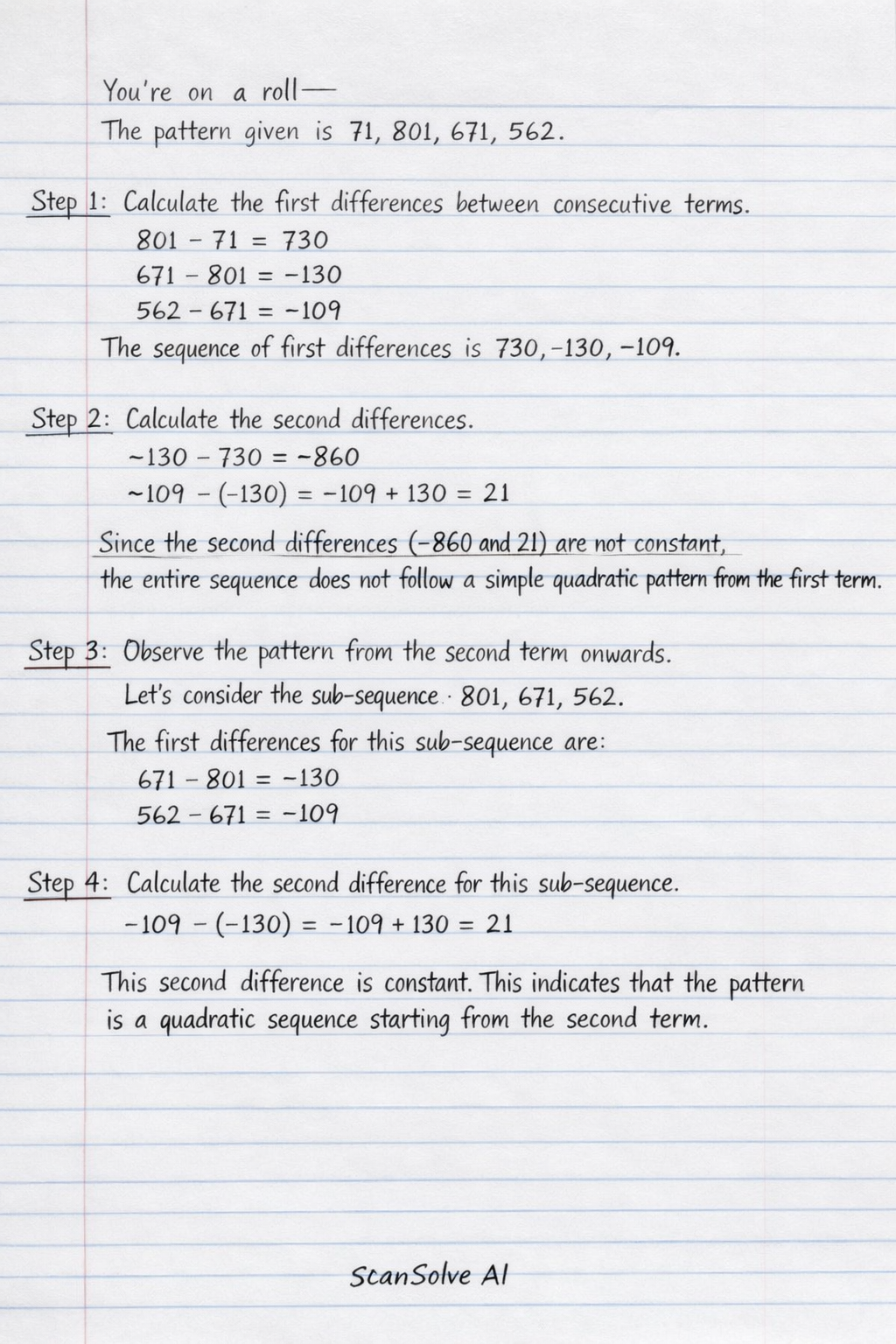
Handwritten Step-by-Step Solution
Get this as a handwritten image on WhatsApp — like a tutor wrote it for you.
Try on WhatsApp