
We read your photo as:
What are the next three numbers and the rule for the following sequences: c) 78, 67, 62, ... e) 3, 9, 27, ... f) 1, 3, 10, 15, ...
Mathematics
ScanSolve AI Answer
Step-by-step solution
9 stepsHere are the solutions for the sequences and the verification of your activity answers:
Mental Maths
- c) 78, 67, 62
Find the differences between consecutive terms.
$67 - 78 = -11$ $62 - 67 = -5$Identify the pattern in the differences.
The pattern is subtracting 11, then subtracting 5, and this pattern repeats.
Apply the rule to find the next three numbers.
$62 - 11 = 51$ $51 - 5 = 46$ $46 - 11 = 35$ Next three numbers: $\boxed{\text{51, 46, 35}}$ Rule: $\boxed{\text{Subtract 11, then subtract 5, alternating}}$- e) 3, 9, 27
Find the ratio between consecutive terms.
$\frac{9}{3} = 3$ $\frac{27}{9} = 3$Identify the rule.
Each term is multiplied by 3 to get the next term.
Apply the rule to find the next three numbers.
$27 \times 3 = 81$ $81 \times 3 = 243$ $243 \times 3 = 729$ Next three numbers: $\boxed{\text{81, 243, 729}}$ Rule: $\boxed{\text{Multiply by 3}}$- f) 1, 3, 10, 15
Find the differences between consecutive terms.
$3 - 1 = 2$ $10 - 3 = 7$ $15 - 10 = 5$The differences (2, 7, 5) do not follow a simple arithmetic or geometric pattern.
Given the context of "Mental Maths" problems, it is highly probable that this sequence was intended to be 1, 3, 6, 10, 15 (triangular numbers). Assuming this common pattern:
The differences would be:
Apply this assumed rule (add consecutive integers starting from 2) to find the next three numbers.
$15 + 6 = 21$ $21 + 7 = 28$ $28 + 8 = 36$ Next three numbers: $\boxed{\text{21, 28, 36}}$ Rule: $\boxed{\text{Add consecutive integers starting from 2}}$Activity
- a) Describe the pattern in words. Your answer: "the pattern grows by adding even odd number" The pattern shows the number of dots as $
Was this helpful?
Still stuck on this one?
Ask a follow-up, and the answer starts from this question.
Got a different question?Ask your own question
More Mathematics Questions
QCalculate the next three terms in each number sequence. a) 6; 14; 22; 30; ... b) 1; 2; 4; 8; 16…QWrite down the next three numbers and describe each pattern: a) 3, 6, 9, 12 b) 1, 8, 15, 22 c) 7, 9…QComplete the following number patterns by finding the rule and calculating the next three terms: b)…QFill in the missing numbers and state the rules for these sequences: a) 3, 5, 9, 15, 23, 33, , 37…QComplete the following number patterns and state the rule: a) 78; 84; 90; 96; ; . b) 2; 8; 32; 128…
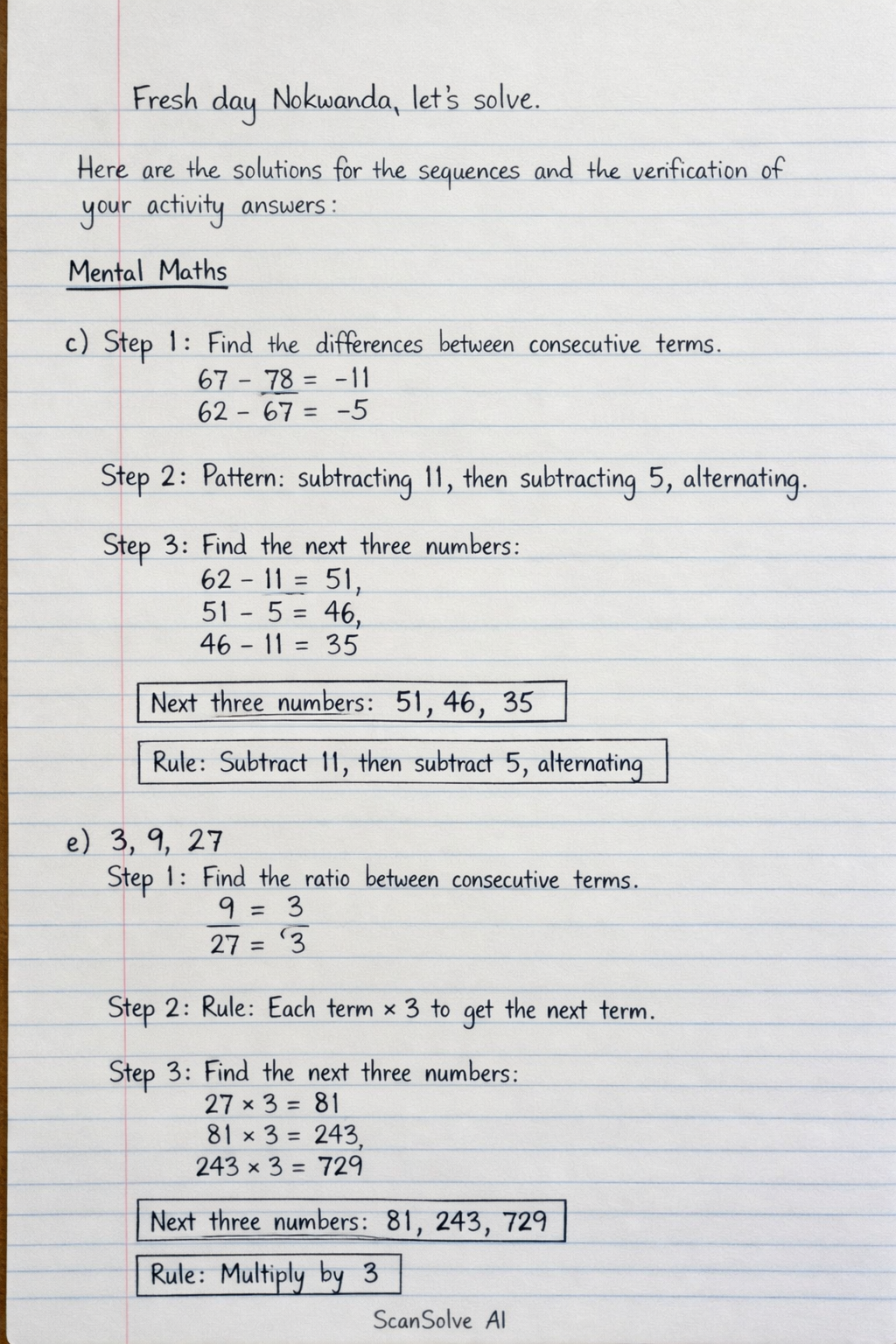
Handwritten Step-by-Step Solution
Get this as a handwritten image on WhatsApp — like a tutor wrote it for you.
Try on WhatsApp