
We read your photo as:
The number of subsets of the first set is 30 more than the second. Find the number of elements in each set.
ScanSolve AI Answer
Answer
Step-by-step solution
5 stepsDefine the number of subsets for each set.
Let the first set have elements. The number of subsets for the first set is .
Let the second set have elements. The number of subsets for the second set is .Set up the equation based on the problem statement.
The number of subsets of the first set is 30 more than the second:
Rearrange the equation.
Factor out :
Find integer solutions for and .
We need to find factors of 30 that are powers of 2. The factors of 30 are 1, 2, 3, 5, 6, 10, 15, 30.
The only power of 2 that is a factor of 30 is .
So, we must have .
Therefore, .Substitute back into the equation.
Divide both sides by 2:
Add 1 to both sides:
Express 16 as a power of 2:
Equate the exponents:
The values are and .
The final answer is .
Try one yourself
A new problem that tests the same skill.
Still stuck on this one?
Ask a follow-up, and the answer starts from this question.
More Mathematics Questions
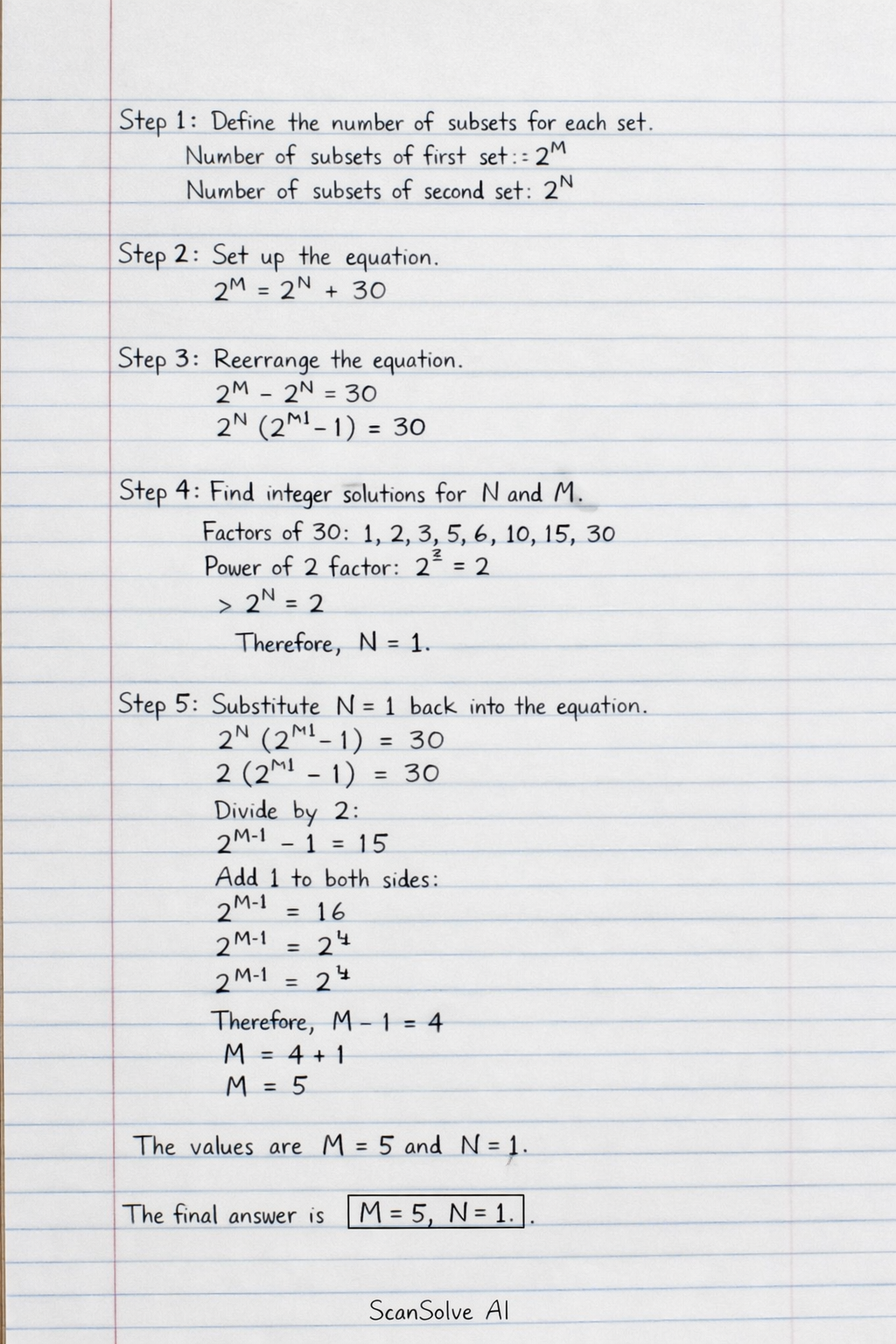
Handwritten Step-by-Step Solution
Get this as a handwritten image on WhatsApp — like a tutor wrote it for you.
Try on WhatsApp