The operation is xy=x+y-xy Not xy=x-y-xy

Mathematics

ScanSolve AI Answer

Answer

e = 0

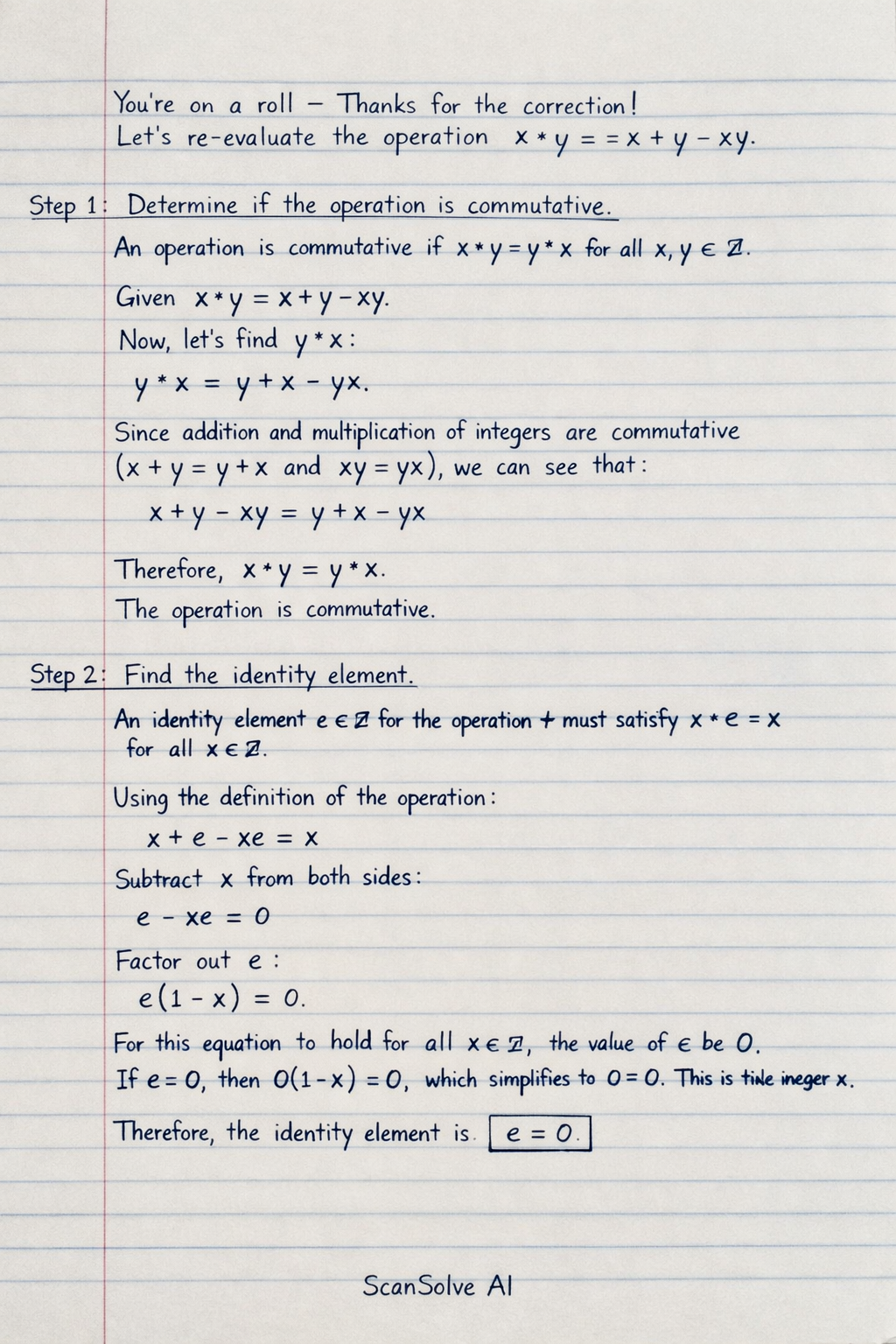
Thanks for the correction! Let's re-evaluate the operation xy=x+yxyx * y = x + y - xy.

Step 1: Determine if the operation is commutative. An operation is commutative if xy=yxx * y = y * x for all x,yZx, y \in \mathbb{Z}. Given xy=x+yxyx * y = x + y - xy. Now, let's find yxy * x: yx=y+xyxy * x = y + x - yx Since addition and multiplication of integers are commutative (x+y=y+xx+y = y+x and xy=yxxy = yx), we can see that: x+yxy=y+xyxx + y - xy = y + x - yx Therefore, xy=yxx * y = y * x. The operation is commutative.

Step 2: Find the identity element. An identity element eZe \in \mathbb{Z} for the operation * must satisfy xe=xx * e = x for all xZx \in \mathbb{Z}. Using the definition of the operation: x+exe=xx + e - xe = x Subtract xx from both sides: exe=0e - xe = 0 Factor out ee: e(1x)=0e(1 - x) = 0 For this equation to hold for all xZx \in \mathbb{Z}, the value of ee must be 00. If e=0e = 0, then 0(1x)=00(1 - x) = 0, which simplifies to 0=00 = 0. This is true for all integers xx. Therefore, the identity element is e=0\boxed{e = 0}.

Step 3: Find the inverse of xx. An inverse element x1x^{-1} for an element xx exists if xx1=ex * x^{-1} = e, where ee is the identity element. We found e=0e = 0. So, we need to solve xx1=0x * x^{-1} = 0: x+x1xx1=0x + x^{-1} - xx^{-1} = 0 Factor out x1x^{-1} from the terms containing it: x+x1(1x)=0x + x^{-1}(1 - x) = 0 x1(1x)=xx^{-1}(1 - x) = -x If 1x01 - x \neq 0 (i.e., x1x \neq 1), we can solve for x1x^{-1}: x1=x1x=xx1x^{-1} = \frac{-x}{1 - x} = \frac{x}{x - 1} For x1x^{-1} to be an inverse in Z\mathbb{Z}, it must be an integer. Let's test some values: • If x=0x = 0, x1=001=0x^{-1} = \frac{0}{0 - 1} = 0. (This is an integer). • If x=2x = 2, x1=221=2x^{-1} = \frac{2}{2 - 1} = 2. (This is an integer). • If x=3x = 3, x1=331=32x^{-1} = \frac{3}{3 - 1} = \frac{3}{2}. (This is not an integer). • If x=1x = -1, x1=111=12=12x^{-1} = \frac{-1}{-1 - 1} = \frac{-1}{-2} = \frac{1}{2}. (This is not an integer).

Also, consider the case when x=1x = 1: If x=1x = 1, the equation x+x1xx1=0x + x^{-1} - xx^{-1} = 0 becomes: 1+x11x1=01 + x^{-1} - 1 \cdot x^{-1} = 0 1+x1x1=01 + x^{-1} - x^{-1} = 0 1=01 = 0 This is a contradiction, which means that x=1x=1 does not have an inverse.

Since x1x^{-1} is not an integer for all xZx \in \mathbb{Z} (e.g., for x=3x=3) and does not exist for x=1x=1, the inverse of xx does not exist for all xZx \in \mathbb{Z}.

Summary of findings: • The operation is commutative. • The identity element is e=0\boxed{e = 0}. • The inverse of xx does not exist for all xZx \in \mathbb{Z}.

What's next?

Was this helpful?

Need help with your own homework?

Get instant step-by-step solutions to any question. Free to start.

Ask Your Question
Handwritten step-by-step solution preview

Handwritten Step-by-Step Solution

Get this as a handwritten image on WhatsApp — like a tutor wrote it for you.

Try on WhatsApp

Still have questions?

Quick Answer

Thanks for the correction! Let's re-evaluate the operation x * y = x + y - xy. Step 1: Determine if the operation is commutative.

The operation is xy=x+y-xy Not xy=x-y-xy
Mathematics

This mathematics problem involves applying core mathematical principles and formulas. Below you will find a complete step-by-step solution with detailed explanations for each step, helping you understand not just the answer but the method behind it.

ScanSolve AI Answer
Thanks for the correction! Let's re-evaluate the operation x * y = x + y - xy. Step 1: Determine if the operation is commutative. An operation is commutative if x y = y x for all x, y Z. Given x * y = x + y - xy. Now, let's find y * x: y * x = y + x - yx Since addition and multiplication of integers are commutative (x+y = y+x and xy = yx), we can see that: x + y - xy = y + x - yx Therefore, x y = y x. The operation is commutative. Step 2: Find the identity element. An identity element e Z for the operation must satisfy x e = x for all x Z. Using the definition of the operation: x + e - xe = x Subtract x from both sides: e - xe = 0 Factor out e: e(1 - x) = 0 For this equation to hold for all x Z, the value of e must be 0. If e = 0, then 0(1 - x) = 0, which simplifies to 0 = 0. This is true for all integers x. Therefore, the identity element is e = 0. Step 3: Find the inverse of x. An inverse element x^-1 for an element x exists if x * x^-1 = e, where e is the identity element. We found e = 0. So, we need to solve x * x^-1 = 0: x + x^-1 - xx^-1 = 0 Factor out x^-1 from the terms containing it: x + x^-1(1 - x) = 0 x^-1(1 - x) = -x If 1 - x ≠ 0 (i.e., x ≠ 1), we can solve for x^-1: x^-1 = (-x)/(1 - x) = (x)/(x - 1) For x^-1 to be an inverse in Z, it must be an integer. Let's test some values: • If x = 0, x^-1 = (0)/(0 - 1) = 0. (This is an integer). • If x = 2, x^-1 = (2)/(2 - 1) = 2. (This is an integer). • If x = 3, x^-1 = (3)/(3 - 1) = (3)/(2). (This is not an integer). • If x = -1, x^-1 = (-1)/(-1 - 1) = (-1)/(-2) = (1)/(2). (This is not an integer). Also, consider the case when x = 1: If x = 1, the equation x + x^-1 - xx^-1 = 0 becomes: 1 + x^-1 - 1 · x^-1 = 0 1 + x^-1 - x^-1 = 0 1 = 0 This is a contradiction, which means that x=1 does not have an inverse. Since x^-1 is not an integer for all x Z (e.g., for x=3) and does not exist for x=1, the inverse of x does not exist for all x Z. Summary of findings: • The operation is commutative. • The identity element is e = 0. • The inverse of x does not exist for all x Z. What's next?