From 8,900 to 7,380 as a result of eliminating department b, therefore the management of the company is advised not to eliminate dept B.

Economics
From 8,900 to 7,380 as a result of eliminating department b, therefore the management of the company is advised not to eliminate dept B.

ScanSolve AI Answer

Answer

N500\text{N}500

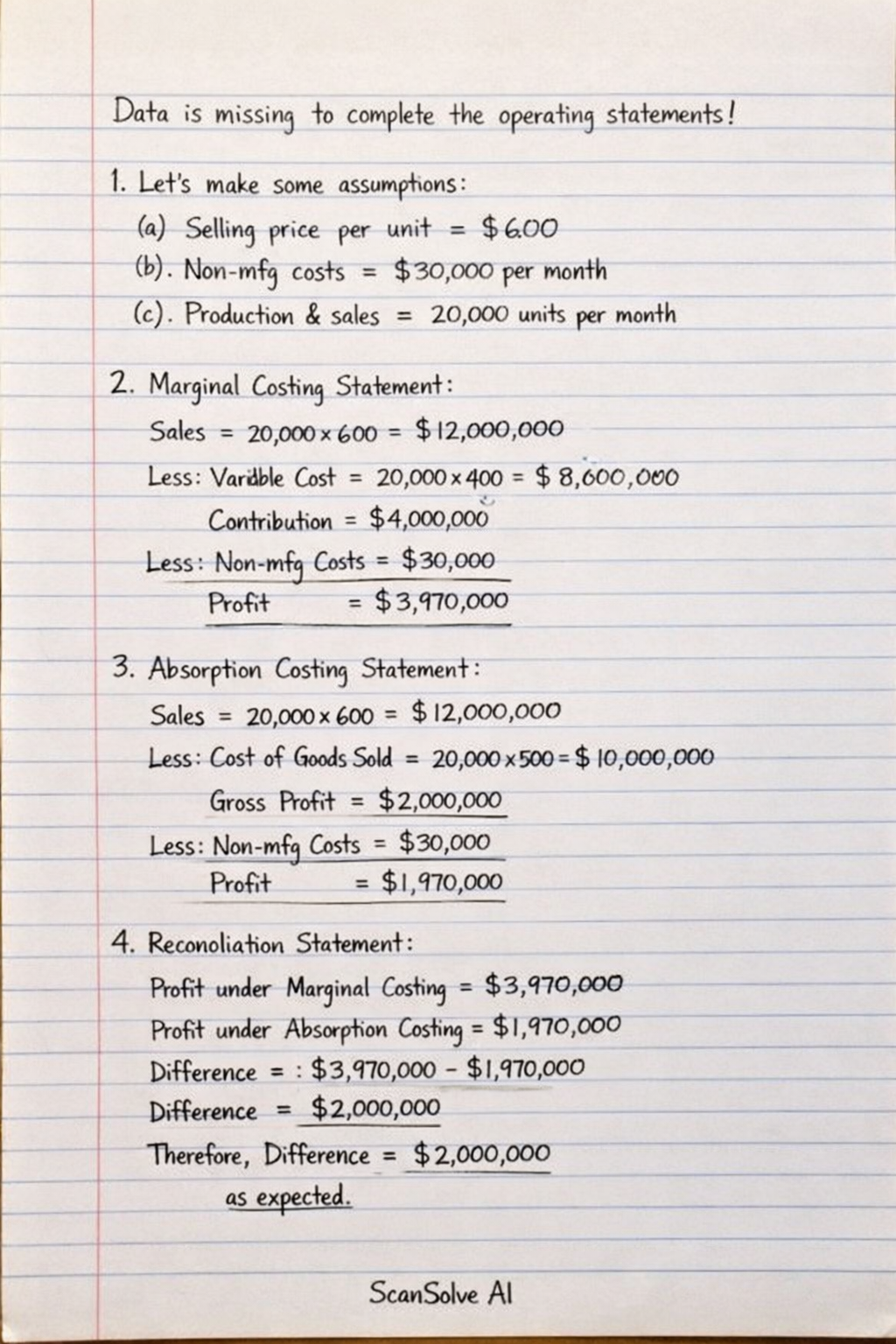
The problem asks for an operating statement using marginal costing and absorption costing, and a reconciliation statement. However, critical information is missing to complete these statements fully.

Missing Information:

  • Selling price per unit: This is required to calculate sales revenue.
  • Non-manufacturing costs: (e.g., selling and administrative expenses, variable or fixed) are not provided.
  • Production and sales quantities for different periods: The problem states "budget for the manufacture and sales of 20,00020,000 computers per month," implying that production equals sales. If production equals sales, there are no changes in inventory, and thus, the profit under marginal costing will be equal to the profit under absorption costing. This makes a reconciliation statement trivial (difference will be zero).
  • The question asks for "three quarters," but the data is given "per month."

Given these limitations, a complete operating statement and a meaningful reconciliation statement cannot be prepared. However, we can determine the per-unit product costs and total fixed manufacturing overhead based on the provided data.

Step 1: Calculate per-unit product costs.

  • Marginal Costing Product Cost (Variable Manufacturing Cost):

    • Direct Materials = N500\text{N}500
    • Direct Labor = N200\text{N}200
    • Variable Overhead = N100\text{N}100 VariableManufacturingCostperunit=N500+N200+N100=N800Variable Manufacturing Cost per unit = N500 + N200 + N100 = N800
  • Absorption Costing Product Cost (Total Manufacturing Cost):

    • Direct Materials = N500\text{N}500
    • Direct Labor = N200\text{N}200
    • Variable Overhead = N100\text{N}100
    • Fixed Overhead = N400\text{N}400
Was this helpful?

Need help with your own homework?

Get instant step-by-step solutions to any question. Free to start.

Ask Your Question
Handwritten step-by-step solution preview

Handwritten Step-by-Step Solution

Get this as a handwritten image on WhatsApp — like a tutor wrote it for you.

Try on WhatsApp

Still have questions?

Quick Answer

The problem asks for an operating statement using marginal costing and absorption costing, and a reconciliation statement.

From 8,900 to 7,380 as a result of eliminating department b, therefore the management of the company is advised not to eliminate dept B.
Economics

This economics question tests your understanding of economic models and analysis. The step-by-step answer below applies the relevant framework and explains the reasoning.

ScanSolve AI Answer
The problem asks for an operating statement using marginal costing and absorption costing, and a reconciliation statement. However, critical information is missing to complete these statements fully. Missing Information: Selling price per unit: This is required to calculate sales revenue. Non-manufacturing costs: (e.g., selling and administrative expenses, variable or fixed) are not provided. Production and sales quantities for different periods: The problem states "budget for the manufacture and sales of 20,000 computers per month," implying that production equals sales. If production equals sales, there are no changes in inventory, and thus, the profit under marginal costing will be equal to the profit under absorption costing. This makes a reconciliation statement trivial (difference will be zero). The question asks for "three quarters," but the data is given "per month." Given these limitations, a complete operating statement and a meaningful reconciliation statement cannot be prepared. However, we can determine the per-unit product costs and total fixed manufacturing overhead based on the provided data. Step 1: Calculate per-unit product costs. Marginal Costing Product Cost (Variable Manufacturing Cost): Direct Materials = N500 Direct Labor = N200 Variable Overhead = N100 Variable Manufacturing Cost per unit = N500 + N200 + N100 = N800 Absorption Costing Product Cost (Total Manufacturing Cost): Direct Materials = N500 Direct Labor = N200 Variable Overhead = N100 Fixed Overhead = N400 \