
We read your photo as:
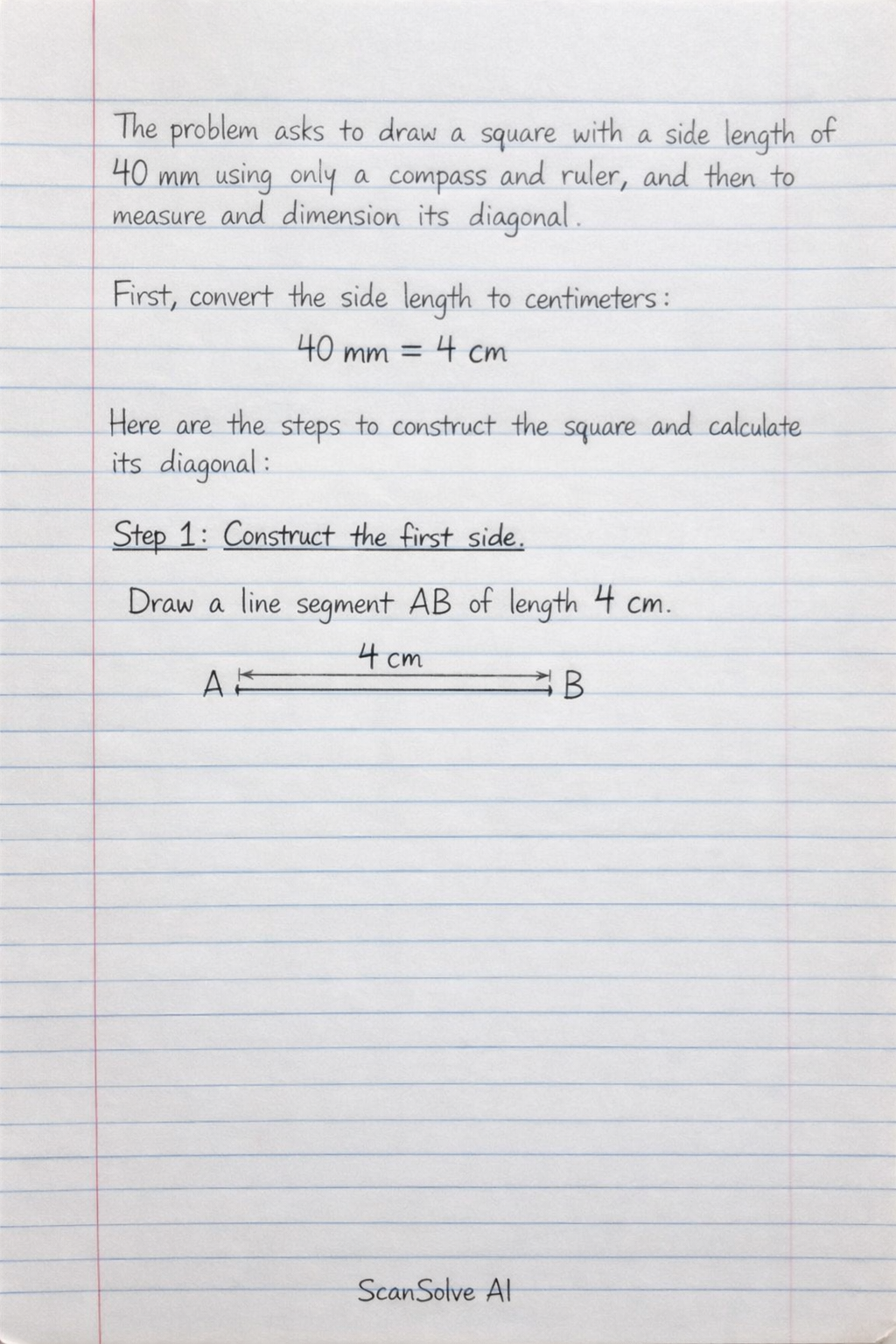
The problem asks to draw a square with a side length of 40 mm. using only a compass and ruler, and then to measure and dimension its diagonal.
ScanSolve AI Answer
Answer
Step-by-step solution
6 stepsThe problem asks to draw a square with a side length of using only a compass and ruler, and then to measure and dimension its diagonal.
First, convert the side length to centimeters:
Here are the steps to construct the square and calculate its diagonal:
Construct the first side
Draw a line segment of length . This step is correctly described in the image.
Construct a perpendicular line at point A
The description in the image for constructing a perpendicular line at point is unclear and contains errors. Here is a correct method:
- Extend the line segment beyond to a point .
- Place the compass at and draw arcs of equal radius to intersect the line at two points, (on ) and (on ).
- Open the compass to a radius greater than . Place the compass at and draw an arc above .
- With the same radius, place the compass at and draw an arc that intersects the previous arc. Label this intersection point .
- Draw a straight line from through . This line is perpendicular to .
Mark the second vertex
On the perpendicular line from (the line ), use the compass to mark a point such that is long.
Locate the fourth vertex
- Place the compass at and draw an arc with a radius of .
- Place the compass at and draw another arc with a radius of .
- The intersection of these two arcs is point .
Complete the square
Draw line segments and to complete the square .
Calculate the diagonal
For a square with side length , the length of the diagonal can be found using the Pythagorean theorem: .
To dimension it numerically:
Try one yourself
A new problem that tests the same skill.
Still stuck on this one?
Ask a follow-up, and the answer starts from this question.
More Mathematics Questions
Handwritten Step-by-Step Solution
Get this as a handwritten image on WhatsApp — like a tutor wrote it for you.
Try on WhatsApp