We read your photo as:

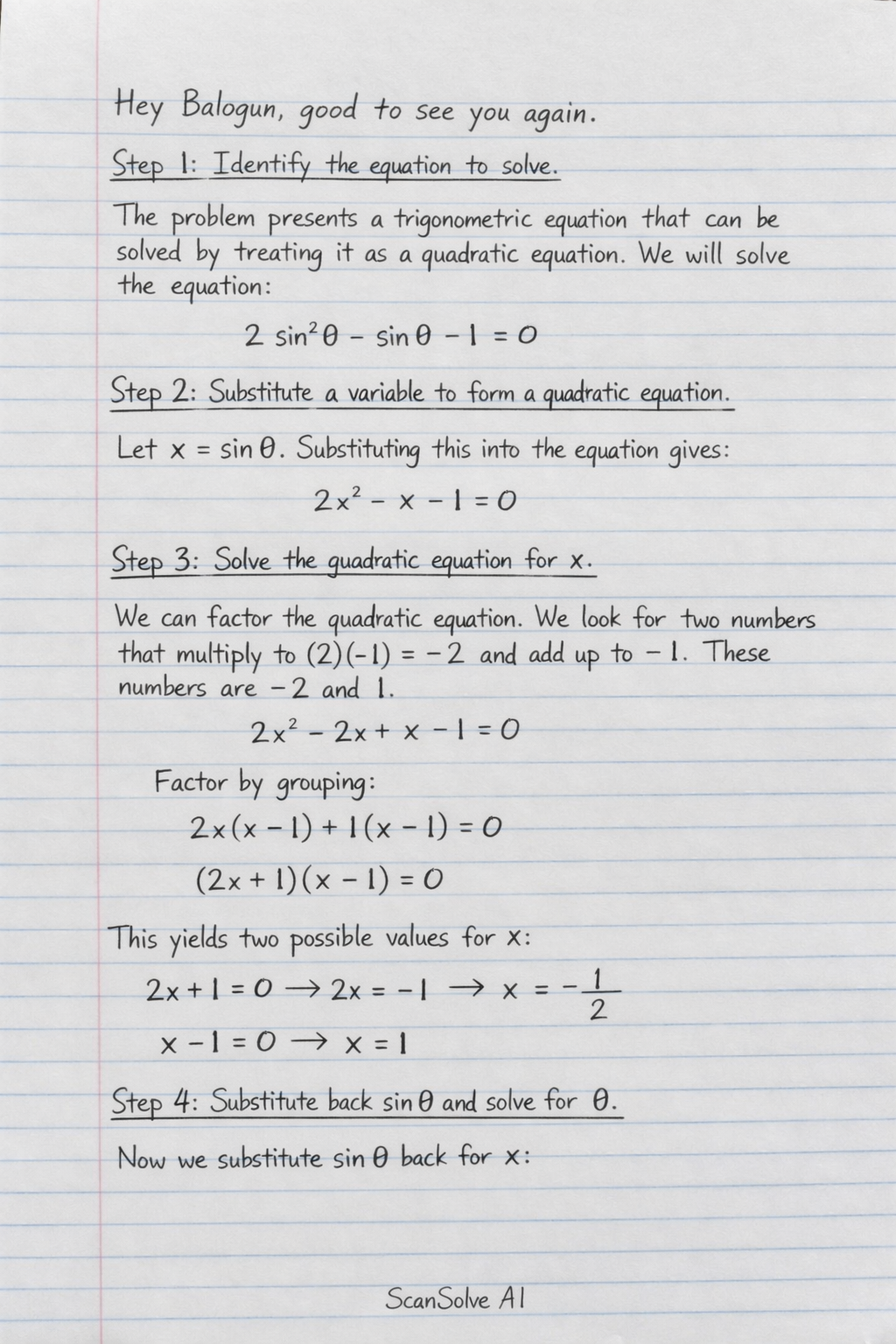
The problem presents a trigonometric equation that can be solved by treating it as a quadratic equation. We will solve the equation:

Mathematics

ScanSolve AI Answer

Step-by-step solution

5 steps
  1. Identify the equation to solve.

    The problem presents a trigonometric equation that can be solved by treating it as a quadratic equation. We will solve the equation:

    2sin⁡2θ−sin⁡θ−1=02 \sin^2 \theta - \sin \theta - 1 = 0
  2. Substitute a variable to form a quadratic equation.

    Let x=sin⁡θx = \sin \theta. Substituting this into the equation gives a standard quadratic form:

    2x2−x−1=02x^2 - x - 1 = 0
  3. Solve the quadratic equation for xx.

    We can factor the quadratic equation. We look for two numbers that multiply to (2)(−1)=−2(2)(-1) = -2 and add up to −1-1. These numbers are −2-2 and 1.

    2x2−2x+x−1=02x^2 - 2x + x - 1 = 0

    Factor by grouping:

    2x(x−1)+1(x−1)=02x(x - 1) + 1(x - 1) = 0 (2x+1)(x−1)=0(2x + 1)(x - 1) = 0

    This yields two possible values for xx:

    2x+1=0  ⟹  2x=−1  ⟹  x=−122x + 1 = 0 \implies 2x = -1 \implies x = -\frac{1}{2} x−1=0  ⟹  x=1x - 1 = 0 \implies x = 1
  4. Substitute back sin⁡θ\sin \theta and solve for θ\theta.

    Now we substitute sin⁡θ\sin \theta back for xx:

    Case 1: sin⁡θ=1\sin \theta = 1
    The general solution for sin⁡θ=1\sin \theta = 1 is when θ\theta is π2\frac{\pi}{2} plus any multiple of 2π2\pi.

    θ=π2+2nπ\theta = \frac{\pi}{2} + 2n\pi

    where nn is an integer.

    Case 2: sin⁡θ=−12\sin \theta = -\frac{1}{2}
    The reference angle for sin⁡α=12\sin \alpha = \frac{1}{2} is α=π6\alpha = \frac{\pi}{6} (30∘30^\circ). Since sin⁡θ\sin \theta is negative, θ\theta must be in the third or fourth quadrants.
    In the third quadrant:

    θ=π+π6=6π6+π6=7π6\theta = \pi + \frac{\pi}{6} = \frac{6\pi}{6} + \frac{\pi}{6} = \frac{7\pi}{6}

    In the fourth quadrant:

    θ=2π−π6=12π6−π6=11π6\theta = 2\pi - \frac{\pi}{6} = \frac{12\pi}{6} - \frac{\pi}{6} = \frac{11\pi}{6}

    The general solutions for sin⁡θ=−12\sin \theta = -\frac{1}{2} are:

    θ=7π6+2nπ\theta = \frac{7\pi}{6} + 2n\pi θ=11π6+2nπ\theta = \frac{11\pi}{6} + 2n\pi

    where nn is an integer.

  5. State the complete set of general solutions.

    Combining all possible values for θ\theta, the general solutions are:

    θ=π2+2nπ,θ=7π6+2nπ,θ=11π6+2nπwhere n∈Z\boxed{\theta = \frac{\pi}{2} + 2n\pi, \quad \theta = \frac{7\pi}{6} + 2n\pi, \quad \theta = \frac{11\pi}{6} + 2n\pi \quad \text{where } n \in \mathbb{Z}}
Was this helpful?

Still stuck on this one?

Ask a follow-up, and the answer starts from this question.

Got a different question?Ask your own question
Handwritten step-by-step solution preview

Handwritten Step-by-Step Solution

Get this as a handwritten image on WhatsApp — like a tutor wrote it for you.

Try on WhatsApp