This mathematics problem involves applying core mathematical principles and formulas. Below you will find a complete step-by-step solution with detailed explanations for each step, helping you understand not just the answer but the method behind it.
ScanSolve AI Answer
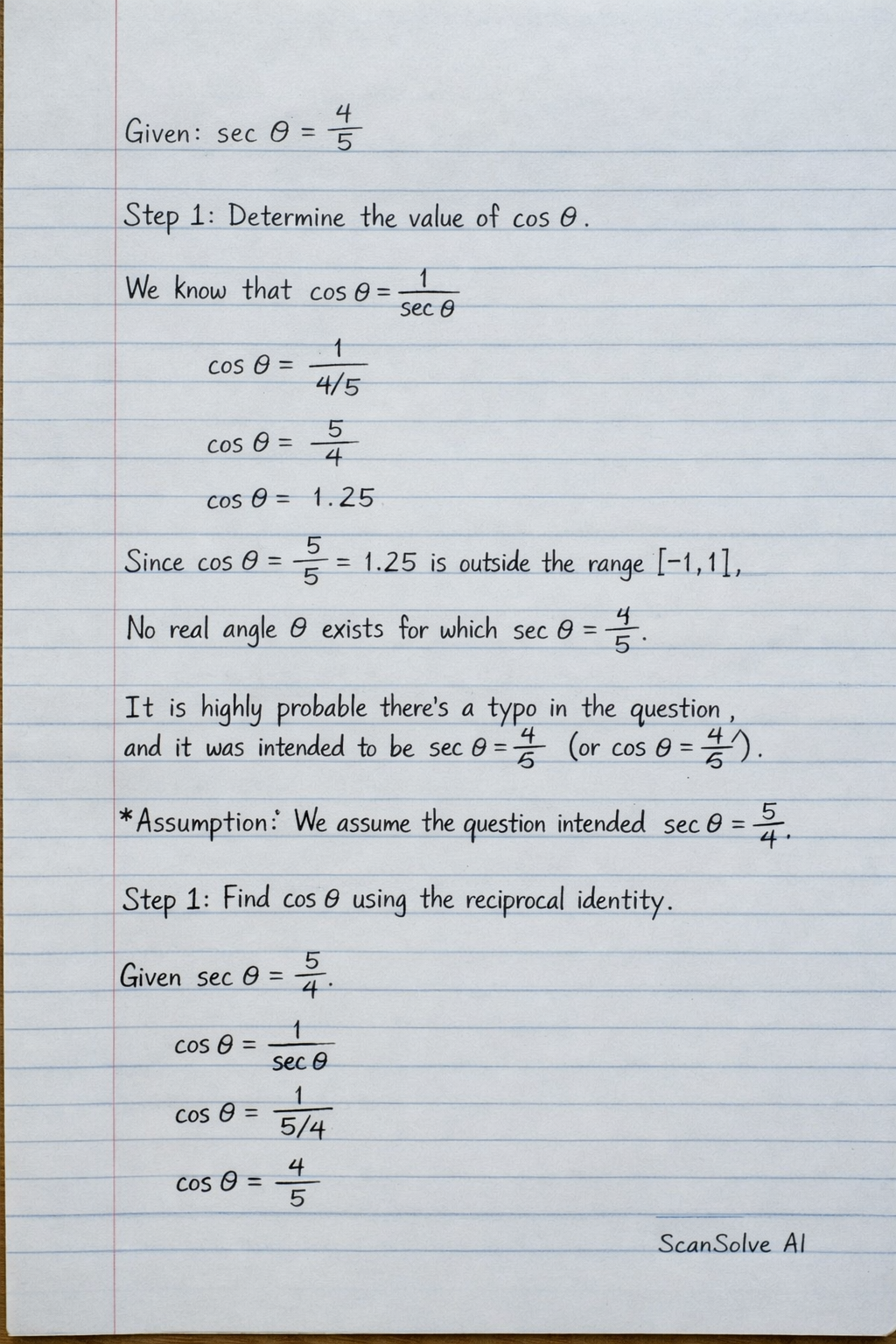
The problem states that $\sec \theta = \frac{4}{5}$.
Step 1: Determine the value of $\cos \theta$.
We know that $\cos \theta = \frac{1}{\sec \theta}$.
$$ \cos \theta = \frac{1}{4/5} = \frac{5}{4} $$
The value $\cos \theta = \frac{5}{4} = 1.25$ is outside the possible range for the cosine function, which is $[-1, 1]$. Therefore, no real angle $\theta$ exists for which $\sec \theta = \frac{4}{5}$.
It is highly probable that there is a typo in the question, and it was intended to be $\sec \theta = \frac{5}{4}$ (or $\cos \theta = \frac{4}{5}$). We will proceed by assuming the intended value was $\sec \theta = \frac{5}{4}$.
Assumption: We assume the question intended $\sec \theta = \frac{5}{4}$.
Step 1: Find $\cos \theta$ using the reciprocal identity.
Given $\sec \theta = \frac{5}{4}$.
$$ \cos \theta = \frac{1}{\sec \theta} $$
$$ \cos \theta = \frac{1}{5/4} $$
$$ \cos \theta = \frac{4}{5} $$
Step 2: Find $\sin \theta$ using the Pythagorean identity.
The Pythagorean identity is $\sin^2 \theta + \cos^2 \theta = 1$.
Substitute the value of $\cos \theta$:
$$ \sin^2 \theta + \left(\frac{4}{5}\right)^2 = 1 $$
$$ \sin^2 \theta + \frac{16}{25} = 1 $$
$$ \sin^2 \theta = 1 - \frac{16}{25} $$
$$ \sin^2 \theta = \frac{25}{25} - \frac{16}{25} $$
$$ \sin^2 \theta = \frac{9}{25} $$
Take the square root of both sides:
$$ \sin \theta = \pm \sqrt{\frac{9}{25}} $$
$$ \sin \theta = \pm \frac{3}{5} $$
Since the quadrant of $\theta$ is not specified, $\sin \theta$ can be positive or negative.
Step 3: Calculate $\cot \theta$.
The identity for $\cot \theta$ is $\cot \theta = \frac{\cos \theta}{\sin \theta}$.
Case 1: If $\sin \theta = \frac{3}{5}$
$$ \cot \theta = \frac{4/5}{3/5} $$
$$ \cot \theta = \frac{4}{3} $$
Case 2: If $\sin \theta = -\frac{3}{5}$
$$ \cot \theta = \frac{4/5}{-3/5} $$
$$ \cot \theta = -\frac{4}{3} $$
Therefore, based on the assumption that $\sec \theta = \frac{5}{4}$, there are two possible values for $\cot \theta$.
The final answer is $\boxed{\pm \frac{4}{3}}$.
Q
The problem states that theta = (4)/(5).
|Mathematics
The problem states that theta = (4)/(5).
ScanSolve AI Answer
The problem states that secθ=54.
Step 1: Determine the value of cosθ.
We know that cosθ=secθ1.
cosθ=4/51=45
The value cosθ=45=1.25 is outside the possible range for the cosine function, which is [−1,1]. Therefore, no real angle θ exists for which secθ=54.
It is highly probable that there is a typo in the question, and it was intended to be secθ=45 (or cosθ=54). We will proceed by assuming the intended value was secθ=45.
Assumption: We assume the question intended secθ=45.
Step 1: Find cosθ using the reciprocal identity.
Given secθ=45.
cosθ=secθ1cosθ=5/41cosθ=54
Step 2: Find sinθ using the Pythagorean identity.
The Pythagorean identity is sin2θ+cos2θ=1.
Substitute the value of cosθ:
sin2θ+(54)2=1sin2θ+2516=1sin2θ=1−2516sin2θ=2525−2516sin2θ=259
Take the square root of both sides:
sinθ=±259sinθ=±53
Since the quadrant of θ is not specified, sinθ can be positive or negative.
Step 3: Calculate cotθ.
The identity for cotθ is cotθ=sinθcosθ.
Case 1: If sinθ=53cotθ=3/54/5cotθ=34
Case 2: If sinθ=−53cotθ=−3/54/5cotθ=−34
Therefore, based on the assumption that secθ=45, there are two possible values for cotθ.
The final answer is ±34.
Need help with your own homework?
Get instant step-by-step solutions to any question. Free to start.