
We read your photo as:
The problem states that when a number x is divided by 30, 45, or 54, the remainder is always 21. This means that x - 21 must be a multiple of 30, 45, and 54. To find the least value of x, we n
Mathematics
ScanSolve AI Answer
Step-by-step solution
4 stepsUnderstand the problem.
The problem states that when a number is divided by 30, 45, or 54, the remainder is always 21. This means that must be a multiple of 30, 45, and 54. To find the least value of , we need to find the least common multiple (LCM) of 30, 45, and 54.
Find the prime factorization of each number.
- For 30:
- For 45:
- For 54:
Calculate the LCM of 30, 45, and 54.
To find the LCM, take the highest power of each prime factor present in any of the numbers:
- Highest power of 2:
- Highest power of 3:
- Highest power of 5:
Determine the value of .
We know that is the LCM.
Add 21 to both sides to find :
The least value of the number is .
Was this helpful?
Still stuck on this one?
Ask a follow-up, and the answer starts from this question.
Got a different question?Ask your own question
More Mathematics Questions
QUnderstand the problem. If a number Z leaves a remainder of 7 when divided by 30, 36, and 47, it…QSolve these division problems with remainders: 596 ÷ 18, 478 ÷ 17, 425 ÷ 14, 389 ÷ 16, 469 ÷ 29, 347…QFind the remainder when 4x3 - 3x + 5 is divided by 2x − 1.QFind the least number which when added to 10 is exactly divisible by 14, 35, 40 and 56.QFind the remainder when 3x³ + 6x − 1 is divided by x − 3.
Browse by topic:Number Theory
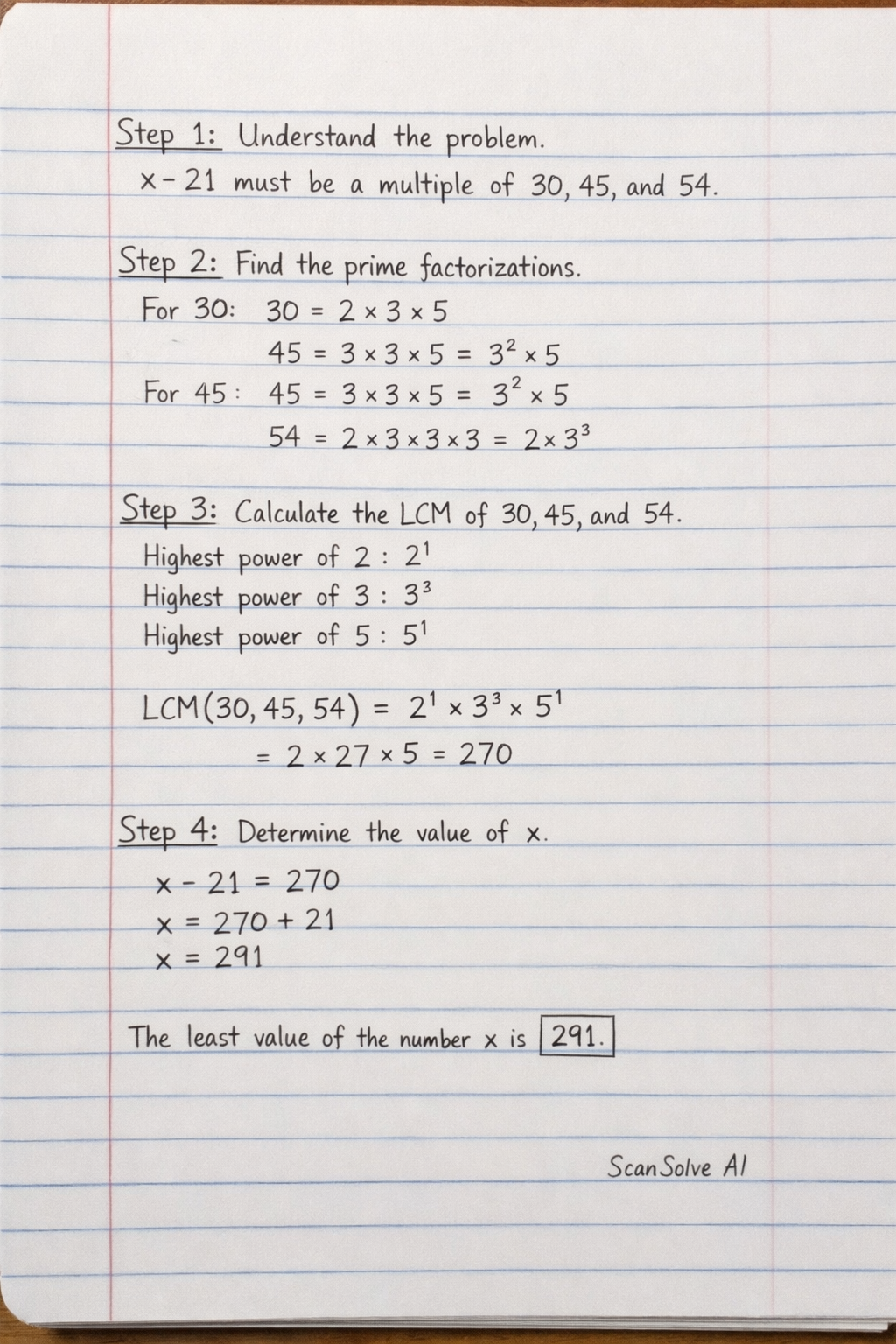
Handwritten Step-by-Step Solution
Get this as a handwritten image on WhatsApp — like a tutor wrote it for you.
Try on WhatsApp