
We read your photo as:
Using Product rule, find the derivatives of the following functions: (i) y = (3x2+2)(5x−3). (ii) y = ex sin x. (iii) y = log x.
Mathematics
ScanSolve AI Answer
Answers
3 partsStep-by-step solution
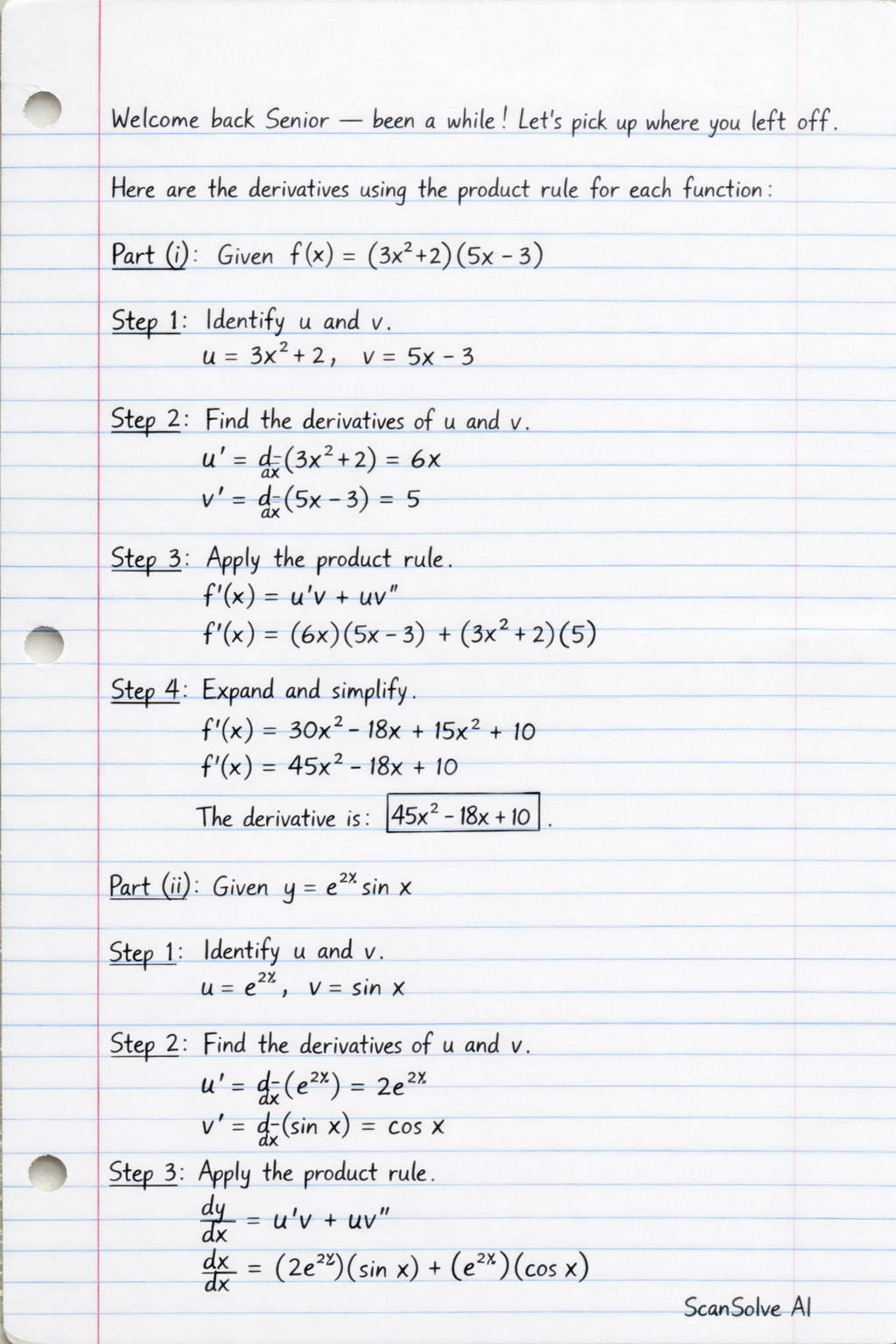
12 stepsHere are the derivatives using the product rule for each function:
Part i· 4 steps
Given
Identify and .
Let and .
Find the derivatives of and .
Apply the product rule .
Expand and simplify the expression.
The derivative is .
Part ii
Given
Identify and .
Let and .
Find the derivatives of and .
Apply the product rule .
Factor out common terms.
The derivative is .
Part iii
Given (assuming refers to the natural logarithm, )
Identify and .
Let and .
Find the derivatives of and .
Apply the product rule .
Factor out common terms.
The derivative is .
Was this helpful?
Try one yourself
A new problem that tests the same skill.
Still stuck on this one?
Ask a follow-up, and the answer starts from this question.
Got a different question?Ask your own question
More Mathematics Questions
QUsing the product rule, find the derivative of each of the following functions wrt x. (i)…QFind the derivative of the following functions using the chain rule and product rule: i) y = (2x3…QFind the derivative of the following functions from first principles: i) y = x2 ii) y = 3x + 2 iii)…QFind the derivatives of the following functions: i) y = (2+3x2-x)/(sqrt(1+x)), ii) y = (x2-2)/(x3-2)QFind the derivatives of the following functions: y = 3 2x, y = −8 3x, and y = (1)/(32)
Handwritten Step-by-Step Solution
Get this as a handwritten image on WhatsApp — like a tutor wrote it for you.
Try on WhatsApp