
We read your photo as:
Find the equation of a line that has the indicated properties and sketch the line. a passing through (−1, 3) and parallel to y = 4x − 5
ScanSolve AI Answer
Use the left and right arrow keys to trace the curve, up and down to jump between key points, and plus and minus to zoom.
| Point | x | y |
|---|---|---|
| y-intercept | 0 | −5 |
| x-intercept | 1.25 | 0 |
Step-by-step solution
36 stepshere are the solutions to your questions.
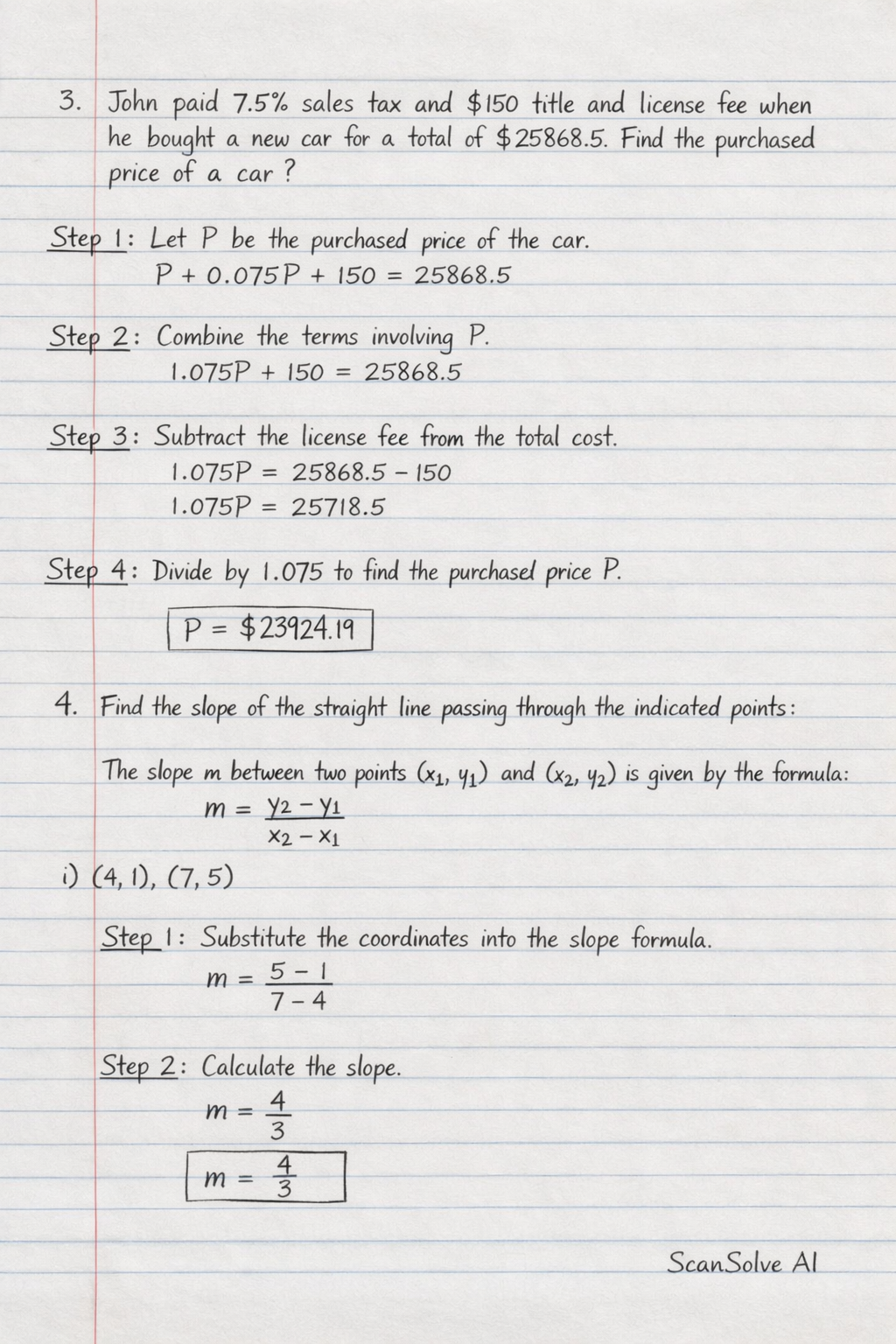
3. John paid 7.5% sales tax and 25868.5. Find the purchased price of a car?
Step 1: Let be the purchased price of the car. The sales tax is of , which is . The total cost is the sum of the purchased price, sales tax, and license fee.
Step 2: Combine the terms involving .
Step 3: Subtract the license fee from the total cost.
Step 4: Divide by 1.075 to find the purchased price .
4. Find the slope of the straight line passing through the indicated points:
The slope between two points and is given by the formula .
Part i· 2 steps
(4, 1), (7, 5)
Substitute the coordinates into the slope formula.
Calculate the slope.
Part ii· 2 steps
(5, -3), (6, -4)
Substitute the coordinates into the slope formula.
Calculate the slope.
Part iii· 2 steps
(1, 0), (0, 5)
Substitute the coordinates into the slope formula.
Calculate the slope.
Part iv· 2 steps
(2, -4), (3, -4)
Substitute the coordinates into the slope formula.
Calculate the slope.
5. Find the equation of a line that has the indicated properties and sketch the line:
To sketch the line, plot the two points used to derive the equation and draw a straight line through them.
Part a· 3 steps
passing through (-1, 3) and parallel to
Parallel lines have the same slope.
The slope of is .
Use the point-slope form with point and .
Solve for to get the slope-intercept form.
To sketch, plot points like and and draw the line.
Part b· 2 steps
has slope 0 and y-intercept
Use the slope-intercept form .
Given and .
Simplify the equation.
To sketch, plot points like and and draw the horizontal line.
Part c· 3 steps
passes through (3, -1) and (-2, -9)
Find the slope using the two points.
Use the point-slope form with point and .
Solve for .
To sketch, plot points and and draw the line.
Part d· 2 steps
passing through origin and has slope -5
The origin is the point $(0, 0)$.
Use the slope-intercept form .
Given and since it passes through , the y-intercept .Simplify the equation.
To sketch, plot points like and and draw the line.
Part e· 4 steps
passing through (-5, 4) and perpendicular to the line
Find the slope of the given line .
Divide by 2 to get . The slope is .
The slope of a perpendicular line is the negative reciprocal of .
Use the point-slope form with point and .
Solve for .
To sketch, plot points like and and draw the line.
Part f· 4 steps
perpendicular to and passing through (3, 4)
The slope of the given line is .
The slope of a perpendicular line is the negative reciprocal of .
Use the point-slope form with point and .
Solve for .
To sketch, plot points like and and draw the line.
Part g· 2 steps
passing through (2, -8) and parallel to
The line is a vertical line.
A line parallel to a vertical line is also a vertical line.
The equation of a vertical line passing through a point is .
For the point , the equation is .
To sketch, plot points like and and draw the vertical line.
6. A small company produces chairs. The weekly fixed and variable costs per chair are 40 respectively. Find the total weekly cost of manufacturing chairs. How many chairs can be manufactured for a total weekly cost of $4,500?
Part 1· 1 step
Find the total weekly cost of manufacturing chairs.
The total weekly cost is the sum of the fixed cost and the total variable cost.
Fixed cost = 40 Total variable cost for chairs =
Part 2· 7 steps
How many chairs can be manufactured for a total weekly cost of $4,500?
Set the total cost to 4500.
Subtract the fixed cost from the total cost.
Divide by 40 to find the number of chairs .
7. The sales of a company were 95,000 in its sixth year. If denote sales in year , what were the sales in the fifth year?
Assume a linear relationship between sales and year. We have two points : and .Find the slope of the line.
Use the point-slope form with point and .
Solve for to get the equation for sales.
Substitute (fifth year) into the equation to find the sales.
Still stuck on this one?
Ask a follow-up, and the answer starts from this question.
More Mathematics Questions
Handwritten Step-by-Step Solution
Get this as a handwritten image on WhatsApp — like a tutor wrote it for you.
Try on WhatsApp