We read your photo as:

The product of two numbers is 1785483. If one of the numbers is 987, what is the other number?

Mathematics

ScanSolve AI Answer

Step-by-step solution

22 steps

Here are the solutions to the problems:

1.

  1. To find the number of cartons required, divide the total number of screws by the number of screws a carton can hold.

    Number of cartons=Total screwsScrews per carton\text{Number of cartons} = \frac{\text{Total screws}}{\text{Screws per carton}}
  2. Perform the division.

    Number of cartons=4426125275=16095\text{Number of cartons} = \frac{4426125}{275} = 16095

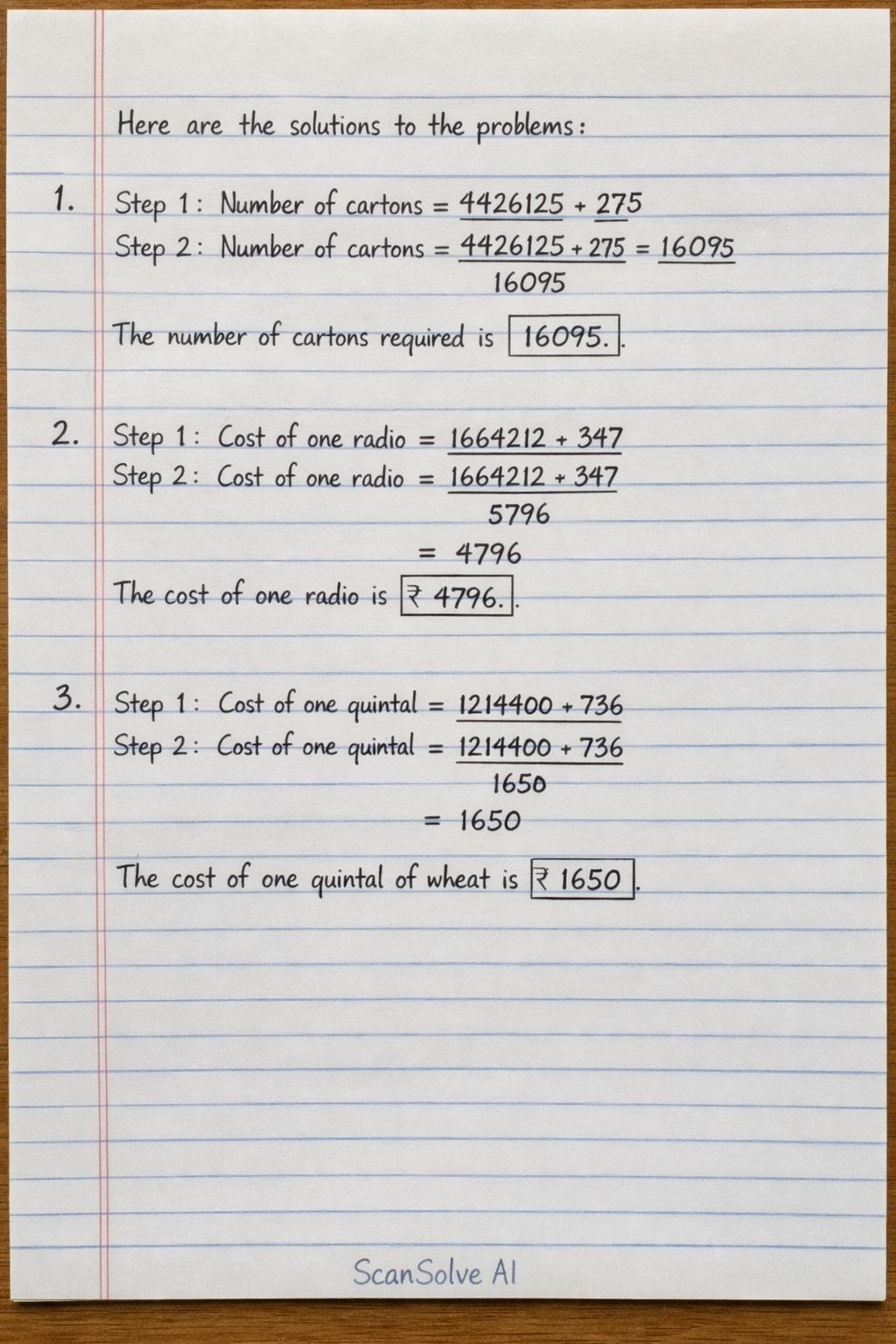
    The number of cartons required is 16095\boxed{16095}.

    2.

  3. To find the cost of one radio, divide the total cost of 347 radios by 347.

    Cost of one radio=Total costNumber of radios\text{Cost of one radio} = \frac{\text{Total cost}}{\text{Number of radios}}
  4. Perform the division.

    Cost of one radio=1664212347=4796\text{Cost of one radio} = \frac{1664212}{347} = 4796

    The cost of one radio is ₹ 4796\boxed{4796}.

    3.

  5. To find the cost of one quintal of wheat, divide the total cost of 736 quintals by 736.

    Cost of one quintal=Total costNumber of quintals\text{Cost of one quintal} = \frac{\text{Total cost}}{\text{Number of quintals}}
  6. Perform the division.

    Cost of one quintal=1214400736=1650\text{Cost of one quintal} = \frac{1214400}{736} = 1650

    The cost of one quintal of wheat is ₹ 1650\boxed{1650}.

    4.

  7. To find the weight carried by one truck, divide the total weight by the number of trucks.

    Weight per truck=Total weightNumber of trucks\text{Weight per truck} = \frac{\text{Total weight}}{\text{Number of trucks}}
  8. Perform the division.

    Weight per truck=1711875 kg249=6875 kg\text{Weight per truck} = \frac{1711875 \text{ kg}}{249} = 6875 \text{ kg}

    One truck can carry 6875 kg\boxed{6875 \text{ kg}}.

    5.

  9. To find the capacity of one water tank, divide the total litres by the number of tanks.

    Capacity of one tank=Total litresNumber of tanks\text{Capacity of one tank} = \frac{\text{Total litres}}{\text{Number of tanks}}
  10. Perform the division.

    Capacity of one tank=1323025 litres187=7075 litres\text{Capacity of one tank} = \frac{1323025 \text{ litres}}{187} = 7075 \text{ litres}

    The capacity of one water tank is 7075 litres\boxed{7075 \text{ litres}}.

    6.

  11. To find the cost of one calculator, divide the total amount collected by the number of calculators sold.

    Cost of one calculator=Total collectedNumber of calculators sold\text{Cost of one calculator} = \frac{\text{Total collected}}{\text{Number of calculators sold}}
  12. Perform the division.

    Cost of one calculator=74275518=41264.166...\text{Cost of one calculator} = \frac{742755}{18} = 41264.166...

    Since cost is usually in whole currency units or two decimal places, and this is a word problem, it's possible there's a slight error in the problem statement or an expectation of rounding. However, without further instruction, we'll provide the exact decimal.
    The cost of one calculator is ₹ 41264.17\boxed{41264.17} (rounded to two decimal places).

    7.

  13. To find the number of calculators sold, divide the total amount collected by the cost of one calculator.

    Number of calculators sold=Total collectedCost of one calculator\text{Number of calculators sold} = \frac{\text{Total collected}}{\text{Cost of one calculator}}
  14. Perform the division.

    Number of calculators sold=742755845=880\text{Number of calculators sold} = \frac{742755}{845} = 880

    The shopkeeper sold 880\boxed{880} calculators.

    8.

  15. To find the number of shelves needed, divide the total number of books by the number of books per shelf.

    Number of shelves=Total booksBooks per shelf\text{Number of shelves} = \frac{\text{Total books}}{\text{Books per shelf}}
  16. Perform the division.

    Number of shelves=669375375=1785\text{Number of shelves} = \frac{669375}{375} = 1785

    The number of shelves needed is 1785\boxed{1785}.

    9.

  17. To find the average number of persons who visited Appu Ghar in one day, divide the total number of persons by the number of days.

    Average persons per day=Total personsNumber of days\text{Average persons per day} = \frac{\text{Total persons}}{\text{Number of days}}
  18. Perform the division.

    Average persons per day=950589327=2907\text{Average persons per day} = \frac{950589}{327} = 2907

    On average, 2907\boxed{2907} persons visited Appu Ghar in one day.

    10.

  19. To find the number of bundles and remaining wire, divide the total length of wire by the length of wire per bundle.

    Number of bundles=Total wireWire per bundle\text{Number of bundles} = \frac{\text{Total wire}}{\text{Wire per bundle}}
  20. Perform the division to find the quotient and remainder.

    1633500÷1821633500 \div 182 1633500=182×8975+501633500 = 182 \times 8975 + 50

    The quotient is 8975 and the remainder is 50.
    The number of bundles made is 8975\boxed{8975} and 50 metres\boxed{50 \text{ metres}} of wire will remain unpacked.

    11.

  21. To find the other number, divide the product of the two numbers by the given number.

    Other number=Product of two numbersOne of the numbers\text{Other number} = \frac{\text{Product of two numbers}}{\text{One of the numbers}}
  22. Perform the division.

    Other number=1785483987=1809\text{Other number} = \frac{1785483}{987} = 1809

    The other number is 1809\boxed{1809}.

Was this helpful?

Still stuck on this one?

Ask a follow-up, and the answer starts from this question.

Got a different question?Ask your own question
Handwritten step-by-step solution preview

Handwritten Step-by-Step Solution

Get this as a handwritten image on WhatsApp — like a tutor wrote it for you.

Try on WhatsApp