

This mathematics problem involves applying core mathematical principles and formulas. Below you will find a complete step-by-step solution with detailed explanations for each step, helping you understand not just the answer but the method behind it.
ScanSolve AI Answer
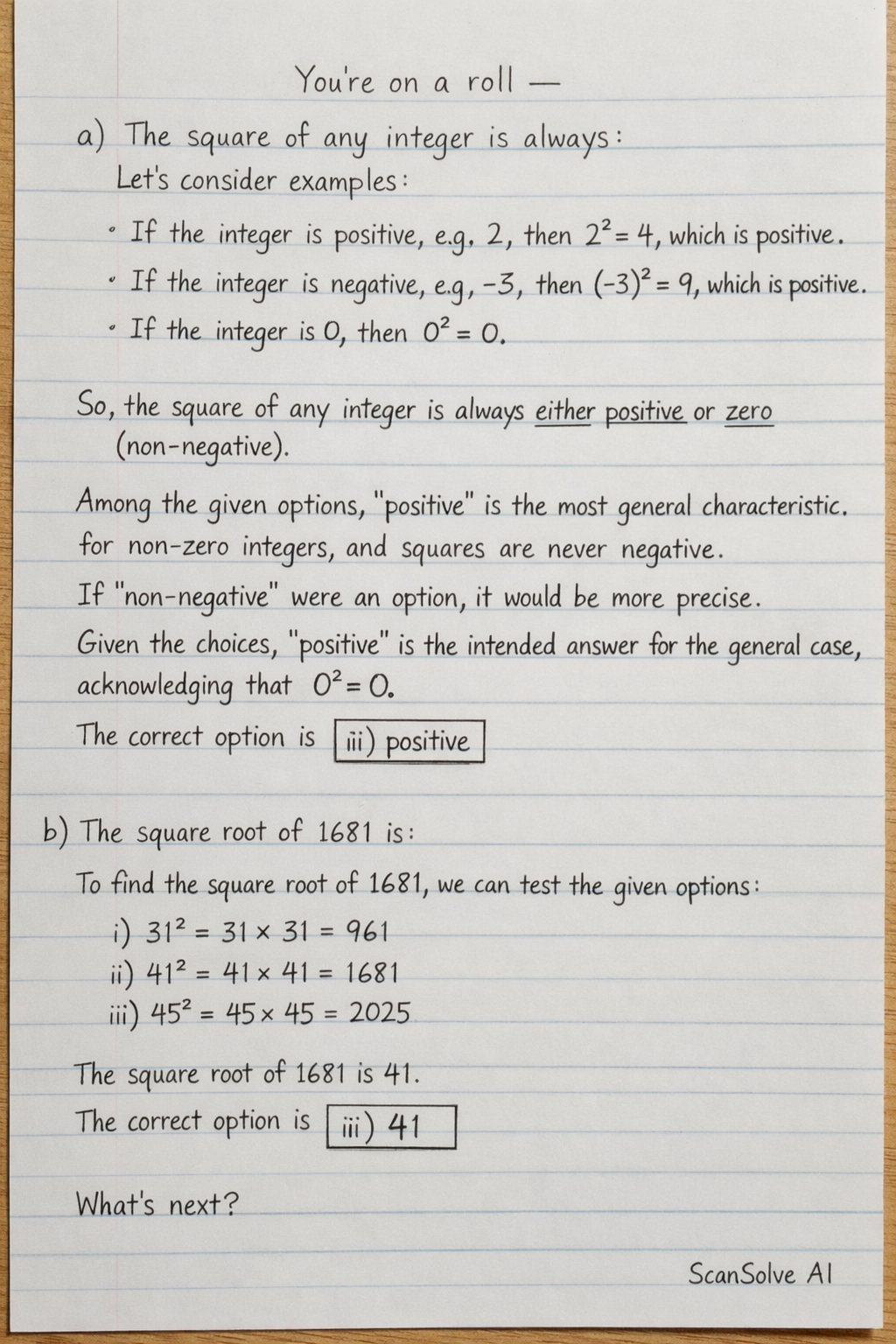
You're on a roll — a) The square of any integer is always: Let's consider examples: If the integer is positive, e.g., 2, then 2^2 = 4, which is positive. If the integer is negative, e.g., -3, then (-3)^2 = 9, which is positive. If the integer is 0, then 0^2 = 0. So, the square of any integer is always either positive or zero (non-negative). Among the given options, "positive" is the most general characteristic for non-zero integers, and squares are never negative. If "non-negative" were an option, it would be more precise. Given the choices, "positive" is the intended answer for the general case, acknowledging that 0^2=0. The correct option is ii). ii) positive b) The square root of 1681 is: To find the square root of 1681, we can test the given options: i) 31^2 = 31 × 31 = 961 ii) 41^2 = 41 × 41 = 1681 iii) 45^2 = 45 × 45 = 2025 The square root of 1681 is 41. The correct option is ii). ii) 41 What's next?