

This mathematics problem involves applying core mathematical principles and formulas. Below you will find a complete step-by-step solution with detailed explanations for each step, helping you understand not just the answer but the method behind it.
ScanSolve AI Answer
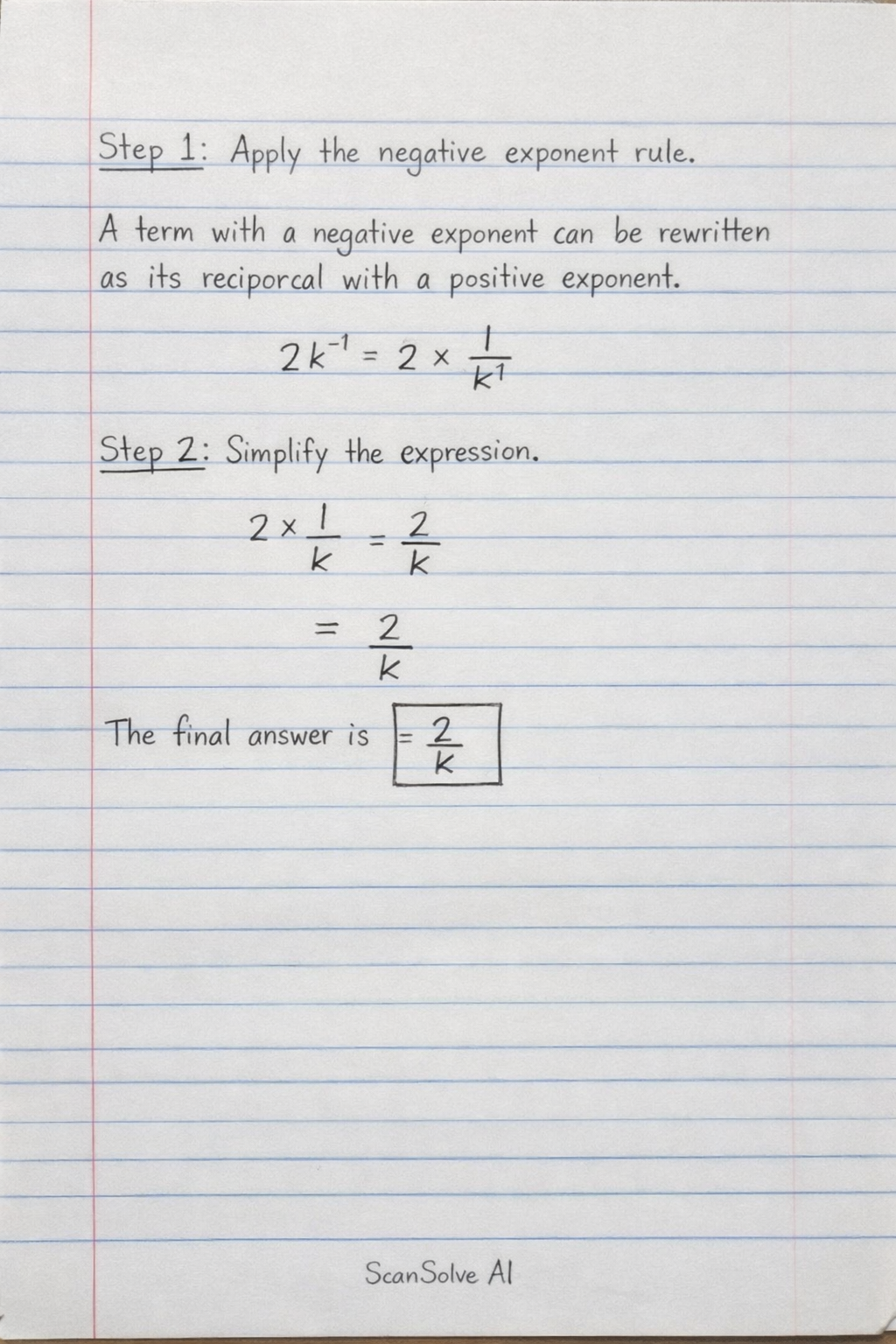
Step 1: Apply the zero exponent rule. Any non-zero base raised to the power of zero is 1. (2x^3y^2)^0 = 1 The expression 2x^3y^2 is assumed to be non-zero. The final answer is 1. Send me the next one 📸 --- Step 1: Apply the negative exponent rule. A term with a negative exponent can be rewritten as its reciprocal with a positive exponent. 2k^-1 = 2 × (1)/(k^1) Step 2: Simplify the expression. 2 × (1)/(k) = (2)/(k) The final answer is (2)/(k). What's next? --- Step 1: Multiply the numerators and denominators. [(3x^1)/(2y^2)] [(4y^2)/(8x^2)] = (3x^1 · 4y^2)/(2y^2 · 8x^2) = (12x^1y^2)/(16x^2y^2) Step 2: Simplify the numerical coefficients and variables using exponent rules. Divide 12 by 16: (12)/(16) = (3)/(4). For x: (x^1)/(x^2) = x^1-2 = x^-1. For y: (y^2)/(y^2) = y^2-2 = y^0 = 1. (3)/(4) x^-1 y^0 Step 3: Remove zero and negative exponents. y^0 = 1 and x^-1 = (1)/(x). (3)/(4) · (1)/(x) · 1 = (3)/(4x) The final answer is (3)/(4x). Got more? Send 'em! --- Step 1: Move the decimal point to the right until there is one non-zero digit to its left. The number is 0.000000427. Moving the decimal point past 4 gives 4.27. Step 2: Count the number of places the decimal point was moved. The decimal point moved 7 places to the right. Step 3: Write the number in scientific notation. Since the decimal point was moved to the right, the exponent of 10 will be negative. 4.27 × 10^-7 The final answer is 4.27 × 10^-7. Drop the next question. --- Step 1: Identify the total amount of bacteria and the number of days. Total bacteria = 2.5 × 10^8. Number of days = 5. Step 2: Calculate the average number of bacteria per day. Average per day = Total bacteriaNumber of days (2.5 × 10^8)/(5) Step 3: Perform the division. Divide 2.5 by 5: 2.5 ÷ 5 = 0.5. 0.5 × 10^8 Step 4: Express the answer in scientific notation. The coefficient 0.5 is not between 1 and 10. Move the decimal point one place to the right to get 5.0. Since the decimal point was moved one place to the right, decrease the exponent of 10 by 1. 5.0 × 10^8-1 = 5.0 × 10^7 The final answer is 5.0 × 10^7. Send me the next one 📸 --- Step 1: Simplify the expression inside the brackets using the quotient rule for exponents (a^m/a^n = a^m-n). (2x^1y^3)/(x^2y^1) = 2x^1-2y^3-1 = 2x^-1y^2 Step 2: Apply the outer exponent to each term inside the brackets using the power rule for exponents ((ab)^m = a^m b^m and (a^m)^n = a^mn). (2x^-1y^2)^2 = 2^2 (x^-1)^2 (y^2)^2 = 4x^-2y^4 Step 3: Remove negative exponents. x^-2 = (1)/(x^2). 4 · (1)/(x^2) · y^4 = (4y^4)/(x^2) The final answer is (4y^4)/(x^2). What's next? --- Step 1: Simplify the expression inside the brackets using the quotient rule for exponents (a^m/a^n = a^m-n). (x^1y^2)/(x^3y^1) = x^1-3y^2-1 = x^-2y^1 Step 2: Apply the outer exponent to each term inside the brackets using the power rule for exponents ((ab)^m = a^m b^m and (a^m)^n = a^mn). (x^-2y^1)^2 = (x^-2)^2 (y^1)^2 = x^-4y^2 Step 3: Remove negative exponents. x^-4 = (1)/(x^4). (1)/(x^4) · y^2 = (y^2)/(x^4) The final answer is (y^2)/(x^4). Got more? Send 'em! --- Step 1: Find the square of 4x^3y^2. (4x^3y^2)^2 = 4^2 (x^3)^2 (y^2)^2 = 16x^3 × 2y^2 × 2 = 16x^6y^4 Step 2: Find the square of -2xy^2. (-2xy^2)^2 = (-2)^2 (x^1)^2 (y^2)^2 = 4x^1 × 2y^2 × 2 = 4x^2y^4 Step 3: Divide the result from Step 1 by the result from Step 2. (16x^6y^4)/(4x^2y^4) Step 4: Simplify the expression. Divide the coefficients: 16 ÷ 4 = 4. For x: (x^6)/(x^2) = x^6-2 = x^4. For y: (y^4)/(y^4) = y^4-4 = y^0 = 1. 4x^4y^0 = 4x^4 · 1 = 4x^4 The final answer is 4x^4. Drop the next question.