
We read your photo as:
Homework:- Make some examples related to real and rational number.
Mathematics
ScanSolve AI Answer
यहाँ वास्तविक और परिमेय संख्याओं से संबंधित कुछ उदाहरण दिए गए हैं:
1. वास्तविक संख्याएँ (Real Numbers)
वास्तविक संख्याएँ वे सभी संख्याएँ होती हैं जिन्हें संख्या रेखा पर दर्शाया जा सकता है। इनमें परिमेय और अपरिमेय दोनों संख्याएँ शामिल होती हैं।
उदाहरण:
- पूर्णांक (Integers):
- भिन्न (Fractions):
- दशमलव (Decimals):
2. परिमेय संख्याएँ (Rational Numbers)
परिमेय संख्याएँ वे संख्याएँ होती हैं जिन्हें के रूप में व्यक्त किया जा सकता है, जहाँ और पूर्णांक होते हैं और होता है।
उदाहरण:
- पूर्णांक (Integers):
- भिन्न (Fractions):
- सांत दशमलव (Terminating Decimals):
- असांत आवर्ती दशमलव (Non-terminating Repeating Decimals):
संक्षेप में:
- सभी परिमेय संख्याएँ वास्तविक संख्याएँ होती हैं।
- अपरिमेय संख्याएँ (जैसे ) भी वास्तविक संख्याएँ होती हैं, लेकिन वे परिमेय नहीं होतीं।
Was this helpful?
Still stuck on this one?
Ask a follow-up, and the answer starts from this question.
Got a different question?Ask your own question
More Mathematics Questions
QPerform the following calculations and provide examples of number properties.QGive me a math exercise on the set of real numbersQWrite the answers of the following questions with reasons: Are all the natural numbers rational…QLook at the number line and answer the questions. a) On the given number line, which rational number…QDefine rational and irrational numbers and convert 0.1111 to a common fraction.
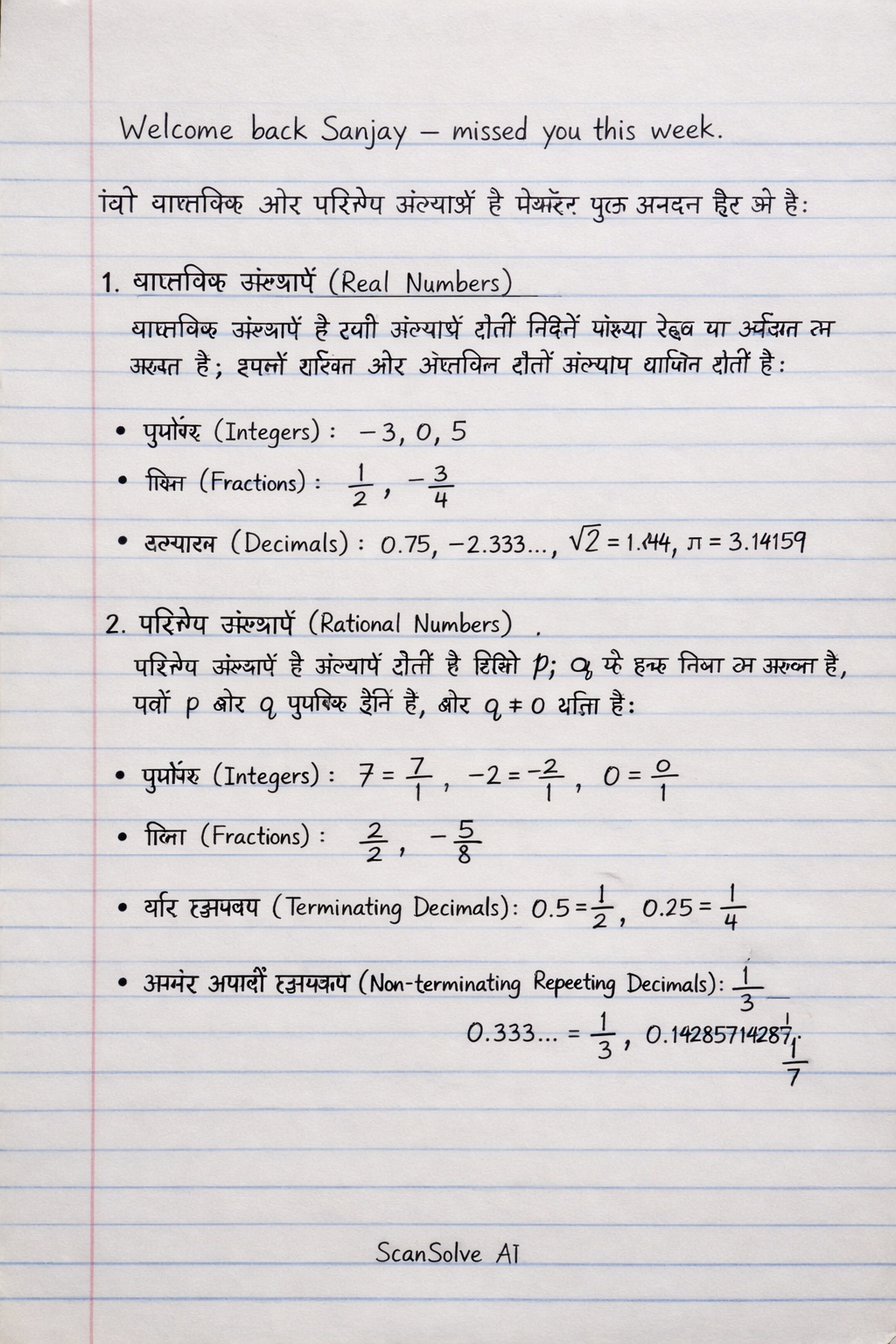
Handwritten Step-by-Step Solution
Get this as a handwritten image on WhatsApp — like a tutor wrote it for you.
Try on WhatsApp