
We read your photo as:
The roots of a quadratic equation are -2/3 and -1/4. Find the equation.
ScanSolve AI Answer
Answers
2 partsStep-by-step solution
9 stepsHere are the solutions for questions 1 and 2.
Part 1· 5 steps
Identify the given roots of the quadratic equation.
The roots are and .
Calculate the sum of the roots.
To add these fractions, find a common denominator, which is 12.
Calculate the product of the roots.
Form the quadratic equation using the formula .
Clear the denominators by multiplying the entire equation by the least common multiple (LCM) of 12 and 6, which is 12.
Comparing this with the given options, the correct equation is B.
The final answer is .
Part 2
Calculate the initial total sum of ages.
Number of learners = 14
Sum of ages = 168Determine the new number of learners and the new mean age.
A new learner is added, so the new number of learners = .
The new mean age = 12.2.Calculate the new total sum of ages.
The formula for mean is .
So,Calculate the age of the new learner.
The age of the new learner is the difference between the new total sum of ages and the initial total sum of ages.
Comparing this with the given options, the correct age is C.
The final answer is .
Try one yourself
A new problem that tests the same skill.
Still stuck on this one?
Ask a follow-up, and the answer starts from this question.
More Mathematics Questions
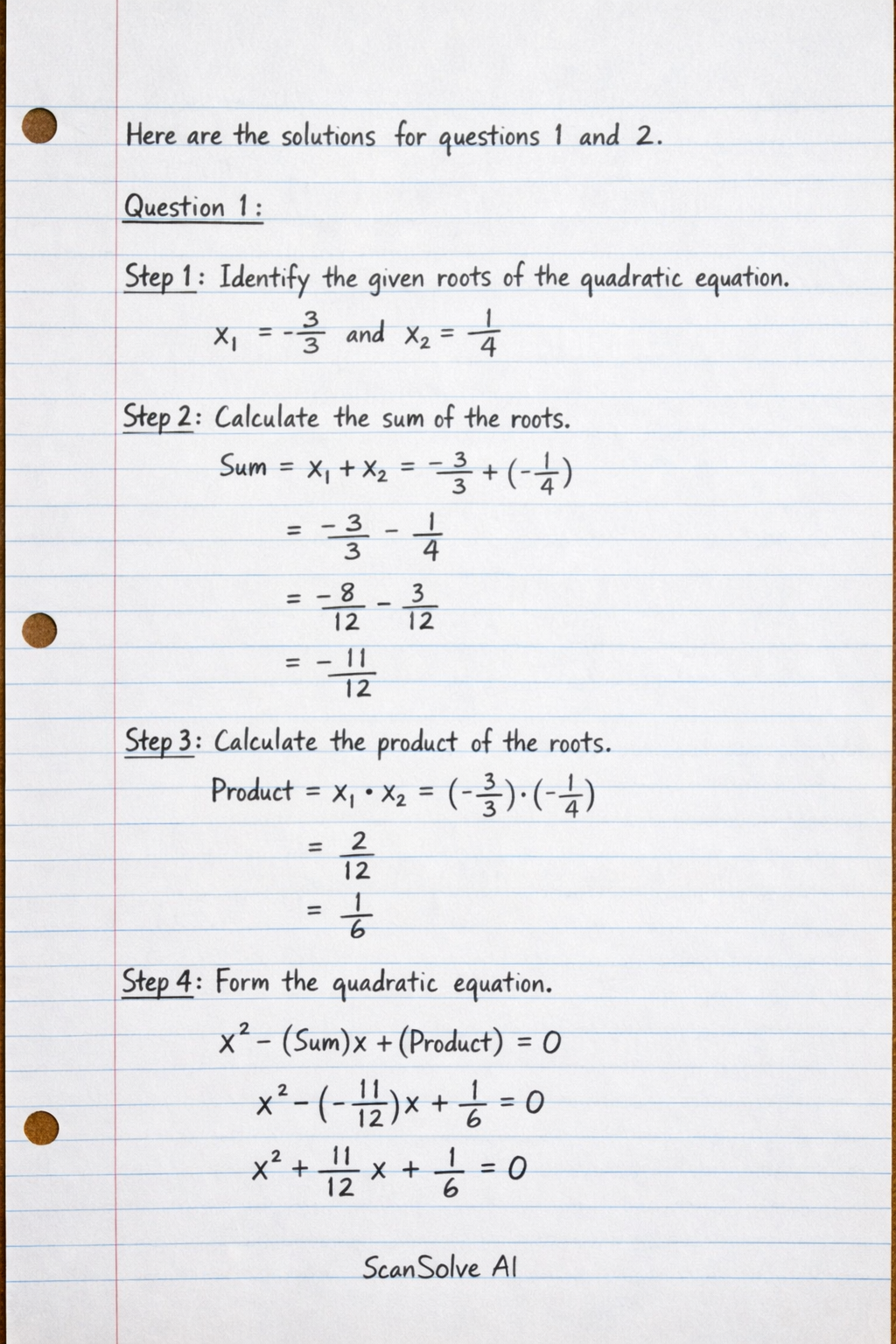
Handwritten Step-by-Step Solution
Get this as a handwritten image on WhatsApp — like a tutor wrote it for you.
Try on WhatsApp