

This mathematics problem involves applying core mathematical principles and formulas. Below you will find a complete step-by-step solution with detailed explanations for each step, helping you understand not just the answer but the method behind it.
ScanSolve AI Answer
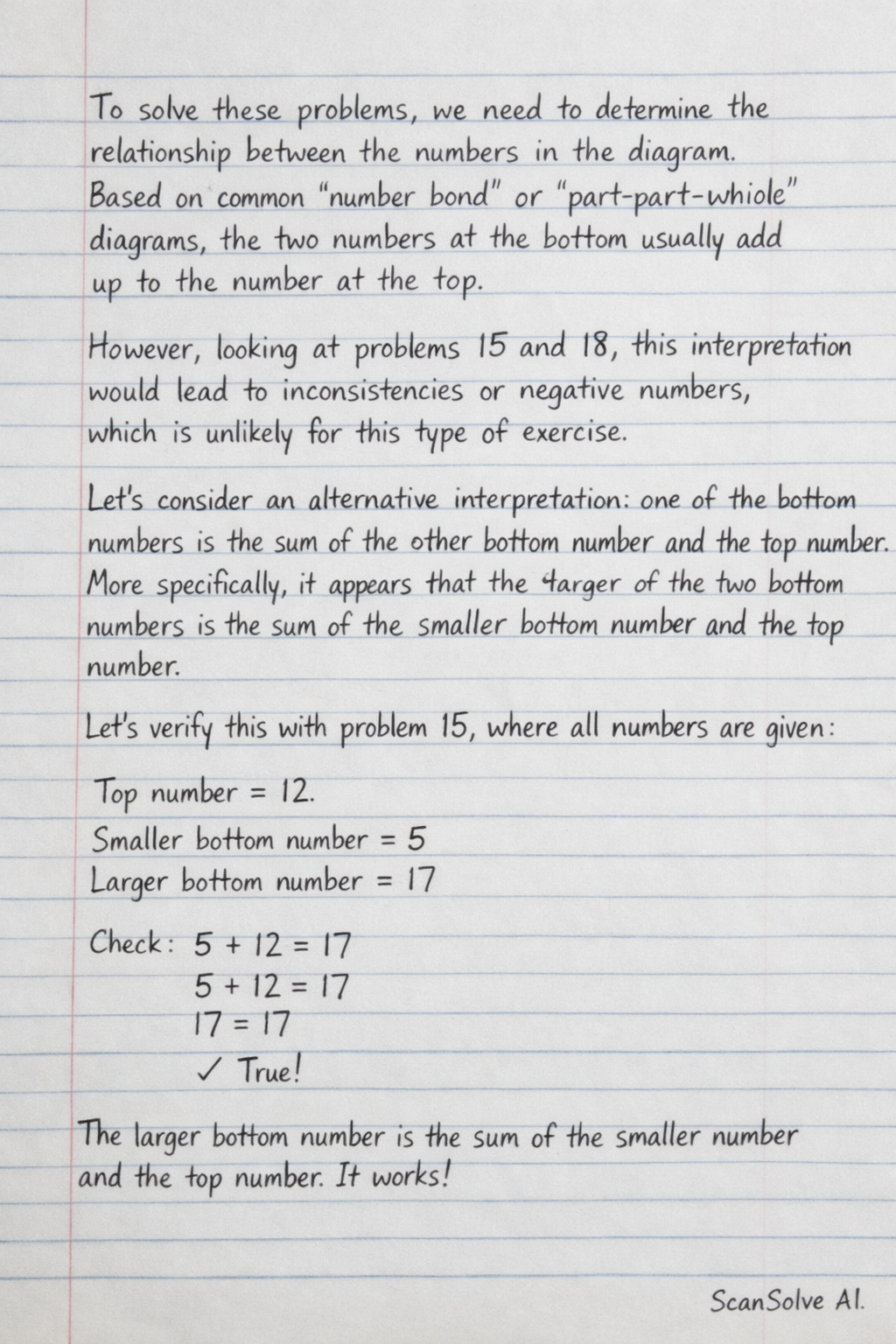
To solve these problems, we need to determine the relationship between the numbers in the diagram. Based on common "number bond" or "part-part-whole" diagrams, the two numbers at the bottom usually add up to the number at the top. However, looking at problems 15 and 18, this interpretation would lead to inconsistencies or negative numbers, which is unlikely for this type of exercise. Let's consider an alternative interpretation: one of the bottom numbers is the sum of the other bottom number and the top number. More specifically, it appears that the larger of the two bottom numbers is the sum of the smaller bottom number and the top number. Let's verify this with problem 15, where all numbers are given: Top number