
We read your photo as:
This problem uses a number bond diagram. Based on the common interpretation for these diagrams, especially when the standard "parts add up to the whole" rule leads to inconsistencies (like negative nu
Chemistry
ScanSolve AI Answer
This problem uses a number bond diagram. Based on the common interpretation for these diagrams, especially when the standard "parts add up to the whole" rule leads to inconsistencies (like negative numbers), the relationship is often that the larger of the two bottom numbers is the sum of the smaller bottom number and the top number.
Let the unknown value in the square be .
The given numbers are:
- Top number () =
- One bottom number () =
- The other bottom number () =
According to the established rule: .
We have two
Was this helpful?
Still stuck on this one?
Ask a follow-up, and the answer starts from this question.
Got a different question?Ask your own question
More Chemistry Questions
QWhat is the rule for the number bond diagram shown, and how do you solve for the missing number in…QSolve for the missing number in the number bond diagram: 9 5/8 = 8 1/8 + XQDraw dot (-) an cross (x) diagram to show bonding in: (i) Nitrogen molecule (N2) (ii) Hydroxonium…QA) Complete the table...i) X (Neutron number for A) ...ii) Y (Electron number for B) ...iii) Z (Mass…QWhat are the 10th multiple of 4, the change from R50 for R36 purchase, and the missing number in the…
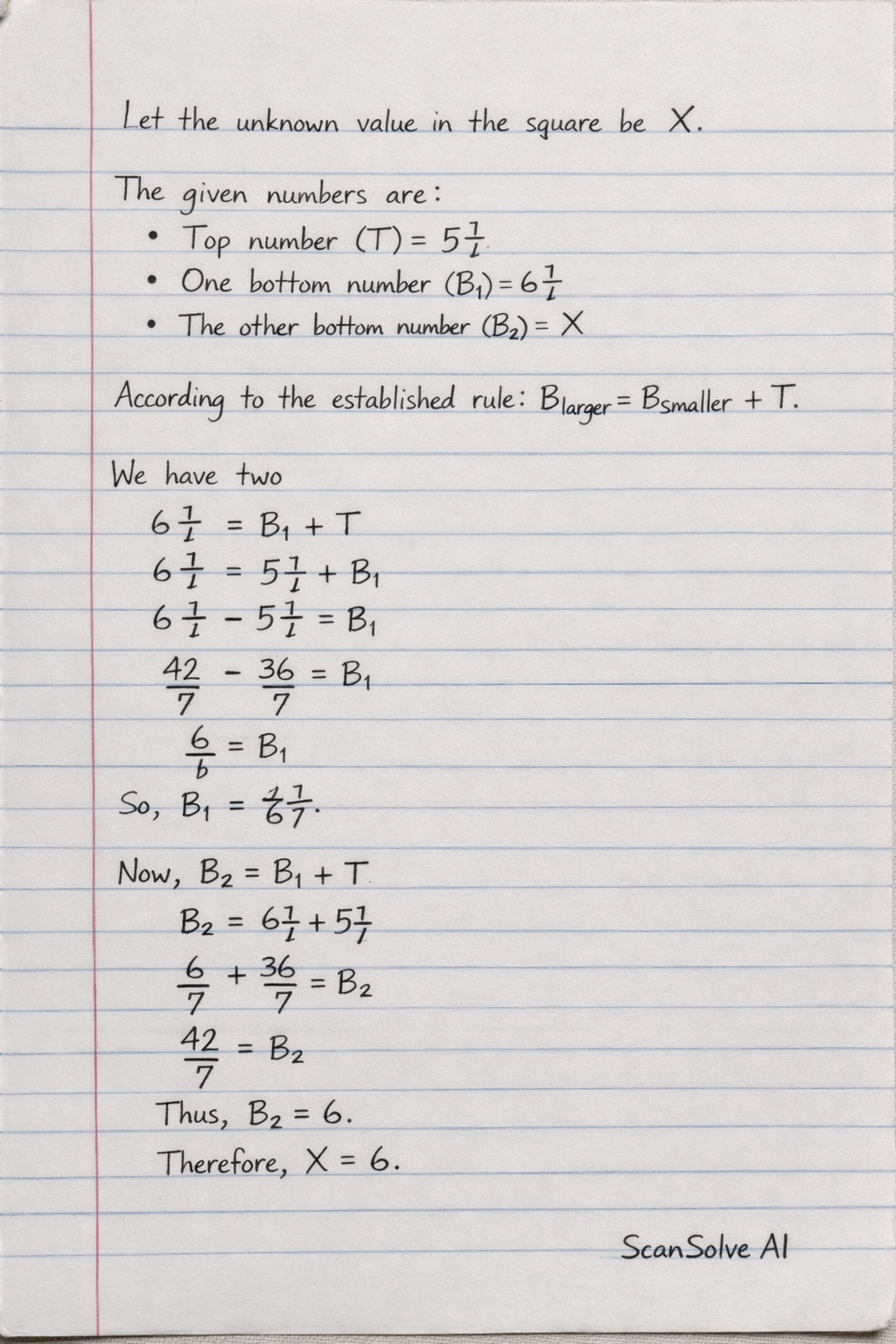
Handwritten Step-by-Step Solution
Get this as a handwritten image on WhatsApp — like a tutor wrote it for you.
Try on WhatsApp