We read your photo as:

What are the solutions for the three given math problems: 1. Finding the number of proper subsets of M = 0, 1, 2, 3, 4. 2. Determining the range of x for x2 - 2x - 3 <= 0. 3. Calculating 3M - 2N for g

Mathematics

ScanSolve AI Answer

Answer

C

Step-by-step solution

22 steps

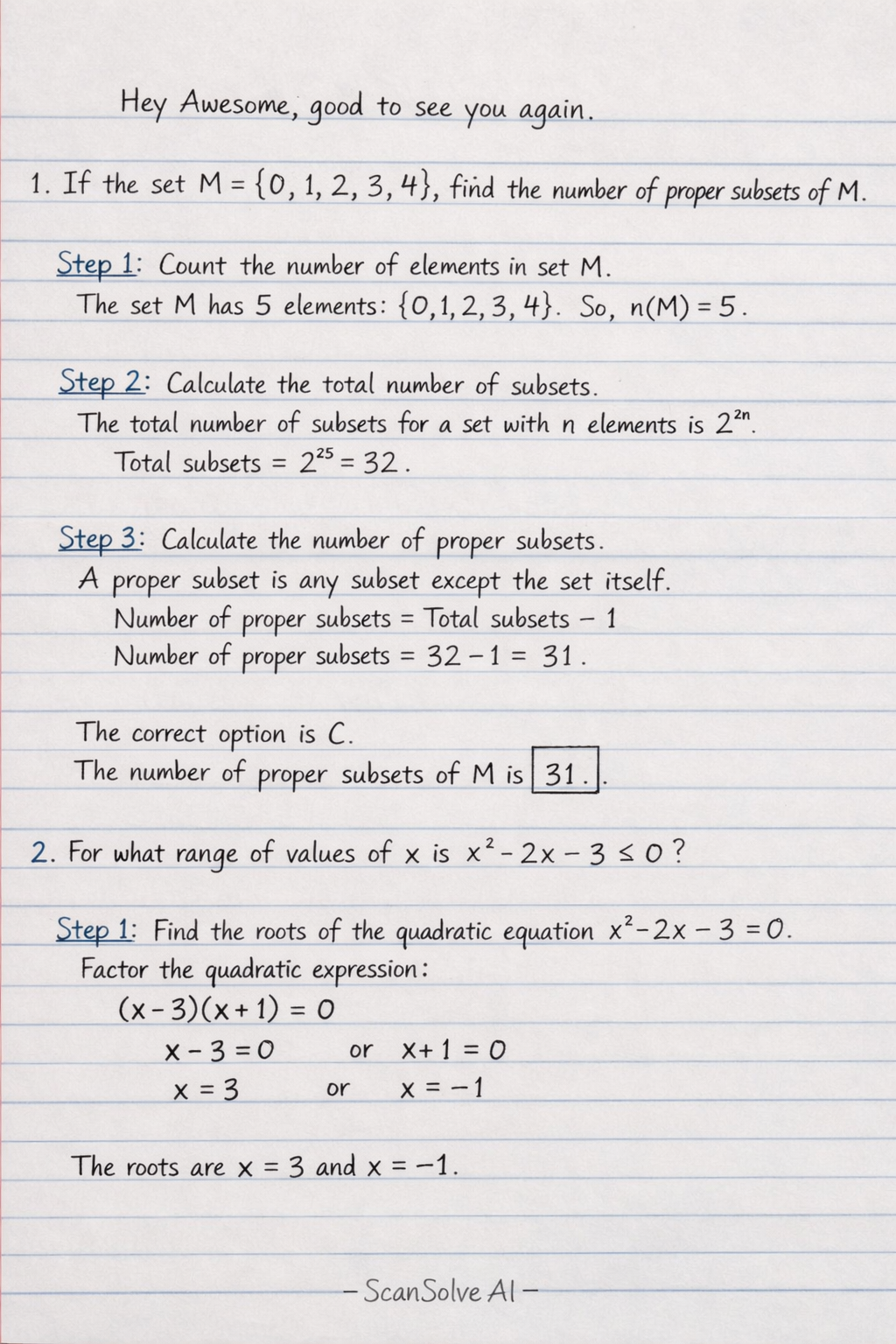
1. If the set M = {0, 1, 2, 3, 4}, find the number of proper subsets of M.

  1. Count the number of elements in set M.

    The set M has 5 elements: {0,1,2,3,4}\{0, 1, 2, 3, 4\}. So, n(M)=5n(M) = 5.

  2. Calculate the total number of subsets.

    The total number of subsets for a set with nn elements is 2n2^n.
    Total subsets =25=32= 2^5 = 32.

  3. Calculate the number of proper subsets.

    A proper subset is any subset except the set itself.
    Number of proper subsets = Total subsets - 1
    Number of proper subsets =32−1=31= 32 - 1 = 31.

    The correct option is C.
    The number of proper subsets of M is 31\boxed{\text{31}}.

    2. For what range of values of x is x2−2x−3≤0x^2 - 2x - 3 \le 0 ?

  4. Find the roots of the quadratic equation x2−2x−3=0x^2 - 2x - 3 = 0.

    Factor the quadratic expression:

    (x−3)(x+1)=0(x-3)(x+1) = 0

    The roots are x=3x = 3 and x=−1x = -1.

  5. Determine the range for which the inequality holds.

    Since the coefficient of x2x^2 is positive (1), the parabola opens upwards. The inequality x2−2x−3≤0x^2 - 2x - 3 \le 0 is satisfied for values of xx between and including the roots.

    −1≤x≤3-1 \le x \le 3

    The correct option is D.
    The range of values for xx is −1≤x≤3\boxed{-1 \le x \le 3}.

    3. Given that M=(32−14)M = \begin{pmatrix} 3 & 2 \\ -1 & 4 \end{pmatrix} and N=(56−2−3)N = \begin{pmatrix} 5 & 6 \\ -2 & -3 \end{pmatrix}, calculate (3M−2N)(3M - 2N).

  6. Calculate $3M$.

    3M=3(32−14)=(3×33×23×(−1)3×4)=(96−312)3M = 3 \begin{pmatrix} 3 & 2 \\ -1 & 4 \end{pmatrix} = \begin{pmatrix} 3 \times 3 & 3 \times 2 \\ 3 \times (-1) & 3 \times 4 \end{pmatrix} = \begin{pmatrix} 9 & 6 \\ -3 & 12 \end{pmatrix}
  7. Calculate $2N$.

    2N=2(56−2−3)=(2×52×62×(−2)2×(−3))=(1012−4−6)2N = 2 \begin{pmatrix} 5 & 6 \\ -2 & -3 \end{pmatrix} = \begin{pmatrix} 2 \times 5 & 2 \times 6 \\ 2 \times (-2) & 2 \times (-3) \end{pmatrix} = \begin{pmatrix} 10 & 12 \\ -4 & -6 \end{pmatrix}
  8. Subtract $2N$ from $3M$.

    3M−2N=(96−312)−(1012−4−6)3M - 2N = \begin{pmatrix} 9 & 6 \\ -3 & 12 \end{pmatrix} - \begin{pmatrix} 10 & 12 \\ -4 & -6 \end{pmatrix} 3M−2N=(9−106−12−3−(−4)12−(−6))3M - 2N = \begin{pmatrix} 9 - 10 & 6 - 12 \\ -3 - (-4) & 12 - (-6) \end{pmatrix} 3M−2N=(−1−6−3+412+6)3M - 2N = \begin{pmatrix} -1 & -6 \\ -3 + 4 & 12 + 6 \end{pmatrix} 3M−2N=(−1−6118)3M - 2N = \begin{pmatrix} -1 & -6 \\ 1 & 18 \end{pmatrix}

    The correct option is C.
    The result of the calculation is (−1−6118)\boxed{\begin{pmatrix} -1 & -6 \\ 1 & 18 \end{pmatrix}}.

    4. Simplify; 13log⁡8+13log⁡64−2log⁡6\frac{1}{3}\log 8 + \frac{1}{3}\log 64 - 2\log 6.

  9. Apply the logarithm property alog⁡b=log⁡baa \log b = \log b^a.

    log⁡81/3+log⁡641/3−log⁡62\log 8^{1/3} + \log 64^{1/3} - \log 6^2
  10. Simplify the terms with exponents.

    81/3=83=28^{1/3} = \sqrt[3]{8} = 2 641/3=643=464^{1/3} = \sqrt[3]{64} = 4 62=366^2 = 36

    Substitute these values back into the expression:

    log⁡2+log⁡4−log⁡36\log 2 + \log 4 - \log 36
  11. Apply the logarithm properties log⁡a+log⁡b=log⁡(ab)\log a + \log b = \log (ab) and log⁡a−log⁡b=log⁡(ab)\log a - \log b = \log \left(\frac{a}{b}\right).

    log⁡(2×4)−log⁡36\log (2 \times 4) - \log 36 log⁡8−log⁡36\log 8 - \log 36 log⁡(836)\log \left(\frac{8}{36}\right)
  12. Simplify the fraction inside the logarithm.

    log⁡(8÷436÷4)=log⁡(29)\log \left(\frac{8 \div 4}{36 \div 4}\right) = \log \left(\frac{2}{9}\right)

    The correct option is B.
    The simplified expression is log⁡29\boxed{\log \frac{2}{9}}.

    5. If 3x+1+3x−1=303^{x+1} + 3^{x-1} = 30, what is the value of x?

  13. Rewrite the terms using exponent rules am+n=amana^{m+n} = a^m a^n and am−n=amana^{m-n} = \frac{a^m}{a^n}.

    3x⋅31+3x31=303^x \cdot 3^1 + \frac{3^x}{3^1} = 30 3⋅3x+13⋅3x=303 \cdot 3^x + \frac{1}{3} \cdot 3^x = 30
  14. Factor out 3x3^x.

    3x(3+13)=303^x \left(3 + \frac{1}{3}\right) = 30
  15. Simplify the expression inside the parentheses.

    3x(93+13)=303^x \left(\frac{9}{3} + \frac{1}{3}\right) = 30 3x(103)=303^x \left(\frac{10}{3}\right) = 30
  16. Isolate 3x3^x.

    3x=30×3103^x = 30 \times \frac{3}{10} 3x=3×33^x = 3 \times 3 3x=93^x = 9
  17. Express 9 as a power of 3.

    3x=323^x = 3^2
  18. Equate the exponents since the bases are the same.

    x=2x = 2

    The correct option is B.
    The value of xx is 2\boxed{2}.

    6. Find the equation of the tangent to the circle x2+y2+8x−12y=15x^2 + y^2 + 8x - 12y = 15 at (2, 3).

  19. Find the center of the circle.

    The general equation of a circle is x2+y2+2gx+2fy+c=0x^2 + y^2 + 2gx + 2fy + c = 0.
    Rewrite the given equation: x2+y2+8x−12y−15=0x^2 + y^2 + 8x - 12y - 15 = 0.
    Comparing coefficients, 2g=8  ⟹  g=42g = 8 \implies g = 4 and 2f=−12  ⟹  f=−62f = -12 \implies f = -6.
    The center of the circle is (−g,−f)=(−4,6)(-g, -f) = (-4, 6).

  20. Find the slope of the radius connecting the center (−4,6)(-4, 6) to the point of tangency (2,3)(2, 3).

    mr=y2−y1x2−x1=3−62−(−4)=−32+4=−36=−12m_r = \frac{y_2 - y_1}{x_2 - x_1} = \frac{3 - 6}{2 - (-4)} = \frac{-3}{2 + 4} = \frac{-3}{6} = -\frac{1}{2}
  21. Find the slope of the tangent line.

    The tangent line is perpendicular to the radius at the point of tangency. The product of the slopes of perpendicular lines is -1.

    mt=−1mr=−1(−1/2)=2m_t = -\frac{1}{m_r} = -\frac{1}{(-1/2)} = 2
  22. Use the point-slope form of a linear equation $y - y_1

Was this helpful?

Try one yourself

A new problem that tests the same skill.

Still stuck on this one?

Ask a follow-up, and the answer starts from this question.

Got a different question?Ask your own question
Handwritten step-by-step solution preview

Handwritten Step-by-Step Solution

Get this as a handwritten image on WhatsApp — like a tutor wrote it for you.

Try on WhatsApp