
We read your photo as:
Given the sets M = : -2 x 4\ and N = : 0 < x < 6 we need to find their intersection M N.
ScanSolve AI Answer
Answer
Step-by-step solution
11 stepsHere are the solutions to the problems you've sent.
Part 12· 2 steps
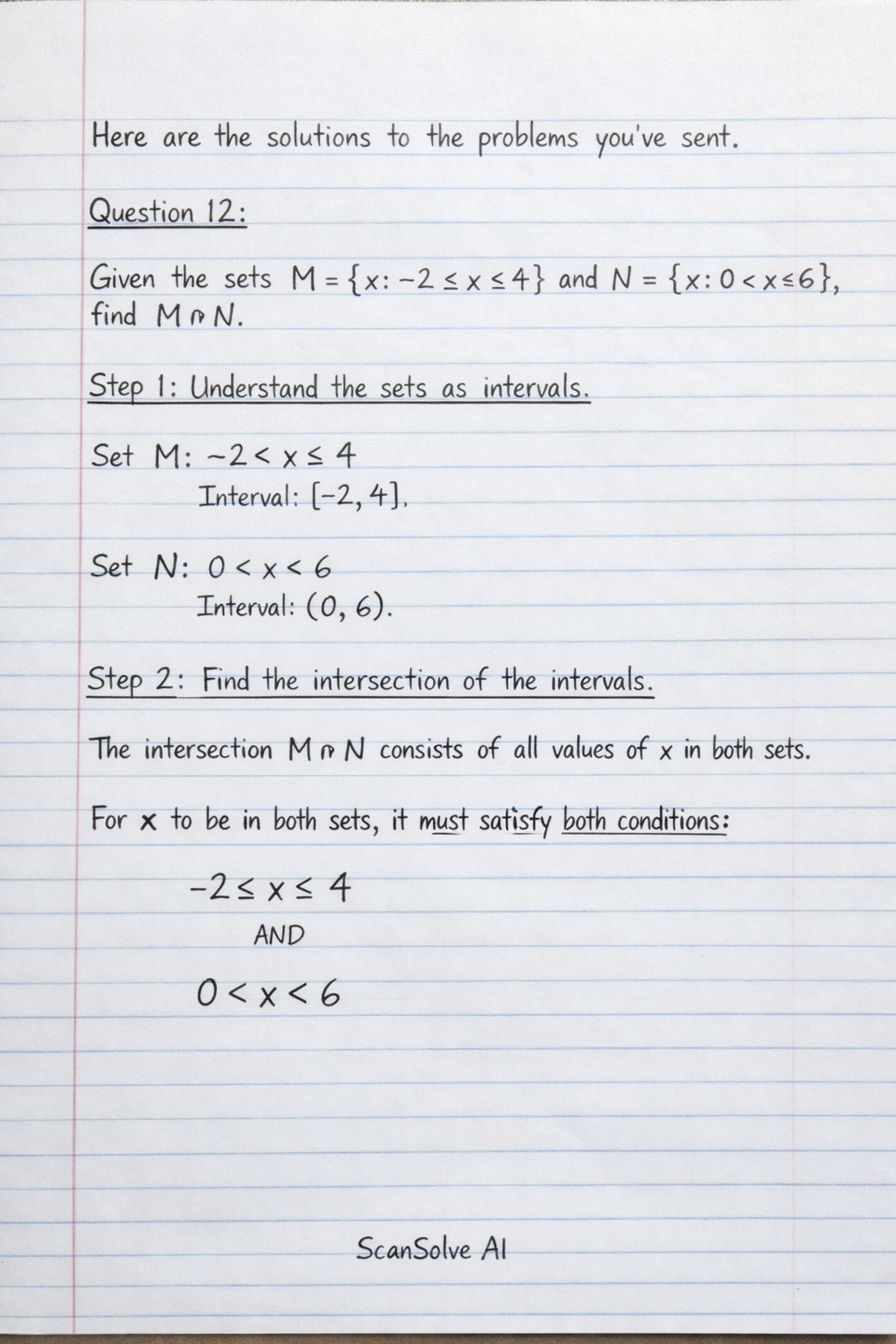
Given the sets and , we need to find their intersection .
Understand the sets as intervals.
The set includes all real numbers such that is greater than or equal to -2 and less than or equal to 4. In interval notation, this is .
The set includes all real numbers such that is greater than 0 and less than 6. In interval notation, this is .Find the intersection of the intervals.
The intersection consists of all values of that are present in both sets.
For to be in both sets, it must satisfy both conditions:
AND
To find the combined range:
- The lower bound for must be greater than the largest of the two lower bounds. Comparing and 0, the larger is 0. Since in , the intersection will have .
- The upper bound for must be less than the smallest of the two upper bounds. Comparing 4 and 6, the smaller is 4. Since in , the intersection will have .
Combining these, we get .
The correct option is A.
Part 13· 2 steps
If , find the value of .
Simplify the left side of the equation.
To subtract the terms on the left side, we need a common denominator, which is .
Set the simplified left side equal to the right side and solve for .
To isolate , divide both sides by :
The correct option is C.
Part 14· 5 steps
Given that the first term of an exponential sequence (G.P.) is and the second term is , find the common ratio.
Recall the formula for the common ratio in a G.P.
For a geometric progression, the common ratio is found by dividing any term by its preceding term.
Given:
First term () =
Second term () =Calculate the common ratio.
To simplify this expression, multiply the numerator and the denominator by the conjugate of the denominator. The conjugate of is .
Expand the denominator.
Using the difference of squares formula :
Expand the numerator.
Combine the simplified numerator and denominator.
The correct option is D.
Part 15· 2 steps
If , express in terms of .
Express the constant term as a logarithm with base 2.
We know that . So, .
Substitute this into the given equation.
Try one yourself
A new problem that tests the same skill.
Still stuck on this one?
Ask a follow-up, and the answer starts from this question.
More Mathematics Questions
Handwritten Step-by-Step Solution
Get this as a handwritten image on WhatsApp — like a tutor wrote it for you.
Try on WhatsApp