
We read your photo as:
Identify the greatest common factor (GCF) of all terms in the expression 2x2 - 8x - 12.
ScanSolve AI Answer
Answer
Step-by-step solution
3 stepsIdentify the greatest common factor (GCF) of all terms in the expression .
The terms are , , and .
The numerical coefficients are 2, , and . The greatest common factor of these numbers is 2.
There is no common variable factor since the last term, , does not contain .Factor out the GCF from each term.
Check if the quadratic expression inside the parenthesis, , can be factored further.
We look for two numbers that multiply to and add to .
The pairs of integer factors for are , , , and .
Their sums are:
None of these sums equal . Therefore, cannot be factored further over integers.
Try one yourself
A new problem that tests the same skill.
Still stuck on this one?
Ask a follow-up, and the answer starts from this question.
More Mathematics Questions
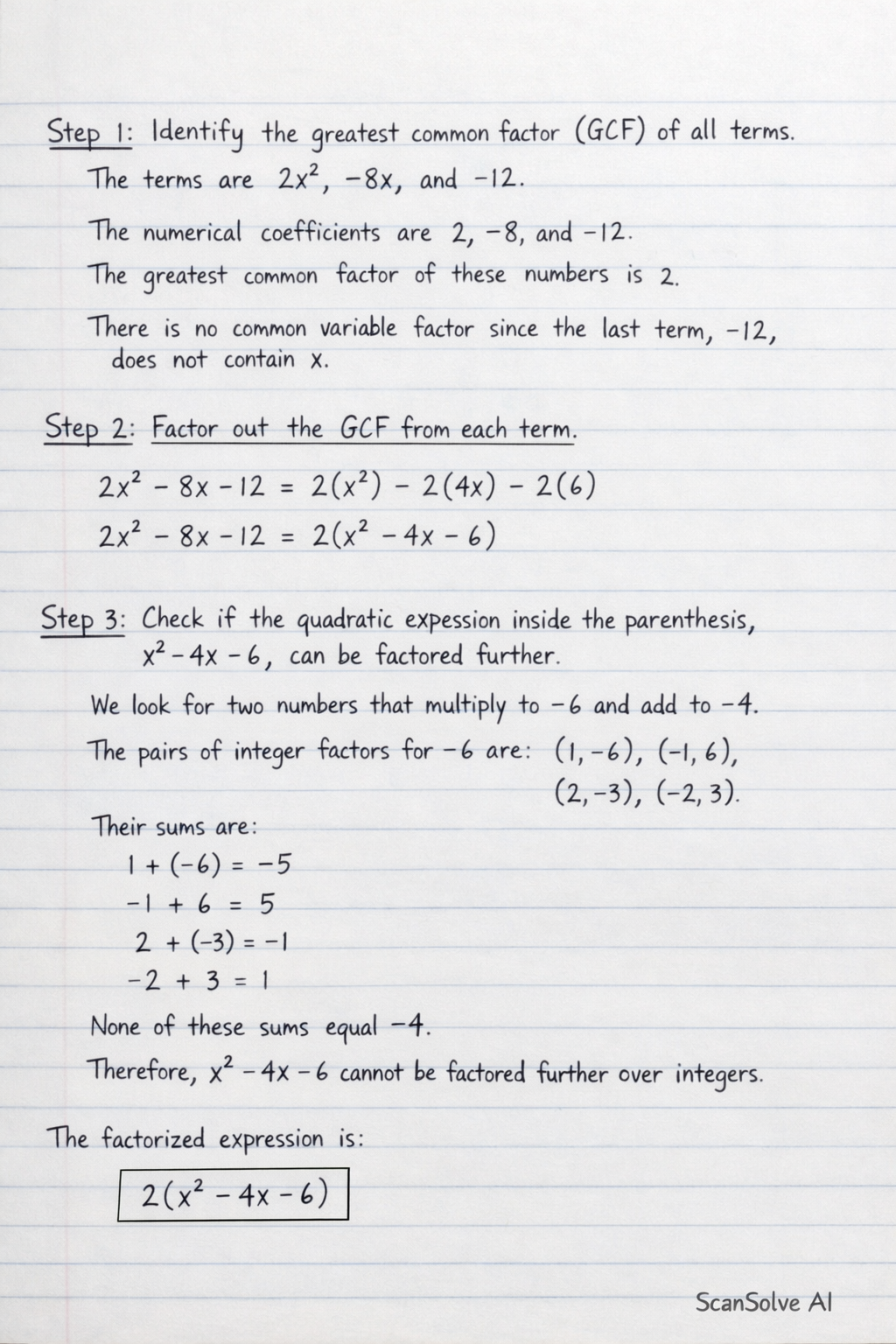
Handwritten Step-by-Step Solution
Get this as a handwritten image on WhatsApp — like a tutor wrote it for you.
Try on WhatsApp