

This mathematics problem involves applying core mathematical principles and formulas. Below you will find a complete step-by-step solution with detailed explanations for each step, helping you understand not just the answer but the method behind it.
ScanSolve AI Answer
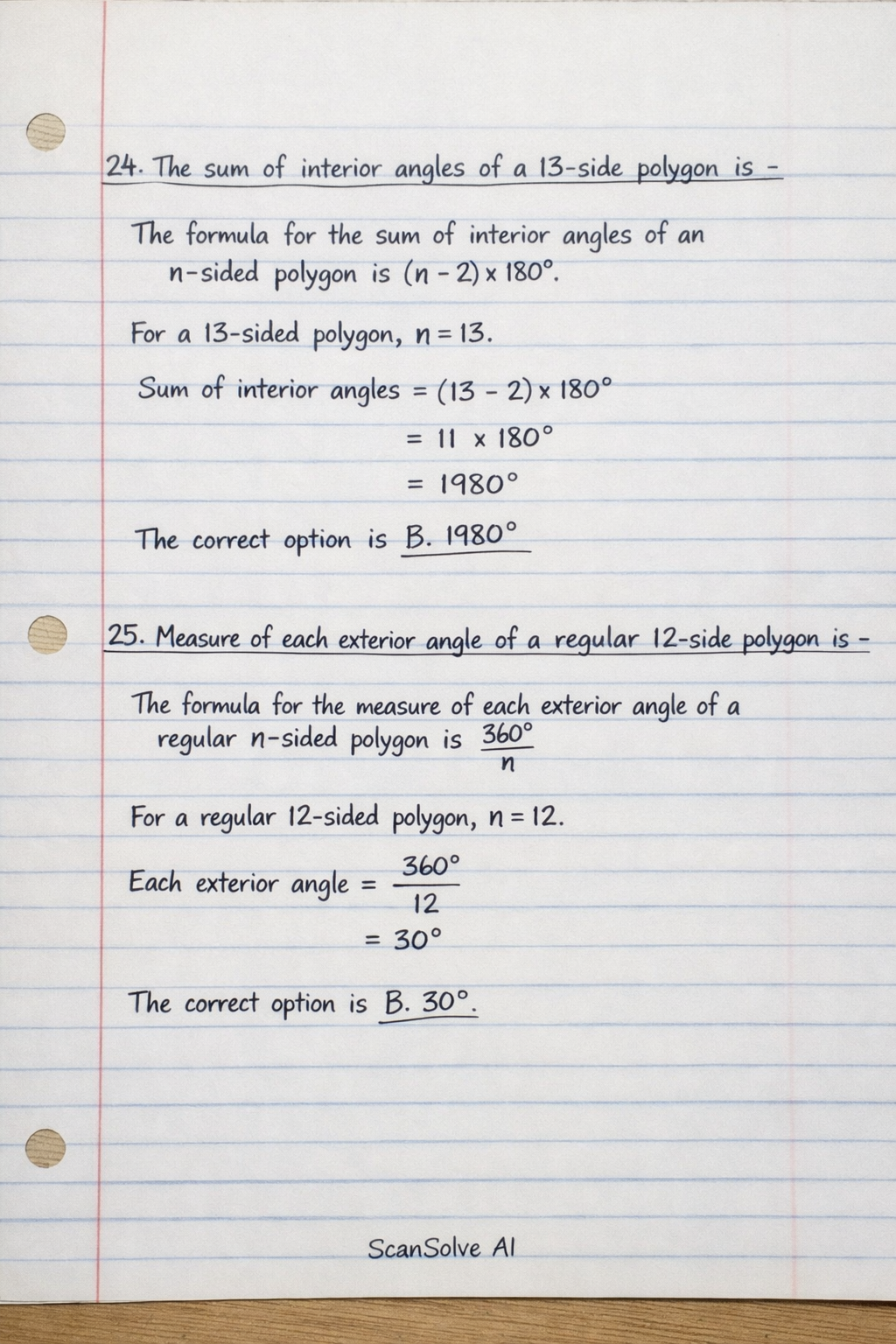
Here are the solutions to your questions: 24. The sum of interior angles of a 13-side polygon is - The formula for the sum of interior angles of an n-sided polygon is (n-2) × 180^. For a 13-sided polygon, n=13. Sum of interior angles = (13-2) × 180^ = 11 × 180^ = 1980^ The correct option is B. 1980^. 25. Measure of each exterior angle of a regular 12-side polygon is - The formula for the measure of each exterior angle of a regular n-sided polygon is (360^)/(n). For a regular 12-sided polygon, n=12. Each exterior angle = (360^)/(12) = 30^ The correct option is B. 30^. 26. For the given ABC, find the measure of exterior angle x. In a triangle, the measure of an exterior angle is equal to the sum of the measures of the two non-adjacent interior angles. From the image, the exterior angle at vertex C is x. The non-adjacent interior angles are A = 20^ and B = (40-x)^. So, we have the equation: x = A + B x = 20^ + (40^ - x) x = 60^ - x Add x to both sides: x + x = 60^ 2x = 60^ Divide by 2: x = (60^)/(2) x = 30^ The correct option is B. 30^. 27. The area of a regular hexagon is 96sqrt(3) cm^2. Then what is its perimeter? The formula for the area of a regular hexagon with side length s is A = 3sqrt(3)2 s^2. Given A = 96sqrt(3) cm^2. 3sqrt(3)2 s^2 = 96sqrt(3) Divide both sides by sqrt(3): (3)/(2) s^2 = 96 Multiply both sides by (2)/(3): s^2 = 96 × (2)/(3) s^2 = 32 × 2 s^2 = 64 Take the square root of both sides: s = sqrt(64) s = 8 cm The perimeter of a regular hexagon is P = 6s. P = 6 × 8 cm P = 48 cm The correct option is B. 48 cm. 28. What is the perimeter of a square with a diagonal of 6sqrt(2)? Let the side length of the square be s. The diagonal d of a square is related to its side length by the formula d = ssqrt(2). Given d = 6sqrt(2). ssqrt(2) = 6sqrt(2) Divide both sides by sqrt(2): s = 6 cm The perimeter of a square is P = 4s. P = 4 × 6 cm P = 24 cm The correct option is C. 24 cm. 29. Which of the following is always true? Let's analyze each statement for a regular n-sided polygon: A. An n-side regular polygon has n symmetric lines. This is true. B. If an odd number of sides, line symmetry connects vertex to side. This is true. For odd n, each line of symmetry passes through a vertex and the midpoint of the opposite side. C. If an even number of sides, line symmetry connects side to side & vertex to vertex. This is true. For even n, lines of symmetry pass either through opposite vertices or through the midpoints of opposite sides. Since statements A, B, and C are all true, the correct option is D. All. 30. What is the name of a polygon whose vertex equals 10? A polygon with 10 vertices (and thus 10 sides) is called a decagon. The correct option is D. Hexagon (This seems to be a typo in the options provided, as Hexagon has 6 vertices. Assuming the question meant "Decagon" or the options are incorrect. If we must choose from the given options, none are correct for 10 vertices. However, if the question meant "What is the name of a polygon whose number of sides equals 10", then it's a decagon. If the options are fixed, and the question is "vertex equals 10", then none of the options are correct. Let's assume there's a typo in the question and it meant "number of sides" and the options are for a different question or are incorrect. Given the options, none of them are for a 10-vertex polygon. A pentagon has 5 vertices, a quadrilateral has 4, a nonagon has 9, a hexagon has 6. There is no correct option among A, B, C, D for a 10-vertex polygon. If the question intended to ask for a 6-vertex polygon, then D would be correct. Given the ambiguity, I will state that none of the options are correct for a 10-vertex polygon, which is a decagon.) Correction: A polygon with 10 vertices is a decagon. None of the options A (pentagon), B (quadrilateral), C (nonagon), D (hexagon) are correct. 31. If the measure of each vertex of interior angle and exterior angle are equal, then what is the name of this regular polygon? Let I be the interior angle and E be the exterior angle. We know that I + E = 180^. Given that I = E. Substitute I=E into the equation: E + E = 180^ 2E = 180^ E = 90^ For a regular polygon, the measure of each exterior angle is E = (360^)/(n), where n is the number of sides. 90^ = (360^)/(n) n = (360^)/(90^) n = 4 A polygon with 4 sides is a quadrilateral. A regular quadrilateral is a square. The correct option is B. Square. 32. Which one cannot be a measure of a central angle? For a regular n-sided polygon, the central angle is (360^)/(n). This means that for a central angle to be possible, it must be a divisor of 360^