
We read your photo as:
What are the solutions to the following probability questions: 8. If the probability that a boy will be late for school is x, what is the probability he will not be late? 9. If the probability that Ka
ScanSolve AI Answer
Step-by-step solution
9 stepsHere are the solutions to the probability questions:
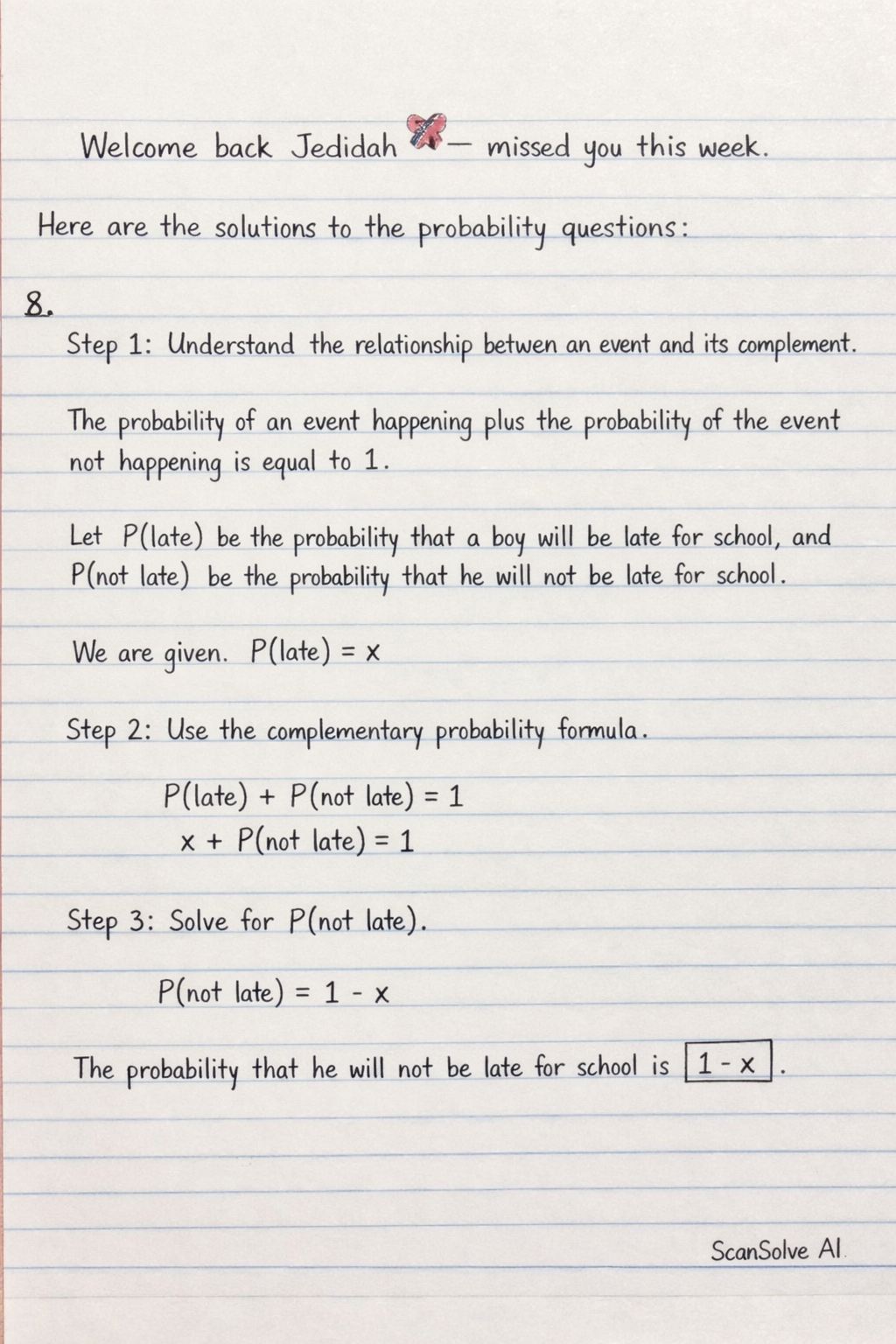
8.
Understand the relationship between an event and its complement.
The probability of an event happening plus the probability of the event not happening is equal to 1.
Let be the probability that a boy will be late for school, and be the probability that he will not be late for school.
We are given .Use the complementary probability formula.
Solve for .
The probability that he will not be late for school is .
9.
Identify the given probability and the event whose probability is required.
The probability of Kasukulu waking up late is 0.3.
We need to find the probability that she will wake up early. Waking up early is the complement of waking up late in this context.
Let be the probability of waking up late, and be the probability of waking up early.
We are given .Apply the complementary probability formula.
Calculate .
The probability that she will wake up early is .
10.
Identify the given probability and the event whose probability is required.
The probability of getting a black button is .
We need to find the probability of getting a button which is not black. "Not black" is the complement of "black".
Let be the probability of getting a black button, and be the probability of getting a button that is not black.
We are given .Apply the complementary probability formula.
Calculate .
The probability of getting a button which is not black is .
Still stuck on this one?
Ask a follow-up, and the answer starts from this question.
More Mathematics Questions
Handwritten Step-by-Step Solution
Get this as a handwritten image on WhatsApp — like a tutor wrote it for you.
Try on WhatsApp