We read your photo as:

What are the solutions to the following problems: 1. Cost of rice: Calculate the cost of 10 kg of rice if 25 kg costs sh 5000. 2. Cultivating land: How many days to cultivate 36 acres if 12 acres are

Mathematics

ScanSolve AI Answer

Step-by-step solution

12 steps

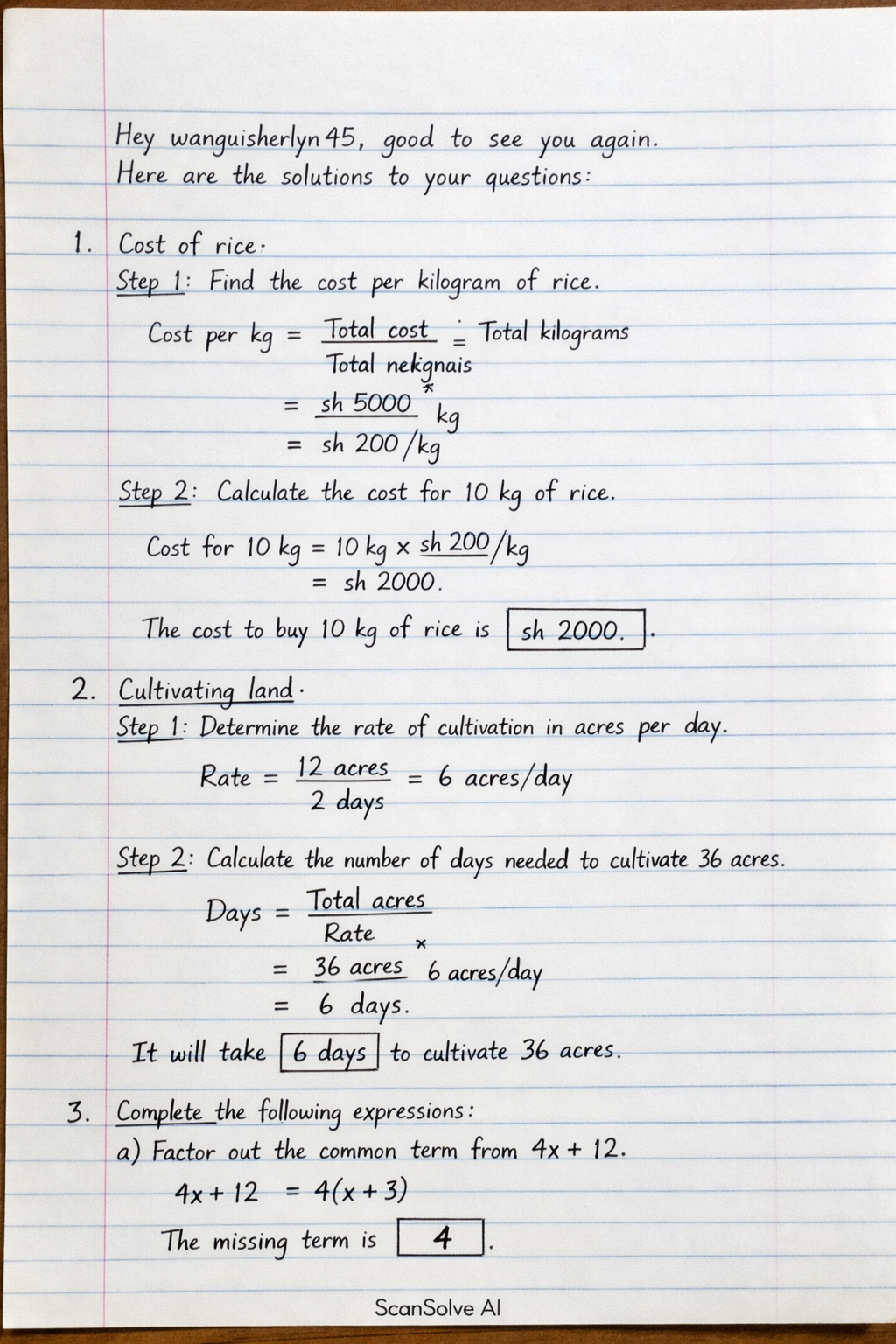
Here are the solutions to your questions:

1. Cost of rice

Step 1: Find the cost per kilogram of rice.

Cost per kg=Total costTotal kilograms=sh 500025 kg=sh 200/kg\text{Cost per kg} = \frac{\text{Total cost}}{\text{Total kilograms}} = \frac{\text{sh } 5000}{25 \text{ kg}} = \text{sh } 200/\text{kg}

Step 2: Calculate the cost for 10 kg of rice.

Cost for 10 kg=10 kg×sh 200/kg=sh 2000\text{Cost for 10 kg} = 10 \text{ kg} \times \text{sh } 200/\text{kg} = \text{sh } 2000

The cost to buy 10 kg of rice is sh 2000\boxed{\text{sh } 2000}.

2. Cultivating land

Step 1: Determine the rate of cultivation in acres per day.

Rate=12 acres2 days=6 acres/day\text{Rate} = \frac{12 \text{ acres}}{2 \text{ days}} = 6 \text{ acres/day}

Step 2: Calculate the number of days needed to cultivate 36 acres.

Days=Total acresRate=36 acres6 acres/day=6 days\text{Days} = \frac{\text{Total acres}}{\text{Rate}} = \frac{36 \text{ acres}}{6 \text{ acres/day}} = 6 \text{ days}

It will take 6 days\boxed{6 \text{ days}} to cultivate 36 acres.

3. Complete the following expressions

Part a

Factor out the common term from 4x+124x+12.

4x+12=4(x+3)4x+12 = 4(x+3)

The missing term is 4\boxed{4}.

Part b· 12 steps

Factor out 2x2x from 4x−14xy4x-14xy.

4x−14xy=2x(2−7y)4x-14xy = 2x(2 - 7y)

The missing terms are 2−7y\boxed{2 - 7y}.

4. Simplify into a single fraction

  1. Find a common denominator for DD and 4, which is 4D4D.

    yD+5+y−14=y⋅4D⋅4+5⋅4D1⋅4D+(y−1)⋅D4⋅D\frac{y}{D} + 5 + \frac{y-1}{4} = \frac{y \cdot 4}{D \cdot 4} + \frac{5 \cdot 4D}{1 \cdot 4D} + \frac{(y-1) \cdot D}{4 \cdot D}
  2. Combine the fractions with the common denominator.

    =4y4D+20D4D+D(y−1)4D= \frac{4y}{4D} + \frac{20D}{4D} + \frac{D(y-1)}{4D} =4y+20D+Dy−D4D= \frac{4y + 20D + Dy - D}{4D}

    The simplified single fraction is 4y+20D+Dy−D4D\boxed{\frac{4y + 20D + Dy - D}{4D}}.

    5. Solve by substitution

    Given equations:

    1. 2p+4q=442p+4q=44
    2. 5p+3q=685p+3q=68
  3. Solve equation (1) for pp.

    2p=44−4q2p = 44 - 4q p=22−2qp = 22 - 2q
  4. Substitute this expression for pp into equation (2).

    5(22−2q)+3q=685(22 - 2q) + 3q = 68 110−10q+3q=68110 - 10q + 3q = 68 110−7q=68110 - 7q = 68
  5. Solve for qq.

    −7q=68−110-7q = 68 - 110 −7q=−42-7q = -42 q=−42−7q = \frac{-42}{-7} q=6q = 6
  6. Substitute the value of qq back into the expression for pp.

    p=22−2(6)p = 22 - 2(6) p=22−12p = 22 - 12 p=10p = 10

    The solution is p=10,q=6\boxed{p=10, q=6}.

    6. Distance covered by minute hand

  7. Identify the given values.

    The length of the minute hand is the radius, r=7 cmr = 7 \text{ cm}.
    The angle moved is θ=45∘\theta = 45^\circ.

  8. Use the formula for arc length.

    The distance the tip covers is the arc length LL.

    L=θ360∘×2πrL = \frac{\theta}{360^\circ} \times 2\pi r L=45∘360∘×2×π×7 cmL = \frac{45^\circ}{360^\circ} \times 2 \times \pi \times 7 \text{ cm}
  9. Calculate the arc length.

    L=18×14π cmL = \frac{1}{8} \times 14\pi \text{ cm} L=14π8 cmL = \frac{14\pi}{8} \text{ cm} L=7π4 cmL = \frac{7\pi}{4} \text{ cm}

    Using π≈3.14159\pi \approx 3.14159:

    L≈7×3.141594 cmL \approx \frac{7 \times 3.14159}{4} \text{ cm} L≈21.991134 cmL \approx \frac{21.99113}{4} \text{ cm} L≈5.49778 cmL \approx 5.49778 \text{ cm}

    The distance the tip covers is approximately 5.50 cm\boxed{5.50 \text{ cm}}.

    7. Find the area of the sector below

  10. Identify the given values from the image and formula.

    Angle θ=135∘\theta = 135^\circ.
    Radius r=14.7 cmr = 14.7 \text{ cm}.
    Formula: Area of a sector =θ360×πr2= \frac{\theta}{360} \times \pi r^2.

  11. Substitute the values into the formula.

    Area=135∘360∘×π×(14.7 cm)2\text{Area} = \frac{135^\circ}{360^\circ} \times \pi \times (14.7 \text{ cm})^2
  12. Calculate the area.

    Area=38×π×216.09 cm2\text{Area} = \frac{3}{8} \times \pi \times 216.09 \text{ cm}^2 Area=648.278π cm2\text{Area} = \frac{648.27}{8} \pi \text{ cm}^2 Area≈81.03375×π cm2\text{Area} \approx 81.03375 \times \pi \text{ cm}^2

    Using π≈3.14159\pi \approx 3.14159:

    Area≈81.03375×3.14159 cm2\text{Area} \approx 81.03375 \times 3.14159 \text{ cm}^2 Area≈254.59 cm2\text{Area} \approx 254.59 \text{ cm}^2

    The area of the sector is approximately 254.59 cm2\boxed{254.59 \text{ cm}^2}.

Was this helpful?

Still stuck on this one?

Ask a follow-up, and the answer starts from this question.

Got a different question?Ask your own question
Handwritten step-by-step solution preview

Handwritten Step-by-Step Solution

Get this as a handwritten image on WhatsApp — like a tutor wrote it for you.

Try on WhatsApp