
We read your photo as:
The sum of three consecutive even numbers is 36. Find the largest of these numbers.
Mathematics
ScanSolve AI Answer
Answer
14
Step-by-step solution
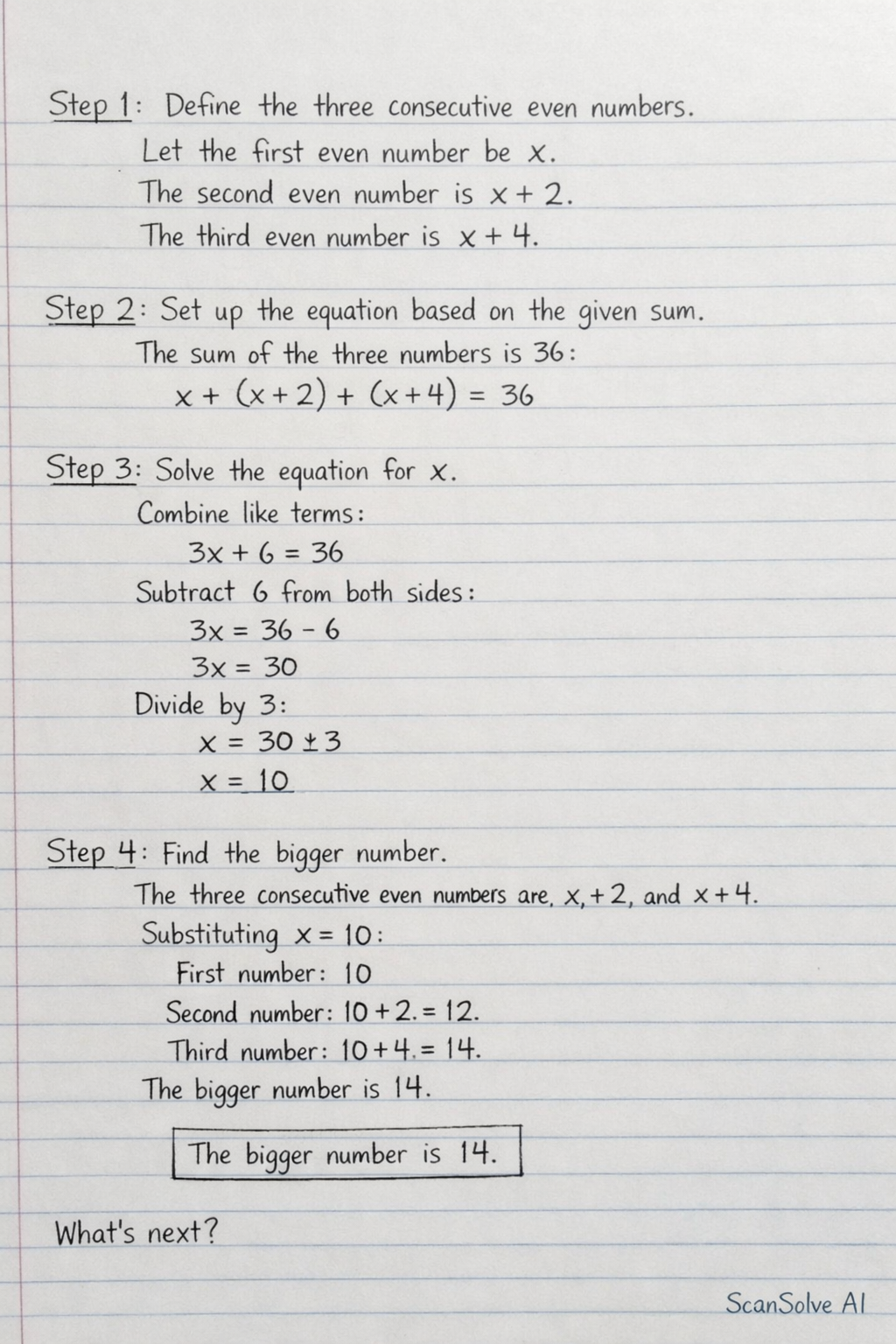
4 stepsDefine the three consecutive even numbers.
Let the first even number be .
The second consecutive even number will be .
The third consecutive even number will be .Set up the equation based on the given sum.
The sum of the three numbers is 36:
Solve the equation for .
Combine like terms:
Subtract 6 from both sides:
Divide by 3:
Find the bigger number.
The three consecutive even numbers are , , and .
Substituting :
First number: 10
Second number:
Third number:
The bigger number is 14.The bigger number is 14.
Was this helpful?
Try one yourself
A new problem that tests the same skill.
Still stuck on this one?
Ask a follow-up, and the answer starts from this question.
Got a different question?Ask your own question
More Mathematics Questions
QThe sum of two consecutive even numbers is 270. What are the two numbers?QThe sum of three consecutive even numbers is 54. If the middle number is m, find the value of m.QThe sum of three consecutive even number is 72 fine the numberQFind the third number if the sum of three numbers is 5,09,826 and two of the numbers are 1,09,678…QThe sum of three consecutive whole numbers is equal to the cube of the square root of the middle…
Handwritten Step-by-Step Solution
Get this as a handwritten image on WhatsApp — like a tutor wrote it for you.
Try on WhatsApp