
This biology question covers important biological concepts and processes. The step-by-step explanation below helps you understand the underlying mechanisms and reasoning.
ScanSolve AI Answer
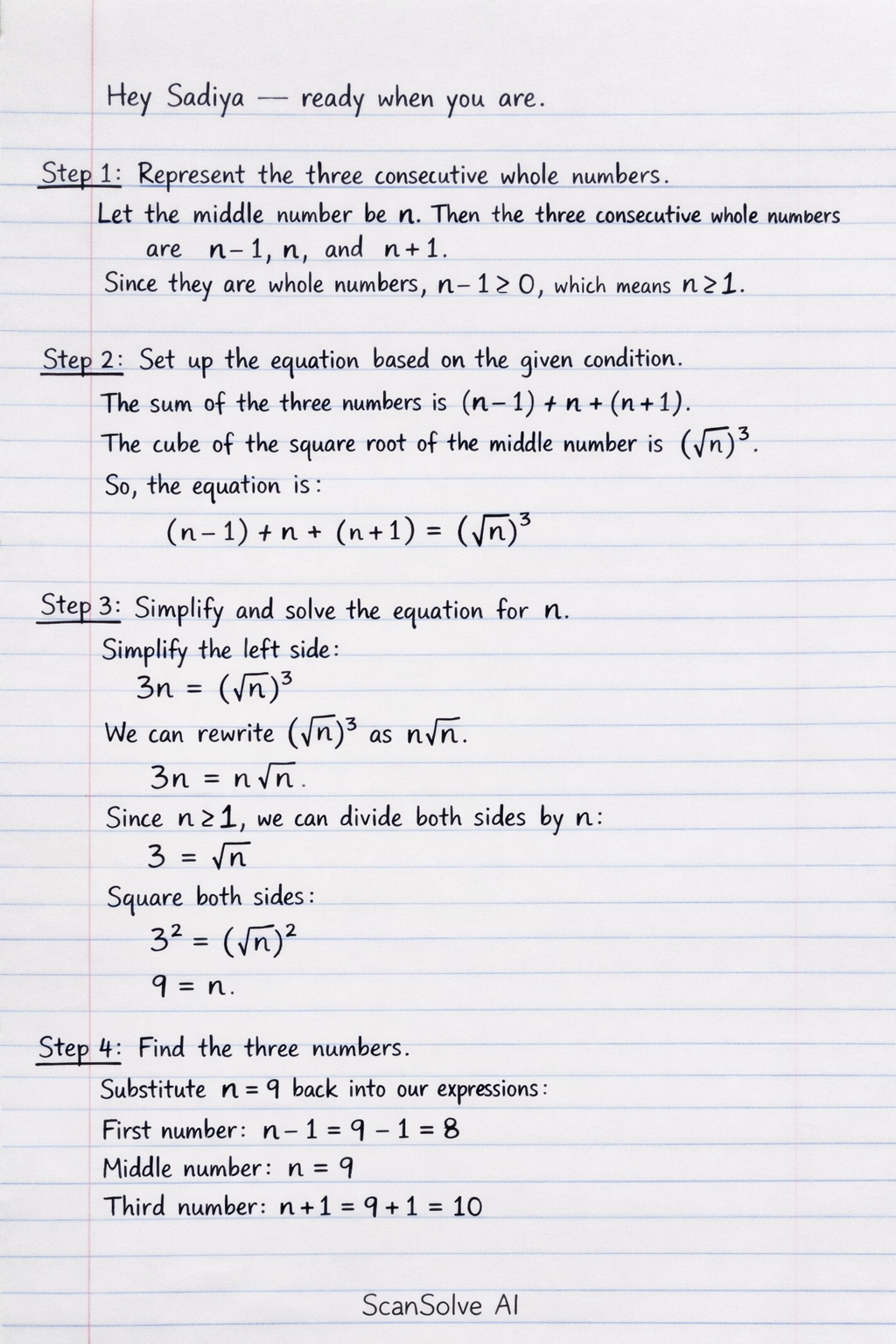
Step 1: Represent the three consecutive whole numbers. Let the middle number be n. Then the three consecutive whole numbers are n-1, n, and n+1. Since they are whole numbers, n-1 0, which means n 1. Step 2: Set up the equation based on the given condition. The sum of the three numbers is (n-1) + n + (n+1). The cube of the square root of the middle number is (sqrt(n))^3. So, the equation is: (n-1) + n + (n+1) = (sqrt(n))^3 Step 3: Simplify and solve the equation for n. Simplify the left side: 3n = (sqrt(n))^3 We can rewrite (sqrt(n))^3 as nsqrt(n). 3n = nsqrt(n) Since n 1, we can divide both sides by n: 3 = sqrt(n) Square both sides to solve for n: 3^2 = (sqrt(n))^2 9 = n Step 4: Find the three numbers. Substitute n=9 back into our expressions for the three numbers: First number: n-1 = 9-1 = 8 Middle number: n = 9 Third number: n+1 = 9+1 = 10 Step 5: Verify the solution. The three numbers are 8, 9, 10. All are whole numbers. Sum: 8+9+10 = 27. Middle number: 9. Cube of the square root of the middle number: (sqrt(9))^3 = 3^3 = 27. The sum (27) is equal to the cube of the square root of the middle number (27). The condition is satisfied. The three numbers are 8, 9, 10.