
We read your photo as:
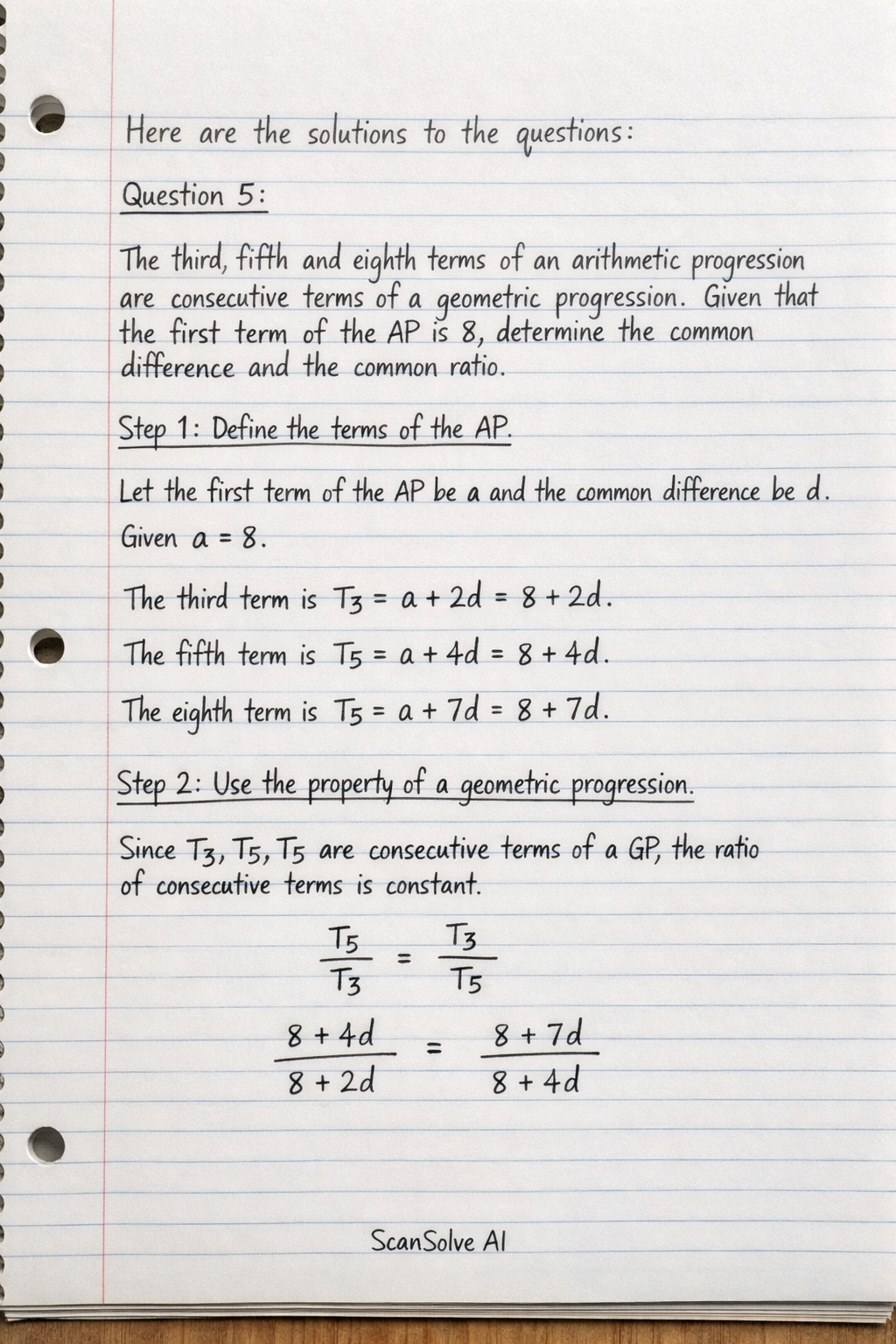
The third, fifth and eighth terms of an arithmetic progression are consecutive terms of a geometric progression. Given that the first term of the AP is 8, determine the common difference and the common ratio.
ScanSolve AI Answer
Step-by-step solution
26 stepsHere are the solutions to the questions:
Part 5· 4 steps
The third, fifth and eighth terms of an arithmetic progression are consecutive terms of a geometric progression. Given that the first term of the AP is 8, determine the common difference and the common ratio.
Define the terms of the AP.
Let the first term of the AP be and the common difference be .
Given .
The third term is .
The fifth term is .
The eighth term is .Use the property of a geometric progression.
Since are consecutive terms of a GP, the ratio of consecutive terms is constant.
Solve the equation for .
Cross-multiply:
Subtract 64 from both sides and rearrange terms:
Factor out :
This gives two possible values for :
or
.Determine the common ratio for each value of .
Case 1: If
The terms of the AP are . The GP terms are .
The common ratio .
Common difference: , Common ratio: .Case 2: If
The terms of the AP are:
The GP terms are .
The common ratio .
Common difference: , Common ratio: .
Part 6· 4 steps
Two places A and B are 900km apart on the earth surface. If A is due North of B and given that the latitude of A is . Find into 1 decimal place the latitude of B. (Take radius of earth to be 6370km).
Identify the given values and the formula for distance along a meridian.
Distance .
Radius of Earth .
Latitude of A = .
The distance along a meridian is given by the formula:where is the difference in latitude in degrees.
Calculate the difference in latitude ().
Substitute the given values into the formula:
Rearrange to solve for :
Determine the latitude of B.
Since A is due North of B, B must be South of A.
Latitude of B = Latitude of A -
Latitude of B = .
This means B is South of the equator.Round the latitude of B to 1 decimal place.
The latitude of B is .
Part 7· 5 steps
A plot costs 600000 currently. If the rate of appreciation is 15% per annum, find to the nearest whole number the number of years it will take to appreciate to Ksh. 1049404.
Identify the compound appreciation formula and given values.
The formula for compound appreciation is:
Where:
= Final amount = Ksh. 1049404
= Principal amount (current cost) = Ksh. 600000
= Annual rate of appreciation = 15% = 0.15
= Number of years (to be found)Substitute the values into the formula.
Isolate the term with .
Solve for using logarithms.
Take the logarithm of both sides:
Using a calculator:
Round to the nearest whole number.
The number of years is .
Part 8· 5 steps
A varies partly as B and partly as the square root of B. When B = 4, A = 22 and when B = 9, A = 42. Find A when B = 25.
Write down the variation equation.
The relationship can be written as:
where and are constants.
Use the given conditions to form simultaneous equations.
Condition 1: When .
Condition 2: When .
Solve the simultaneous equations for and .
From Equation 1, divide by 2:
Substitute this expression for into Equation 2:
Subtract 33 from both sides:
Now substitute back into the expression for :
Write the complete variation equation.
Substitute the values of and into the original equation:
Find A when B = 25.
Substitute into the complete variation equation:
When B = 25, A is .
Part 9· 5 steps
The floor of a rectangular room measures 4.8m by 3.2m. Estimate the percentage error in the area.
Assumption: The measurements 4.8m and 3.2m are rounded to one decimal place. This means the maximum possible error in each measurement is .
Calculate the nominal area.
Nominal length .
Nominal width .
Nominal area .Determine the maximum and minimum possible values for length and width.
Maximum length .
Minimum length .
Maximum width .
Minimum width .Calculate the maximum and minimum possible areas.
Maximum possible area .
Minimum possible area .Calculate the maximum absolute error in the area.
The maximum absolute error is the larger of and .
.
.
The maximum absolute error .Calculate the percentage error.
Percentage error =
Percentage error =Rounding to two decimal places:
The percentage error in the area is approximately .
Part 10· 3 steps
There are two grades of tea, grade A and grade B. Grade A costs Ksh. 80 per kg and grade B costs Sh. 60 per kg. In what ratio must the two be mixed in order to produce a blend worth Sh. 75 per kg.
Define variables for the quantities of each grade of tea.
Let be the quantity (in kg) of Grade A tea.
Let be the quantity (in kg) of Grade B tea.Set up an equation based on the total cost and total quantity.
Cost of kg of Grade A tea = .
Cost of kg of Grade B tea = .
Total cost of the mixture = .
Total quantity of the mixture = .
The desired price of the blend is Sh. 75 per kg.
So, the average cost per kg is 75:Solve the equation for the ratio .
Multiply both sides by :
Rearrange the terms to group terms and terms:
Divide both sides by to find the ratio :
The ratio of Grade A to Grade B is .
Still stuck on this one?
Ask a follow-up, and the answer starts from this question.
More Mathematics Questions
Handwritten Step-by-Step Solution
Get this as a handwritten image on WhatsApp — like a tutor wrote it for you.
Try on WhatsApp