
We read your photo as:
If the 5th, 9th, and 16th terms of an arithmetic progression are also consecutive terms of a geometric progression, find the common ratio of the geometric progression.
ScanSolve AI Answer
Answer
Step-by-step solution
4 stepsApply the property of a Geometric Progression (GP).
If , , and are consecutive terms of a GP, then the square of the middle term equals the product of the first and third terms.
Substitute the expressions for , , and :
Expand both sides of the equation.
Simplify the equation to find the relationship between and .
Subtract from both sides:
Rearrange the terms to one side:
Since cannot be zero (otherwise all terms of the AP would be the same, and thus the GP terms would also be the same, leading to a common ratio of 1, which is a trivial case and usually not what's intended in such problems), we can divide both sides by :
Express in terms of :
Calculate the common ratio of the GP.
The common ratio of the GP is given by .
Substitute into the expression for :
To simplify, find a common denominator for the terms in the numerator and denominator:
Multiply by the reciprocal of the denominator:
Cancel out 3 and :
Simplify the fraction by dividing both numerator and denominator by their greatest common divisor, which is 4:
The common ratio of the GP is .
Try one yourself
A new problem that tests the same skill.
Still stuck on this one?
Ask a follow-up, and the answer starts from this question.
More Mathematics Questions
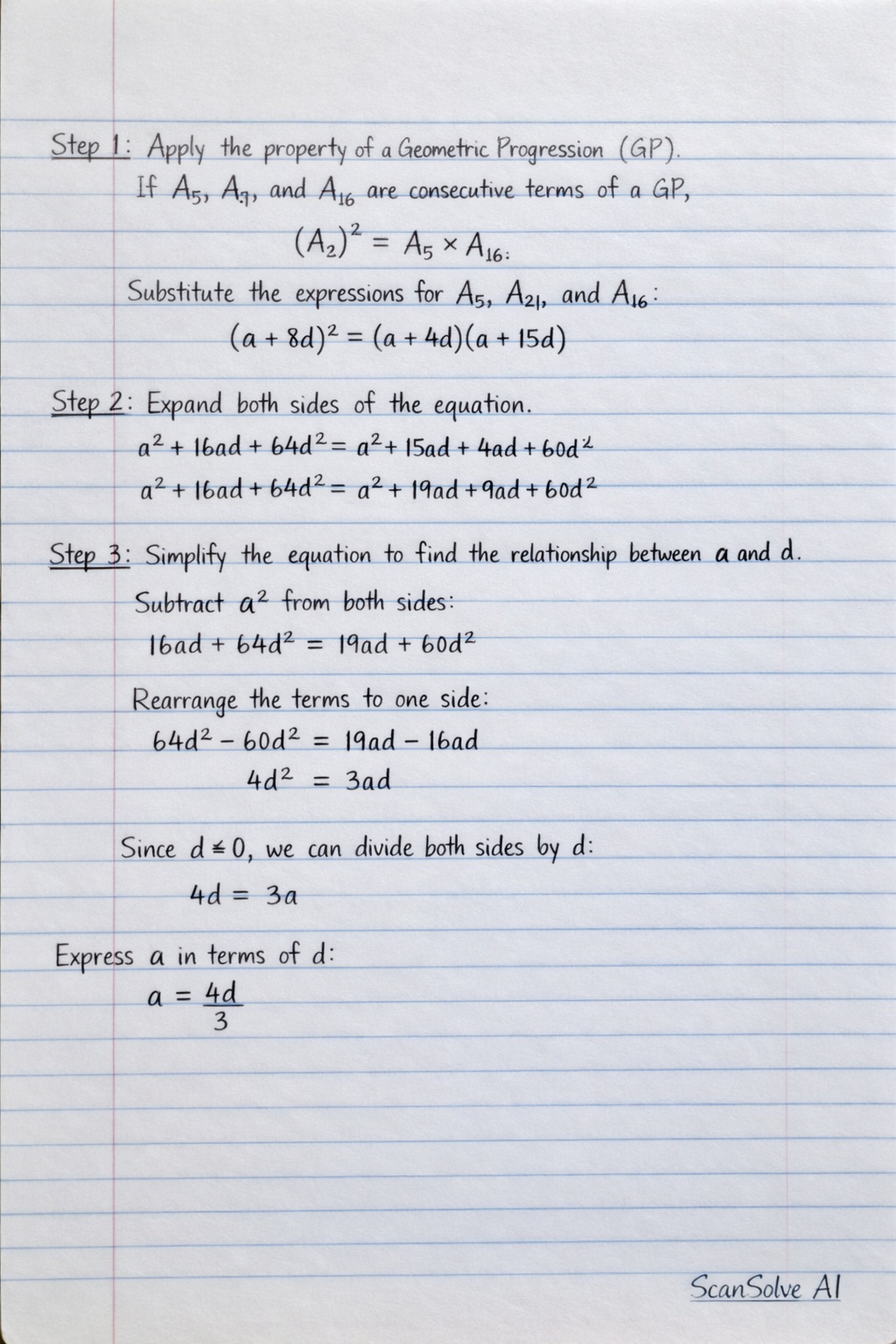
Handwritten Step-by-Step Solution
Get this as a handwritten image on WhatsApp — like a tutor wrote it for you.
Try on WhatsApp