We read your photo as:

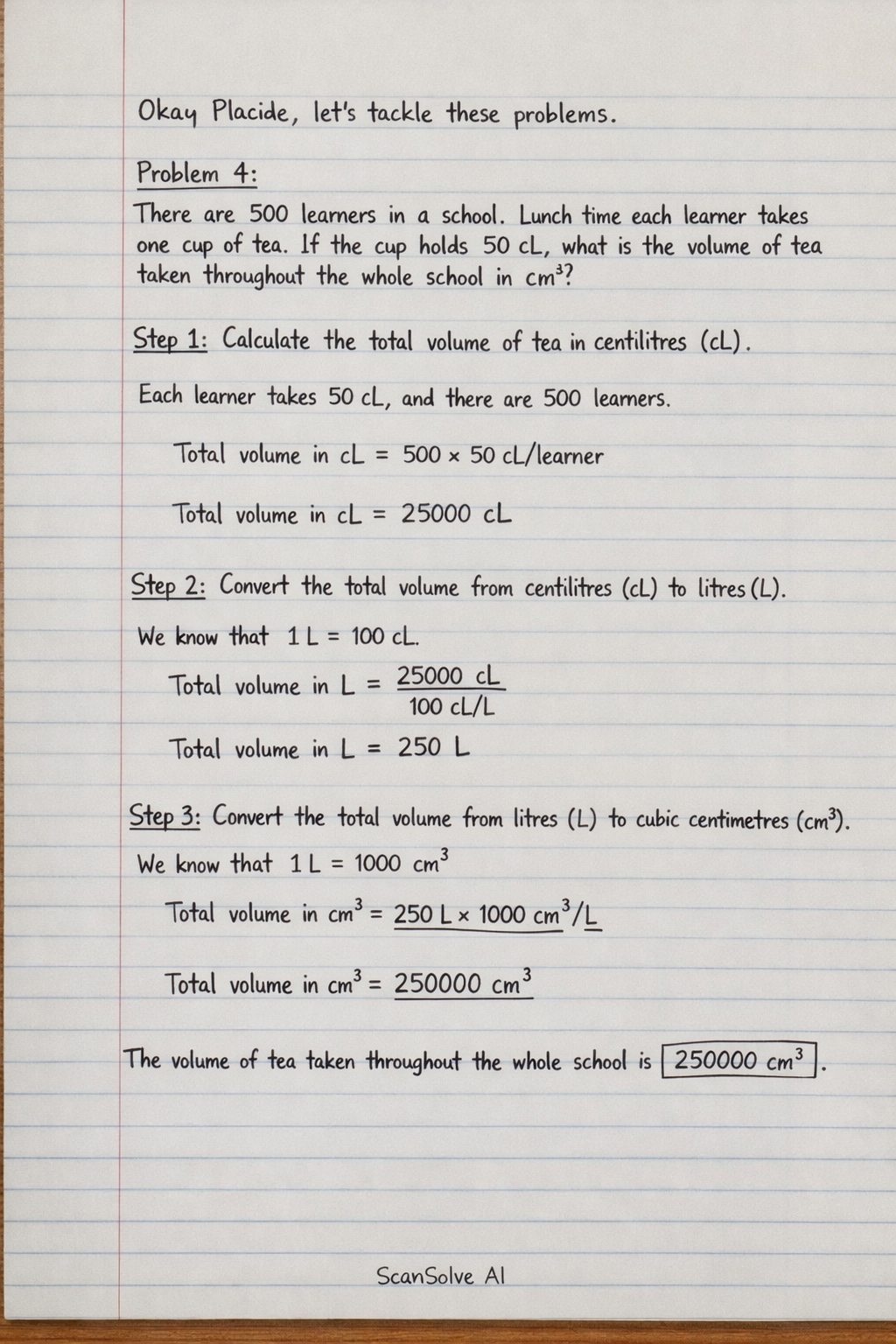
There are 500 learners in a school. Lunch time each learner takes one cup of tea. If the cup holds 50 cL, what is the volume of tea taken throughout the whole school in cm³?

Mathematics

ScanSolve AI Answer

Step-by-step solution

9 steps

Okay Placide, let's tackle these problems.

:
There are 500 learners in a school. Lunch time each learner takes one cup of tea. If the cup holds 50 cL, what is the volume of tea taken throughout the whole school in cm³?

  1. Calculate the total volume of tea in centilitres (cL).

    Each learner takes 50 cL, and there are 500 learners.

    Total volume in cL=500 learners×50 cL/learner\text{Total volume in cL} = 500 \text{ learners} \times 50 \text{ cL/learner} Total volume in cL=25000 cL\text{Total volume in cL} = 25000 \text{ cL}
  2. Convert the total volume from centilitres (cL) to litres (L).

    We know that 1 L=100 cL1 \text{ L} = 100 \text{ cL}.

    Total volume in L=25000 cL100 cL/L\text{Total volume in L} = \frac{25000 \text{ cL}}{100 \text{ cL/L}} Total volume in L=250 L\text{Total volume in L} = 250 \text{ L}
  3. Convert the total volume from litres (L) to cubic centimetres (cm³).

    We know that 1 L=1000 cm31 \text{ L} = 1000 \text{ cm}^3.

    Total volume in cm3=250 L×1000 cm3/L\text{Total volume in cm}^3 = 250 \text{ L} \times 1000 \text{ cm}^3/\text{L} Total volume in cm3=250000 cm3\text{Total volume in cm}^3 = 250000 \text{ cm}^3

    The volume of tea taken throughout the whole school is 250000 cm3\boxed{250000 \text{ cm}^3}.

    :
    How many cubic centimetres make up a litre?

    This is a standard conversion factor.

    1 litre=1000 cubic centimetres1 \text{ litre} = 1000 \text{ cubic centimetres}

    1000 cm3\boxed{1000 \text{ cm}^3} make up a litre.

    :
    5 jerrycans full of water weigh 109 kg. Each of the empty jerrycans weighs 1,800 g.
    (The question is incomplete, but based on similar problems, we will find the mass of water in one jerrycan and its volume, and the mass of one full jerrycan.)

  4. Convert the mass of one empty jerrycan from grams (g) to kilograms (kg).

    We know that 1 kg=1000 g1 \text{ kg} = 1000 \text{ g}.

    Mass of one empty jerrycan=1800 g×1 kg1000 g\text{Mass of one empty jerrycan} = 1800 \text{ g} \times \frac{1 \text{ kg}}{1000 \text{ g}} Mass of one empty jerrycan=1.8 kg\text{Mass of one empty jerrycan} = 1.8 \text{ kg}
  5. Calculate the total mass of 5 empty jerrycans.

    Total mass of empty jerrycans=5×1.8 kg\text{Total mass of empty jerrycans} = 5 \times 1.8 \text{ kg} Total mass of empty jerrycans=9 kg\text{Total mass of empty jerrycans} = 9 \text{ kg}
  6. Calculate the total mass of water in 5 jerrycans.

    Total mass of water=Mass of 5 full jerrycans−Mass of 5 empty jerrycans\text{Total mass of water} = \text{Mass of 5 full jerrycans} - \text{Mass of 5 empty jerrycans} Total mass of water=109 kg−9 kg\text{Total mass of water} = 109 \text{ kg} - 9 \text{ kg} Total mass of water=100 kg\text{Total mass of water} = 100 \text{ kg}
  7. Calculate the mass of water in one jerrycan.

    Mass of water per jerrycan=100 kg5\text{Mass of water per jerrycan} = \frac{100 \text{ kg}}{5} Mass of water per jerrycan=20 kg\text{Mass of water per jerrycan} = 20 \text{ kg}
  8. Calculate the volume of water in one jerrycan.

    Assuming the density of water is 1 kg/L1 \text{ kg/L}:

    Volume of water per jerrycan=20 kg×1 L1 kg\text{Volume of water per jerrycan} = 20 \text{ kg} \times \frac{1 \text{ L}}{1 \text{ kg}} Volume of water per jerrycan=20 L\text{Volume of water per jerrycan} = 20 \text{ L}
  9. Calculate the mass of one full jerrycan.

    Mass of one full jerrycan=Mass of one empty jerrycan+Mass of water per jerrycan\text{Mass of one full jerrycan} = \text{Mass of one empty jerrycan} + \text{Mass of water per jerrycan} Mass of one full jerrycan=1.8 kg+20 kg\text{Mass of one full jerrycan} = 1.8 \text{ kg} + 20 \text{ kg} Mass of one full jerrycan=21.8 kg\text{Mass of one full jerrycan} = 21.8 \text{ kg}

    For :
    Mass of water in one jerrycan: 20 kg\boxed{20 \text{ kg}}
    Volume of water in one jerrycan: 20 L\boxed{20 \text{ L}}
    Mass of one full jerrycan: 21.8 kg\boxed{21.8 \text{ kg}}

Was this helpful?

Still stuck on this one?

Ask a follow-up, and the answer starts from this question.

Got a different question?Ask your own question
Handwritten step-by-step solution preview

Handwritten Step-by-Step Solution

Get this as a handwritten image on WhatsApp — like a tutor wrote it for you.

Try on WhatsApp