
We read your photo as:
If 23 pupils did not pass maths, find the value of y. Find the probability of picking up at a random a pupil who like both subjects. A tea girl prepared milk tea in such a way that milk was 20% more than water. If was 12 litre only in the tea, how much tea was prepared?
ScanSolve AI Answer
This answer stops before the end.
It was cut off when it was first written. Ask ScanSolve this question again for the full working.
Step-by-step solution
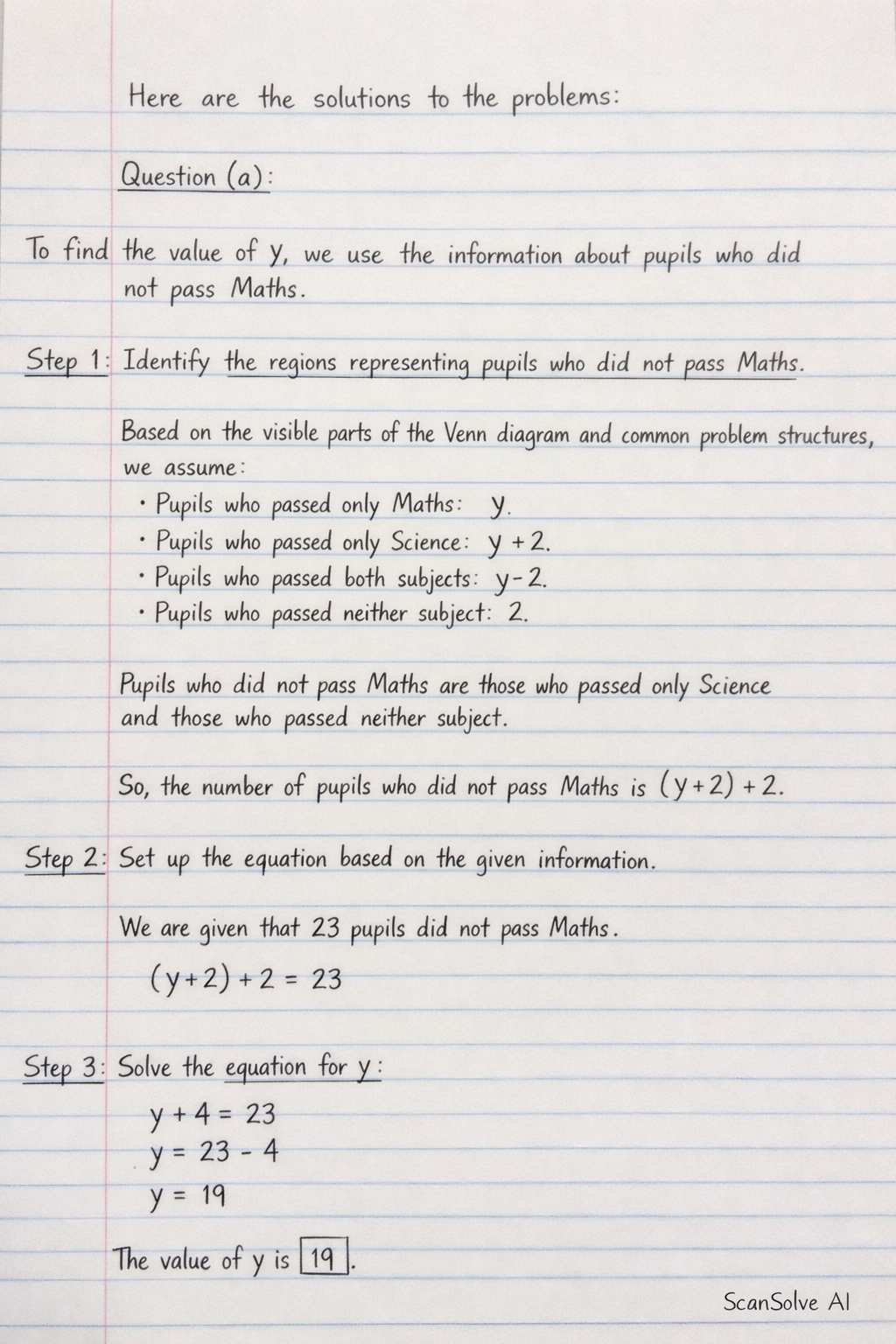
9 stepsHere are the solutions to the problems:
Part a· 3 steps
To find the value of , we use the information about pupils who did not pass Maths.
Identify the regions representing pupils who did not pass Maths.
Based on the visible parts of the Venn diagram and common problem structures, we assume:
- Pupils who passed only Maths:
- Pupils who passed only the other subject (let's call it Science):
- Pupils who passed both subjects:
- Pupils who passed neither subject: 2 Pupils who did not pass Maths are those who passed only Science and those who passed neither subject. So, the number of pupils who did not pass Maths is .
Set up the equation based on the given information.
We are given that 23 pupils did not pass Maths.
Solve the equation for .
The value of is .
Part b· 6 steps
To find the probability of picking a pupil who likes both subjects, we need the number of pupils who like both and the total number of pupils.
Calculate the number of pupils who like both subjects.
The number of pupils who like both subjects is represented by .
Substitute the value of :Calculate the total number of pupils.
The total number of pupils is the sum of all regions in the Venn diagram:
Substitute :
Calculate the probability.
The probability is the ratio of pupils who like both subjects to the total number of pupils.
The probability is .
Question (Tea Problem):
To find the total amount of tea prepared, we need to calculate the amount of milk and then add it to the amount of water.Identify the given amount of water and the relationship between milk and water.
Amount of water () = .
Milk () was 20% more than water, which can be expressed as .Calculate the amount of milk.
Calculate the total amount of tea prepared.
The total amount of tea is the sum of the
Still stuck on this one?
Ask a follow-up, and the answer starts from this question.
More Mathematics Questions
Handwritten Step-by-Step Solution
Get this as a handwritten image on WhatsApp — like a tutor wrote it for you.
Try on WhatsApp