This mathematics problem involves applying core mathematical principles and formulas. Below you will find a complete step-by-step solution with detailed explanations for each step, helping you understand not just the answer but the method behind it.
ScanSolve AI Answer
Here's a step-by-step solution to the complex number problem:
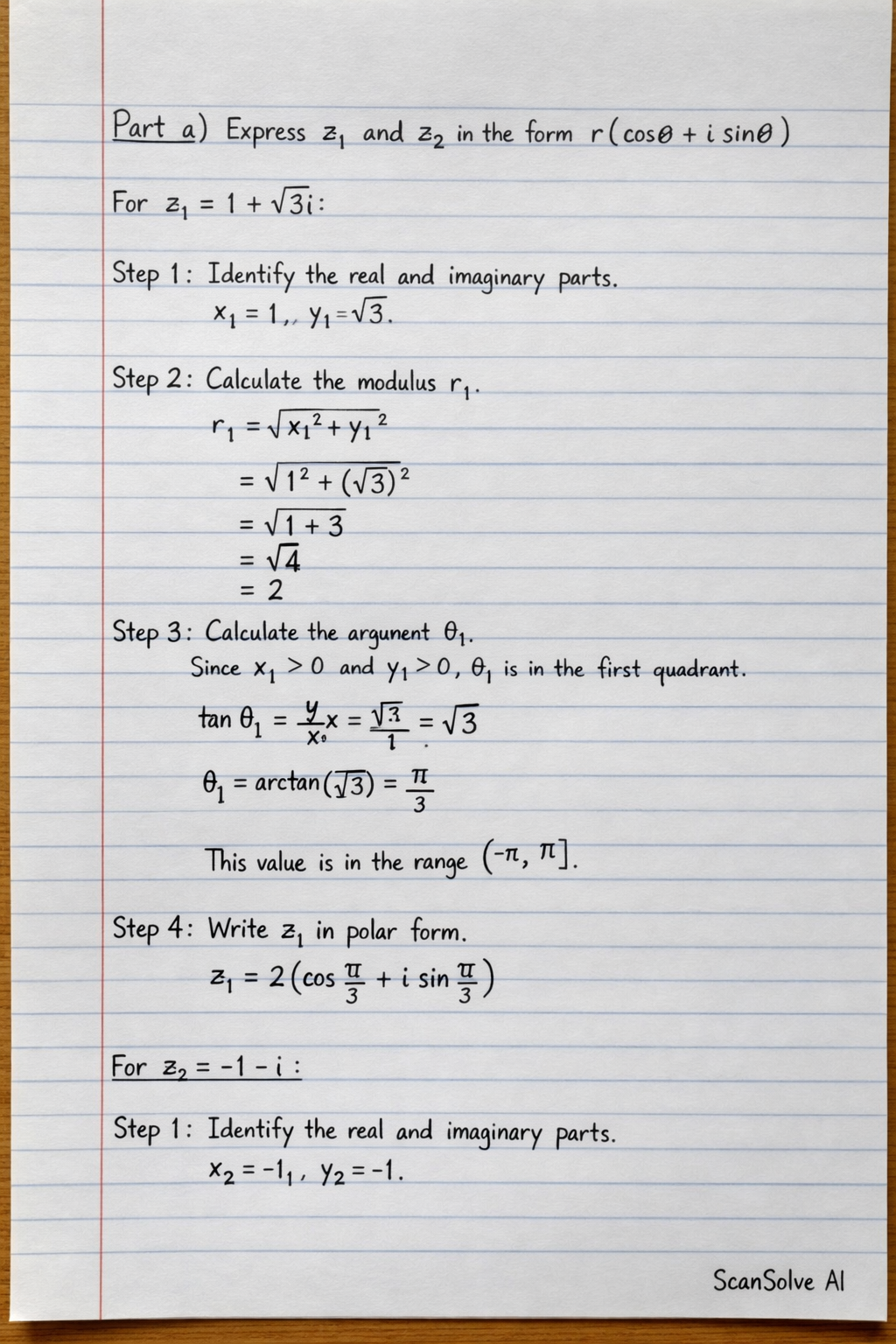
Part a) Express $z_1$ and $z_2$ in the form $r(\cos\theta + i\sin\theta)$
For a complex number $z = x + yi$, its polar form is $z = r(\cos\theta + i\sin\theta)$, where $r = \sqrt{x^2 + y^2}$ and $\theta = \arctan\left(\frac{y}{x}\right)$ adjusted for the correct quadrant, such that $-\pi < \theta \le \pi$.
For $z_1 = 1 + \sqrt{3}i$:
Step 1: Identify the real and imaginary parts.
$x_1 = 1$, $y_1 = \sqrt{3}$.
Step 2: Calculate the modulus $r_1$.
$$r_1 = \sqrt{x_1^2 + y_1^2} = \sqrt{1^2 + (\sqrt{3})^2} = \sqrt{1 + 3} = \sqrt{4} = 2$$
Step 3: Calculate the argument $\theta_1$.
Since $x_1 > 0$ and $y_1 > 0$, $\theta_1$ is in the first quadrant.
$$\tan\theta_1 = \frac{y_1}{x_1} = \frac{\sqrt{3}}{1} = \sqrt{3}$$
$$\theta_1 = \arctan(\sqrt{3}) = \frac{\pi}{3}$$
This value is in the range $(-\pi, \pi]$.
Step 4: Write $z_1$ in polar form.
$$z_1 = 2\left(\cos\frac{\pi}{3} + i\sin\frac{\pi}{3}\right)$$
For $z_2 = -1 - i$:
Step 1: Identify the real and imaginary parts.
$x_2 = -1$, $y_2 = -1$.
Step 2: Calculate the modulus $r_2$.
$$r_2 = \sqrt{x_2^2 + y_2^2} = \sqrt{(-1)^2 + (-1)^2} = \sqrt{1 + 1} = \sqrt{2}$$
Step 3: Calculate the argument $\theta_2$.
Since $x_2 < 0$ and $y_2 < 0$, $\theta_2$ is in the third quadrant.
$$\tan\theta_2 = \frac{y_2}{x_2} = \frac{-1}{-1} = 1$$
The reference angle is $\frac{\pi}{4}$. For the third quadrant, $\theta_2 = -\left(\pi - \frac{\pi}{4}\right) = -\frac{3\pi}{4}$.
This value is in the range $(-\pi, \pi]$.
Step 4: Write $z_2$ in polar form.
$$z_2 = \sqrt{2}\left(\cos\left(-\frac{3\pi}{4}\right) + i\sin\left(-\frac{3\pi}{4}\right)\right)$$
Part b) Evaluate $\left|\frac{z_1}{z_2}\right|^3$ and $\arg\left(\frac{z_1}{z_2}\right)^3$
Step 1: Find the polar form of $\frac{z_1}{z_2}$.
If $z_1 = r_1(\cos\theta_1 + i\sin\theta_1)$ and $z_2 = r_2(\cos\theta_2 + i\sin\theta_2)$, then
$$\frac{z_1}{z_2} = \frac{r_1}{r_2}(\cos(\theta_1 - \theta_2) + i\sin(\theta_1 - \theta_2))$$
Substitute the values from part a):
$$\frac{r_1}{r_2} = \frac{2}{\sqrt{2}} = \sqrt{2}$$
$$\theta_1 - \theta_2 = \frac{\pi}{3} - \left(-\frac{3\pi}{4}\right) = \frac{\pi}{3} + \frac{3\pi}{4} = \frac{4\pi + 9\pi}{12} = \frac{13\pi}{12}$$
So,
$$\frac{z_1}{z_2} = \sqrt{2}\left(\cos\left(\frac{13\pi}{12}\right) + i\sin\left(\frac{13\pi}{12}\right)\right)$$
Step 2: Evaluate $\left|\frac{z_1}{z_2}\right|^3$.
Using De Moivre's Theorem, if $Z = r(\cos\theta + i\sin\theta)$, then $|Z^n| = r^n$.
Here, $Z = \frac{z_1}{z_2}$, so $r = \sqrt{2}$ and $n=3$.
$$\left|\frac{z_1}{z_2}\right|^3 = (\sqrt{2})^3 = 2\sqrt{2}$$
Step 3: Evaluate $\arg\left(\frac{z_1}{z_2}\right)^3$.
Using De Moivre's Theorem, $\arg(Z^n) = n\theta$.
Here, $\theta = \frac{13\pi}{12}$ and $n=3$.
$$\arg\left(\frac{z_1}{z_2}\right)^3 = 3 \times \frac{13\pi}{12} = \frac{13\pi}{4}$$
The argument must be in the range $(-\pi, \pi]$. We adjust $\frac{13\pi}{4}$ by subtracting multiples of $2\pi$:
$$\frac{13\pi}{4} - 2\pi = \frac{13\pi - 8\pi}{4} = \frac{5\pi}{4}$$
Since $\frac{5\pi}{4} > \pi$, we subtract $2\pi$ again:
$$\frac{5\pi}{4} - 2\pi = \frac{5\pi - 8\pi}{4} = -\frac{3\pi}{4}$$
This value is in the range $(-\pi, \pi
There we go with the first question on complex number ππ½ππ½
|Mathematics
There we go with the first question on complex number ππ½ππ½
ScanSolve AI Answer
Here's a step-by-step solution to the complex number problem:
Part a) Express z1β and z2β in the form r(cosΞΈ+isinΞΈ)
For a complex number z=x+yi, its polar form is z=r(cosΞΈ+isinΞΈ), where r=x2+y2β and ΞΈ=arctan(xyβ) adjusted for the correct quadrant, such that βΟ<ΞΈβ€Ο.
For z1β=1+3βi:
Step 1: Identify the real and imaginary parts.
x1β=1, y1β=3β.
Step 2: Calculate the modulus r1β.
r1β=x12β+y12ββ=12+(3β)2β=1+3β=4β=2
Step 3: Calculate the argument ΞΈ1β.
Since x1β>0 and y1β>0, ΞΈ1β is in the first quadrant.
tanΞΈ1β=x1βy1ββ=13ββ=3βΞΈ1β=arctan(3β)=3Οβ
This value is in the range (βΟ,Ο].
Step 4: Write z1β in polar form.
z1β=2(cos3Οβ+isin3Οβ)
For z2β=β1βi:
Step 1: Identify the real and imaginary parts.
x2β=β1, y2β=β1.
Step 2: Calculate the modulus r2β.
r2β=x22β+y22ββ=(β1)2+(β1)2β=1+1β=2β
Step 3: Calculate the argument ΞΈ2β.
Since x2β<0 and y2β<0, ΞΈ2β is in the third quadrant.
tanΞΈ2β=x2βy2ββ=β1β1β=1
The reference angle is 4Οβ. For the third quadrant, ΞΈ2β=β(Οβ4Οβ)=β43Οβ.
This value is in the range (βΟ,Ο].
Step 4: Write z2β in polar form.
z2β=2β(cos(β43Οβ)+isin(β43Οβ))
Part b) Evaluate βz2βz1βββ3 and arg(z2βz1ββ)3
Step 1: Find the polar form of z2βz1ββ.
If z1β=r1β(cosΞΈ1β+isinΞΈ1β) and z2β=r2β(cosΞΈ2β+isinΞΈ2β), then
z2βz1ββ=r2βr1ββ(cos(ΞΈ1ββΞΈ2β)+isin(ΞΈ1ββΞΈ2β))
Substitute the values from part a):
r2βr1ββ=2β2β=2βΞΈ1ββΞΈ2β=3Οββ(β43Οβ)=3Οβ+43Οβ=124Ο+9Οβ=1213Οβ
So,
z2βz1ββ=2β(cos(1213Οβ)+isin(1213Οβ))
Step 2: Evaluate βz2βz1βββ3.
Using De Moivre's Theorem, if Z=r(cosΞΈ+isinΞΈ), then β£Znβ£=rn.
Here, Z=z2βz1ββ, so r=2β and n=3.
βz2βz1βββ3=(2β)3=22β
Step 3: Evaluate arg(z2βz1ββ)3.
Using De Moivre's Theorem, arg(Zn)=nΞΈ.
Here, ΞΈ=1213Οβ and n=3.
arg(z2βz1ββ)3=3Γ1213Οβ=413Οβ
The argument must be in the range (βΟ,Ο]. We adjust 413Οβ by subtracting multiples of 2Ο:
413Οββ2Ο=413Οβ8Οβ=45Οβ
Since 45Οβ>Ο, we subtract 2Ο again:
45Οββ2Ο=45Οβ8Οβ=β43Οβ
This value is in the range $(-\pi, \pi
Need help with your own homework?
Get instant step-by-step solutions to any question. Free to start.