

This mathematics problem involves applying core mathematical principles and formulas. Below you will find a complete step-by-step solution with detailed explanations for each step, helping you understand not just the answer but the method behind it.
ScanSolve AI Answer
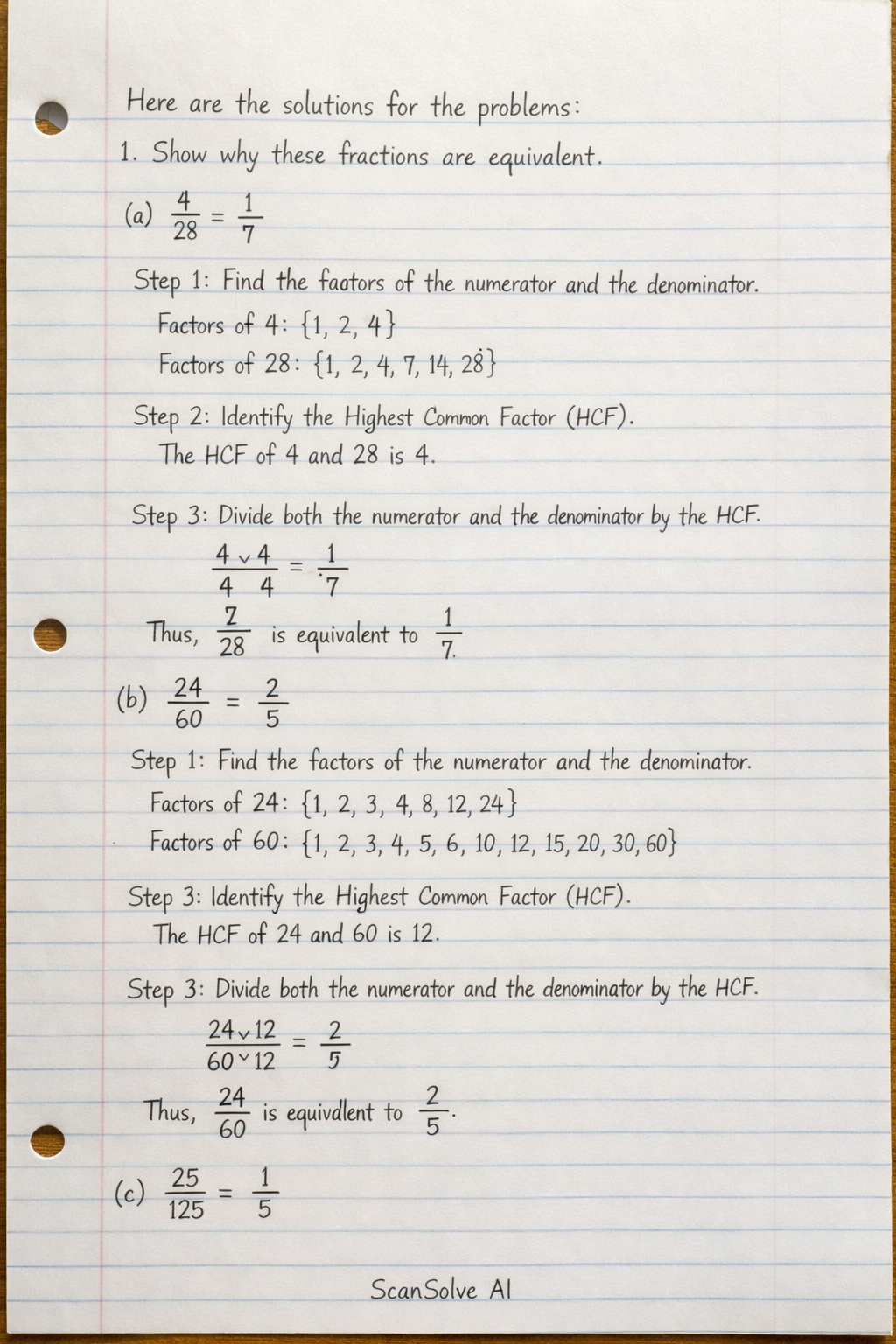
Here are the solutions for the problems: 1. Show why these fractions are equivalent. a) (4)/(28) = (1)/(7) Step 1: Find the factors of the numerator and the denominator. Factors of 4: \1, 2, 4\ Factors of 28: \1, 2, 4, 7, 14, 28\ Step 2: Identify the Highest Common Factor (HCF). The HCF of 4 and 28 is 4. Step 3: Divide both the numerator and the denominator by the HCF. (4 ÷ 4)/(28 ÷ 4) = (1)/(7) Thus, (4)/(28) is equivalent to (1)/(7). b) (24)/(60) = (2)/(5) Step 1: Find the factors of the numerator and the denominator. Factors of 24: \1, 2, 3, 4, 6, 8, 12, 24\ Factors of 60: \1, 2, 3, 4, 5, 6, 10, 12, 15, 20, 30, 60\ Step 2: Identify the Highest Common Factor (HCF). The HCF of 24 and 60 is 12. Step 3: Divide both the numerator and the denominator by the HCF. (24 ÷ 12)/(60 ÷ 12) = (2)/(5) Thus, (24)/(60) is equivalent to (2)/(5). c) (25)/(125) = (1)/(5) Step 1: Find the factors of the numerator and the denominator. Factors of 25: \1, 5, 25\ Factors of 125: \1, 5, 25, 125\ Step 2: Identify the Highest Common Factor (HCF). The HCF of 25 and 125 is 25. Step 3: Divide both the numerator and the denominator by the HCF. (25 ÷ 25)/(125 ÷ 25) = (1)/(5) Thus, (25)/(125) is equivalent to (1)/(5). 2. Calculate and simplify fractions that are multiples of each other. a) (2)/(4) + (7)/(8) - (1)/(6) Step 1: Find the Least Common Multiple (LCM) of the denominators 4, 8, and 6. Multiples of 4: 4, 8, 12, 16, 20, 24, ... Multiples of 8: 8, 16, 24, ... Multiples of 6: 6, 12, 18, 24, ... The LCM of 4, 8, and 6 is 24. Step 2: Convert each fraction to an equivalent fraction with a denominator of 24. (2)/(4) = (2 × 6)/(4 × 6) = (12)/(24) (7)/(8) = (7 × 3)/(8 × 3) = (21)/(24) (1)/(6) = (1 × 4)/(6 × 4) = (4)/(24) Step 3: Perform the addition and subtraction. (12)/(24) + (21)/(24) - (4)/(24) = (12 + 21 - 4)/(24) = (33 - 4)/(24) = (29)/(24) Step 4: Convert the improper fraction to a mixed number. (29)/(24) = 1 (5)/(24) The simplified answer is 1 (5)/(24). b) (9)/(10) - (3)/(5) - (2)/(8) + (7)/(8) Step 1: Find the Least Common Multiple (LCM) of the denominators 10, 5, and 8. Multiples of 10: 10, 20, 30, 40, ... Multiples of 5: 5, 10, 15, 20, 25, 30, 35, 40, ... Multiples of 8: 8, 16, 24, 32, 40, ... The LCM of 10, 5, and 8 is 40. Step 2: Convert each fraction to an equivalent fraction with a denominator of 40. (9)/(10) = (9 × 4)/(10 × 4) = (36)/(40) (3)/(5) = (3 × 8)/(5 × 8) = (24)/(40) (2)/(8) = (2 × 5)/(8 × 5) = (10)/(40) (7)/(8) = (7 × 5)/(8 × 5) = (35)/(40) Step 3: Perform the addition and subtraction. (36)/(40) - (24)/(40) - (10)/(40) + (35)/(40) = (36 - 24 - 10 + 35)/(40) = (12 - 10 + 35)/(40) = (2 + 35)/(40) = (37)/(40) The simplified answer is (37)/(40). c) (2)/(6) + (5)/(12) + (1)/(12) Step 1: Find the Least Common Multiple (LCM) of the denominators 6 and 12. Multiples of 6: 6, 12, ... Multiples of 12: 12, ... The LCM of 6 and 12 is 12. Step 2: Convert the fraction (2)/(6) to an equivalent fraction with a denominator of 12. (2)/(6) = (2 × 2)/(6 × 2) = (4)/(12) The other fractions already have a denominator of 12. Step 3: Perform the addition. (4)/(12) + (5)/(12) + (1)/(12) = (4 + 5 + 1)/(12) = (10)/(12) Step 4: Simplify the fraction by dividing the numerator and denominator by their HCF. The HCF of 10 and 12 is 2. (10 ÷ 2)/(12 ÷ 2) = (5)/(6) The simplified answer is (5)/(6). That's 2 down. 3 left today — send the next one.