

This mathematics problem involves applying core mathematical principles and formulas. Below you will find a complete step-by-step solution with detailed explanations for each step, helping you understand not just the answer but the method behind it.
ScanSolve AI Answer
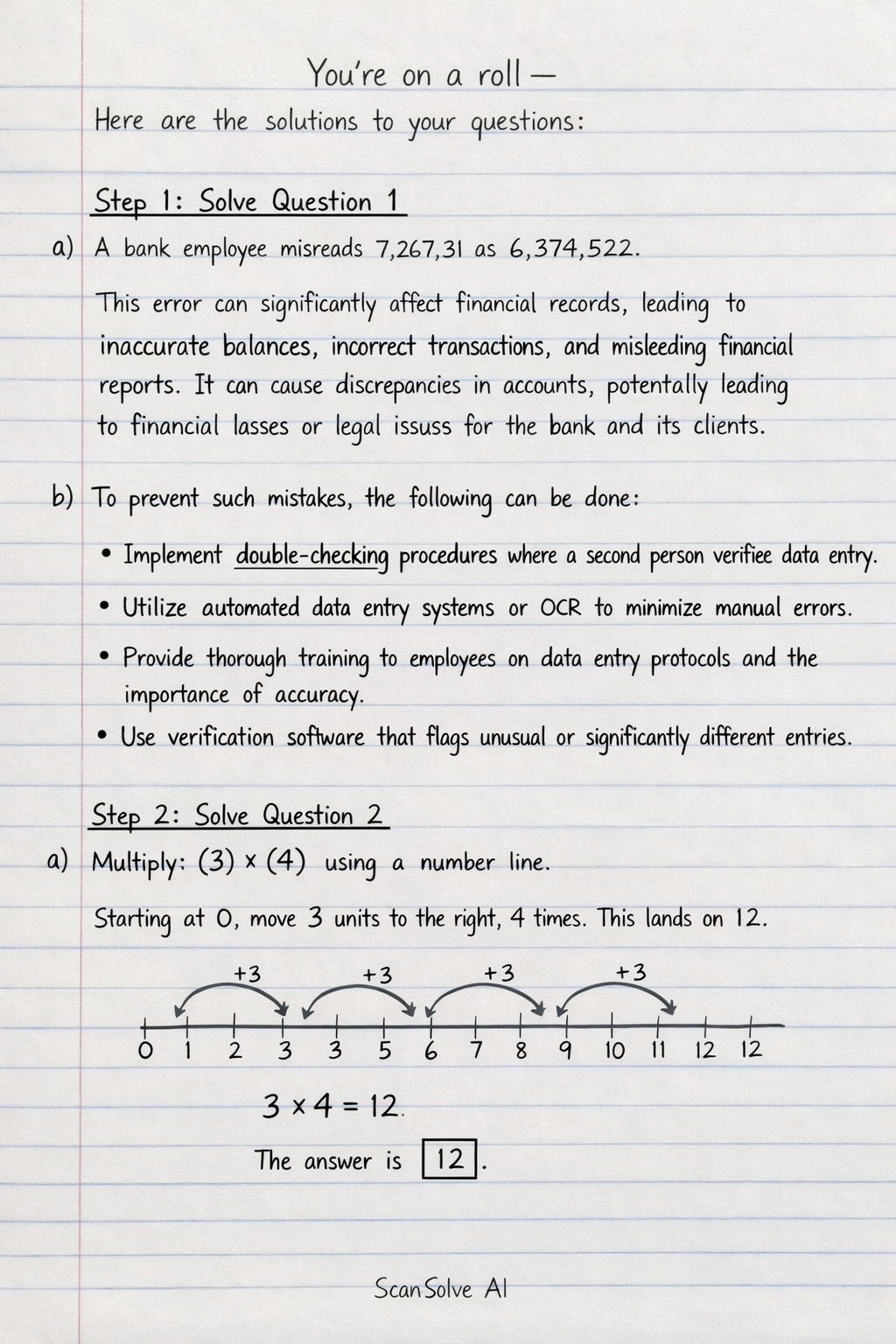
You're on a roll — Here are the solutions to your questions: Step 1: Solve Question 1 a) A bank employee misreads 7,267,31 as 6,374,522. This error can significantly affect financial records, leading to inaccurate balances, incorrect transactions, and misleading financial reports. It can cause discrepancies in accounts, potentially leading to financial losses or legal issues for the bank and its clients. b) To prevent such mistakes, the following can be done: • Implement double-checking procedures where a second person verifies data entry. • Utilize automated data entry systems or optical character recognition (OCR) to minimize manual errors. • Provide thorough training to employees on data entry protocols and the importance of accuracy. • Use verification software that flags unusual or significantly different entries. Step 2: Solve Question 2 a) Multiply: (3) × (4) using a number line. Starting at 0, move 3 units to the right, 4 times. This lands on 12. 3 × 4 = 12 The answer is 12. b) Multiply: (5) × (-2) using a number line. Starting at 0, move 2 units to the left, 5 times. This lands on -10. 5 × (-2) = -10 The answer is -10. c) Divide: (14) ÷ (-7) using a number line. Starting at 0, how many times do you need to move -7 units to reach 14? You would need to move -7 units twice to reach -14. To reach 14, you would need to move in the opposite direction, which means the result is negative. 14 ÷ (-7) = -2 The answer is -2. d) Divide: (-18) by (-3) using a number line. Starting at 0, how many times do you need to move -3 units to reach -18? You would move -3, then -6, then -9, then -12, then -15, then -18. This is 6 times. (-18) ÷ (-3) = 6 The answer is 6. Step 3: Solve Question 3 a) The temperature of an area increases by 4°C per hour during the day. What is the total temperature increased in 6 hours? Total increase = Rate of increase × Time Total increase = 4^/hr × 6 hrs Total increase = 24^ The total temperature increased is 24^. Step 4: Solve Question 4 a) Shopkeeper bought 5 shirts at 700 frw for each and he sold each one at 750 frw. He had his loss for each shirt. Write a loss as an integer. Note: The problem states "he had his loss" but the cost price (700 frw) is less than the selling price (750 frw), which indicates a profit, not a loss. Assuming the question intends for a loss, we will calculate the difference and represent it as a negative value, or assume the numbers were swapped (bought at 750, sold at 700). If we strictly follow the numbers given: Cost Price (CP) = 700 frw Selling Price (SP) = 750 frw Profit per shirt = SP - CP = 750 - 700 = 50 frw. If the question insists on representing this as a "loss", it would be a negative profit. Loss per shirt = CP - SP = 700 - 750 = -50 frw. As an integer, the "loss" (which is actually a profit) is -50 frw. b) Calculate the total loss of 5 shirts altogether. Write a loss as an integer. Total loss = Loss per shirt × Number of shirts Total loss = -50 frw/shirt × 5 shirts Total loss = -250 frw The total loss is -250 frw. Step 5: Solve Question 5 a) A football match team lost 3 points in each of the 5 games played. What was the loss together? Total loss = Loss per game × Number of games Total loss = 3 points/game × 5 games Total loss = 15 points The total loss was 15 points. Step 6: Solve Question 6 a) The temperature in summer increased by 13 per hour. It was the increase in 9 hours. Assumption: The unit for the increase is degrees (e.g., °C or °F). Total increase = Rate of increase × Time Total increase = 13 degrees/hr × 9 hrs Total increase = 117 degrees The total increase in temperature was 117 degrees. b) A loss of 120 frw was shared equally among 10 people. How much did each person lose? Loss per person = Total loss ÷ Number of people Loss per person = 120 frw10 people Loss per person = 12 frw/person Each person lost 12 frw. What's next?