
We read your photo as:
Three friends, Amina, Brian, and Chebet, invest in a business in the ratio 3:5:2. They make a profit of 12,000 shillings. How much does each person receive?
ScanSolve AI Answer
Step-by-step solution
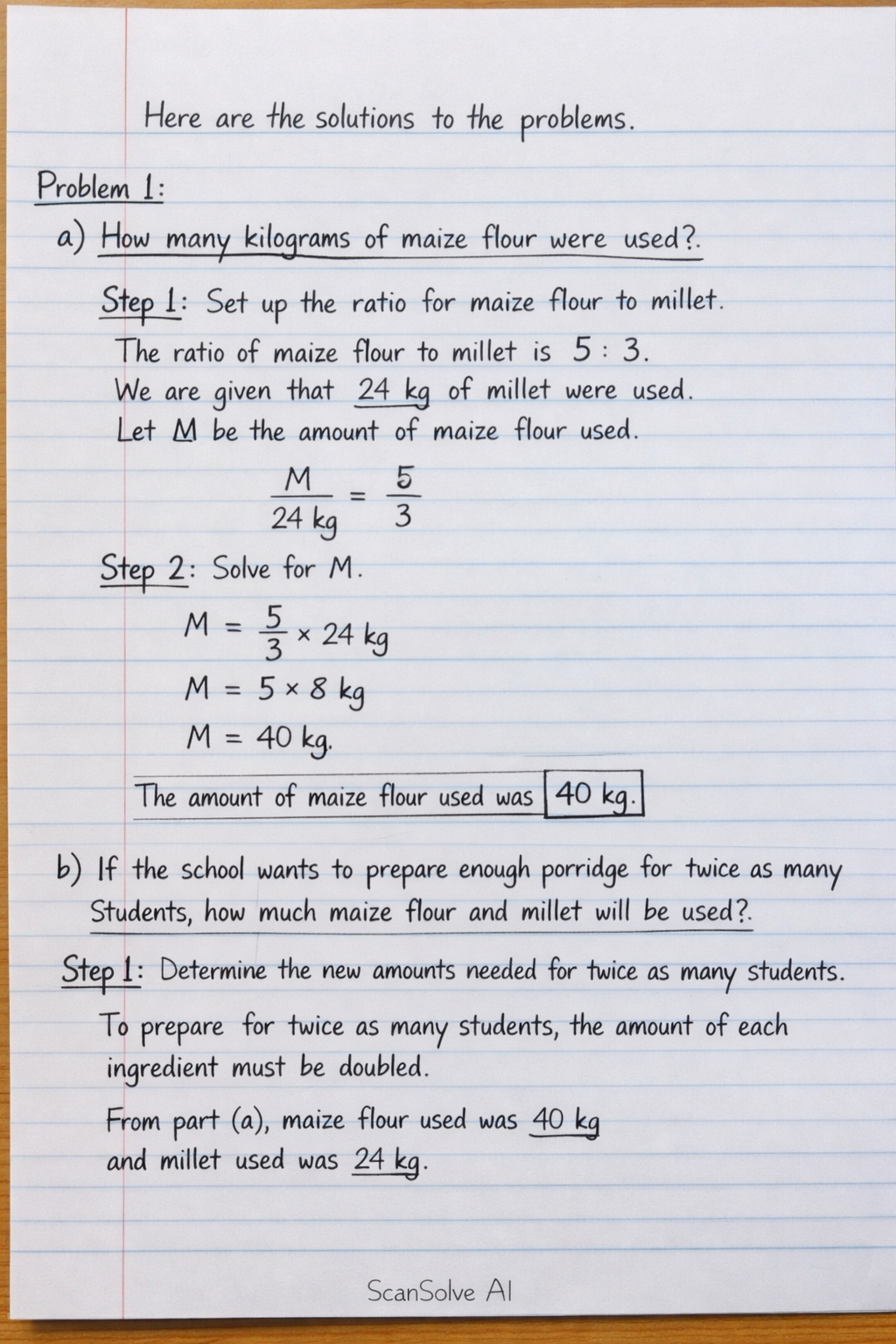
8 stepsHere are the solutions to the problems.
:
Part a· 2 steps
How many kilograms of maize flour were used?
Set up the ratio for maize flour to millet.
The ratio of maize flour to millet is .
We are given that of millet were used. Let be the amount of maize flour used.Solve for .
The amount of maize flour used was .
Part b· 6 steps
If the school wants to prepare enough porridge for twice as many students, how much maize flour and millet will be used?
Determine the new amounts needed for twice as many students.
To prepare for twice as many students, the amount of each ingredient must be doubled.
From part (a), maize flour used was and millet used was .Calculate the new amounts of maize flour and millet.
New maize flour needed:
New millet needed:
For twice as many students, the school will use .
:
Three friends, Amina, Brian, and Chebet, invest in a business in the ratio . They make a profit of 12,000 shillings. How much does each person receive?Calculate the total number of ratio parts.
The investment ratio is Amina : Brian : Chebet = .
Total parts = parts.Calculate Amina's share of the profit.
Amina's share =
Calculate Brian's share of the profit.
Brian's share =
Calculate Chebet's share of the profit.
Chebet's share =
Amina receives , Brian receives , and Chebet receives .
Still stuck on this one?
Ask a follow-up, and the answer starts from this question.
More Mathematics Questions
Handwritten Step-by-Step Solution
Get this as a handwritten image on WhatsApp — like a tutor wrote it for you.
Try on WhatsApp