

This mathematics problem involves applying core mathematical principles and formulas. Below you will find a complete step-by-step solution with detailed explanations for each step, helping you understand not just the answer but the method behind it.
ScanSolve AI Answer
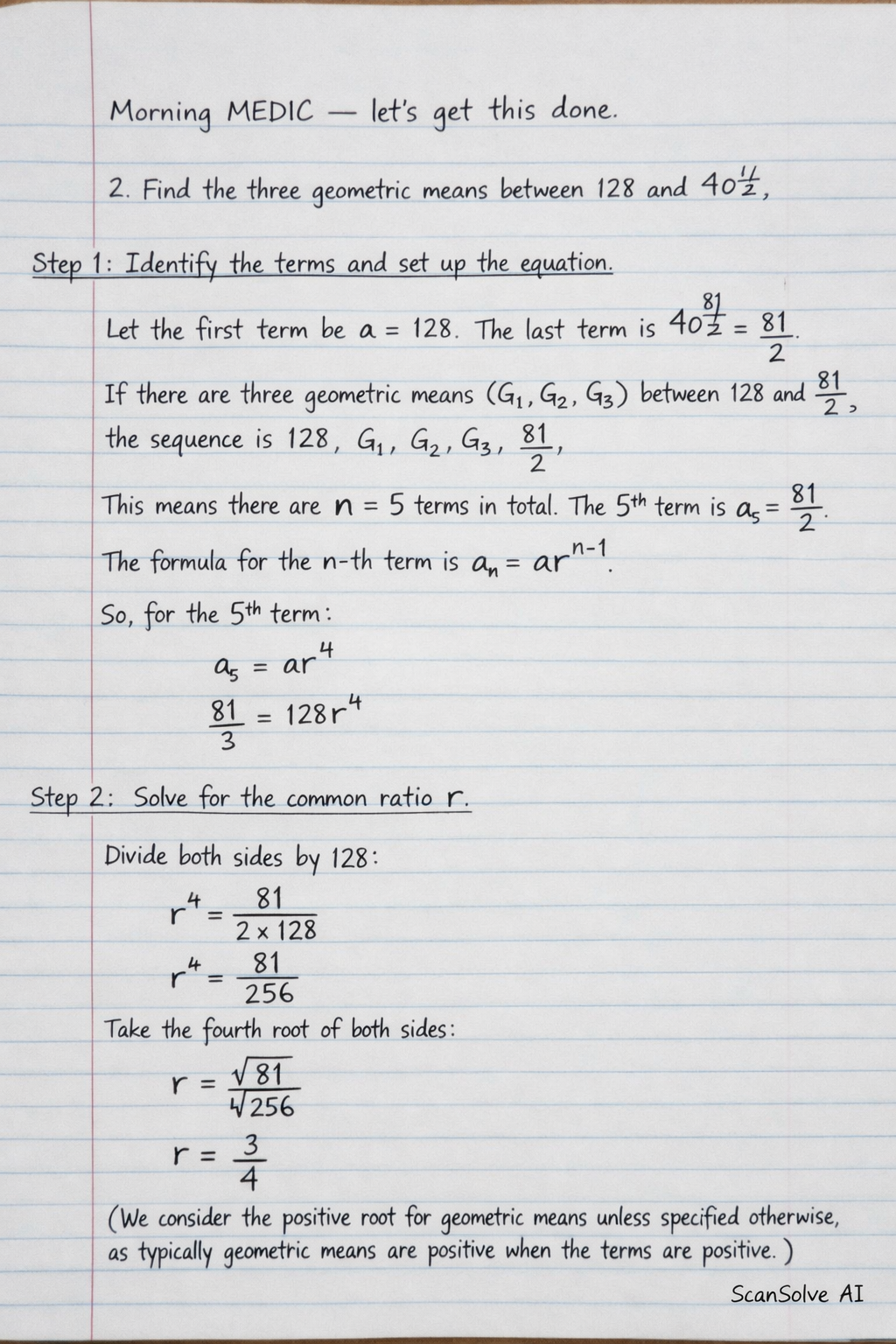
Morning MEDIC — let's get this done. 2. Find the three geometric means between 128 and 40(1)/(2). Step 1: Identify the terms and set up the equation. Let the first term be a = 128. The last term is 40(1)/(2) = (81)/(2). If there are three geometric means (G_1, G_2, G_3) between 128 and (81)/(2), the sequence is 128, G_1, G_2, G_3, (81)/(2). This means there are n=5 terms in total. The 5th term is a_5 = (81)/(2). The formula for the n-th term of a geometric progression is a_n = ar^n-1. So, for the 5th term: a_5 = ar^5-1 = ar^4 (81)/(2) = 128r^4 Step 2: Solve for the common ratio r. Divide both sides by 128: r^4 = (81)/(2 × 128) r^4 = (81)/(256) Take the fourth root of both sides: r = 4/(256) r = [4]81[4]256 r = (3)/(4) (We consider the positive root for geometric means unless specified otherwise, as typically geometric means are positive when the terms are positive). Step 3: Calculate the three geometric means. The geometric means are G_1 = ar, G_2 = ar^2, and G_3 = ar^3. G_1 = 128 × (3)/(4) = 32 × 3 = 96 G_2 = 128 × ((3)/(4))^2 = 128 × (9)/(16) = 8 × 9 = 72 G_3 = 128 × ((3)/(4))^3 = 128 × (27)/(64) = 2 × 27 = 54 The three geometric means are 96, 72, 54. 96, 72, 54 3. The sum of the first n terms of a sequence is given by S_n = (3n^2)/(2) - (3n)/(2). a) Find the first four terms of the sequence. Step 1: Calculate S_1, S_2, S_3, S_4. S_1 = (3(1)^2)/(2) - (3(1))/(2) = (3)/(2) - (3)/(2) = 0 S_2 = (3(2)^2)/(2) - (3(2))/(2) = (3 × 4)/(2) - (6)/(2) = (12)/(2) - (6)/(2) = 6 - 3 = 3 S_3 = (3(3)^2)/(2) - (3(3))/(2) = (3 × 9)/(2) - (9)/(2) = (27)/(2) - (9)/(2) = (18)/(2) = 9 S_4 = (3(4)^2)/(2) - (3(4))/(2) = (3 × 16)/(2) - (12)/(2) = (48)/(2) - (12)/(2) = 24 - 6 = 18 Step 2: Calculate a_1, a_2, a_3, a_4. The first term is a_1 = S_1. a_1 = 0 The n-th term is given by a_n = S_n - S_n-1 for n > 1. a_2 = S_2 - S_1 = 3 - 0 = 3 a_3 = S_3 - S_2 = 9 - 3 = 6 a_4 = S_4 - S_3 = 18 - 9 = 9 The first four terms of the sequence are 0, 3, 6, 9. 0, 3, 6, 9 b) Derive an expression for the n-th term of the sequence. Step 1: Write out S_n and S_n-1. S_n = (3n^2)/(2) - (3n)/(2) S_n-1 = (3(n-1)^2)/(2) - (3(n-1))/(2) Step 2: Substitute into a_n = S_n - S_n-1 and simplify. a_n = ((3n^2)/(2) - (3n)/(2)) - ((3(n-1)^2)/(2) - (3(n-1))/(2)) a_n = (1)/(2) [ (3n^2 - 3n) - (3(n^2 - 2n + 1) - (3n - 3)) ] a_n = (1)/(2) [ (3n^2 - 3n) - (3n^2 - 6n + 3 - 3n + 3) ] a_n = (1)/(2) [ (3n^2 - 3n) - (3n^2 - 9n + 6) ] a_n = (1)/(2) [ 3n^2 - 3n - 3n^2 + 9n - 6 ] a_n = (1)/(2) [ 6n - 6 ] a_n = 3n - 3 Step 3: Check for n=1. For n=1, a_1 = 3(1) - 3 = 0. This matches the a_1 found in part (a). The expression for the n-th term is a_n = 3n - 3. a_n = 3n - 3 Send me the next one 📸