
We read your photo as:
Explain the three structures of addition word problems: Result Unknown, Change Unknown, and Initial Unknown. Provide examples for each.
ScanSolve AI Answer
Answers
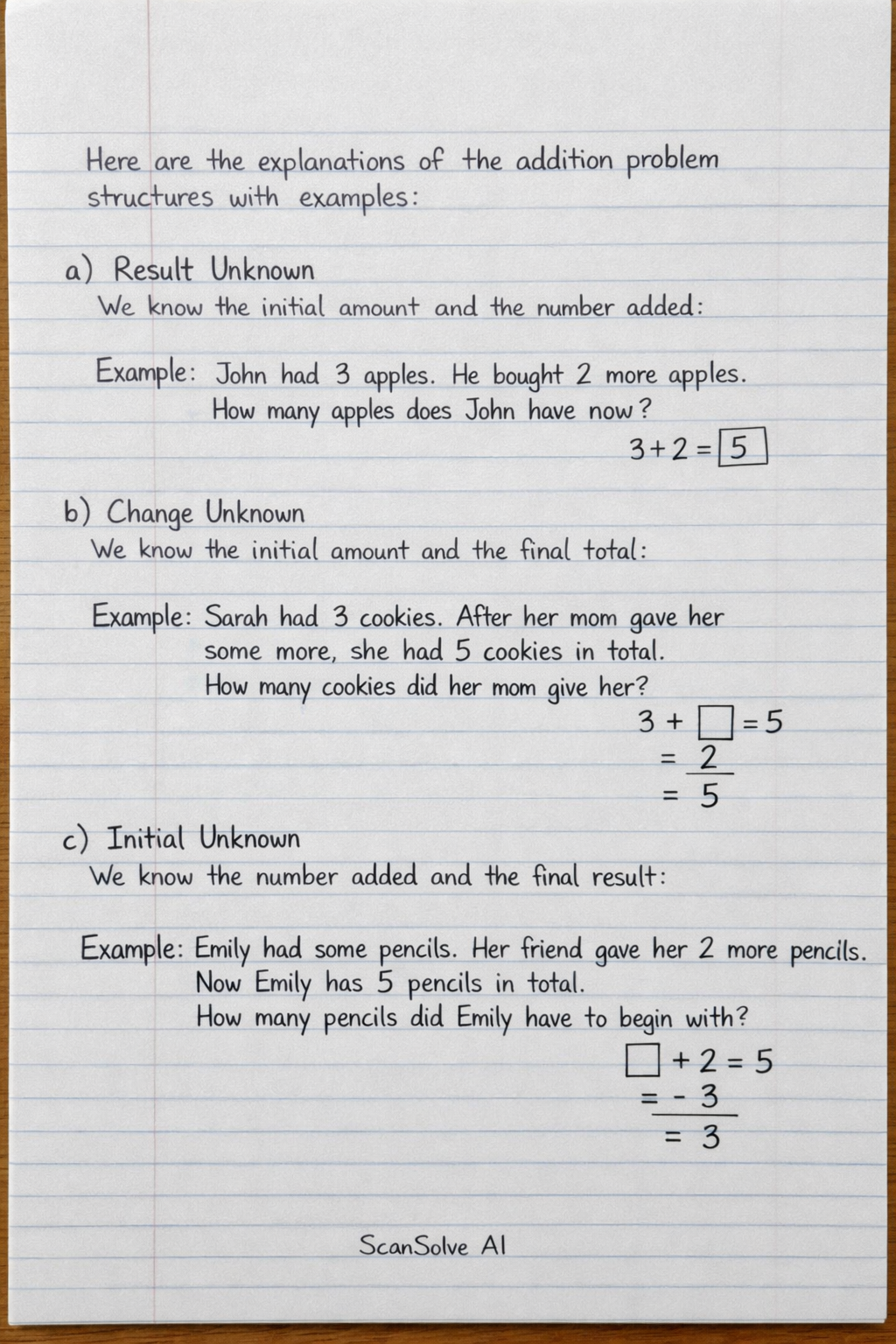
3 partsHere are the explanations of the addition problem structures with examples:
a) Result Unknown
In this type of problem, the initial quantity and the quantity added (the change) are known, and the goal is to find the total or the result after the addition.
Example: John had 3 apples. He bought 2 more apples. How many apples does John have now?
b) Change Unknown
In this type of problem, the initial quantity and the final total (the result) are known, and the goal is to find how much was added (the change).
Example: Sarah had 3 cookies. After her mom gave her some more, she had 5 cookies in total. How many cookies did her mom give her?
c) Initial Unknown
In this type of problem, the quantity added (the change) and the final total (the result) are known, and the goal is to find the initial quantity before the addition.
Example: Emily had some pencils. Her friend gave her 2 more pencils, and now Emily has 5 pencils in total. How many pencils did Emily have to begin with?
Still stuck on this one?
Ask a follow-up, and the answer starts from this question.
More Mathematics Questions
Handwritten Step-by-Step Solution
Get this as a handwritten image on WhatsApp — like a tutor wrote it for you.
Try on WhatsApp