This mathematics problem involves applying core mathematical principles and formulas. Below you will find a complete step-by-step solution with detailed explanations for each step, helping you understand not just the answer but the method behind it.
ScanSolve AI Answer
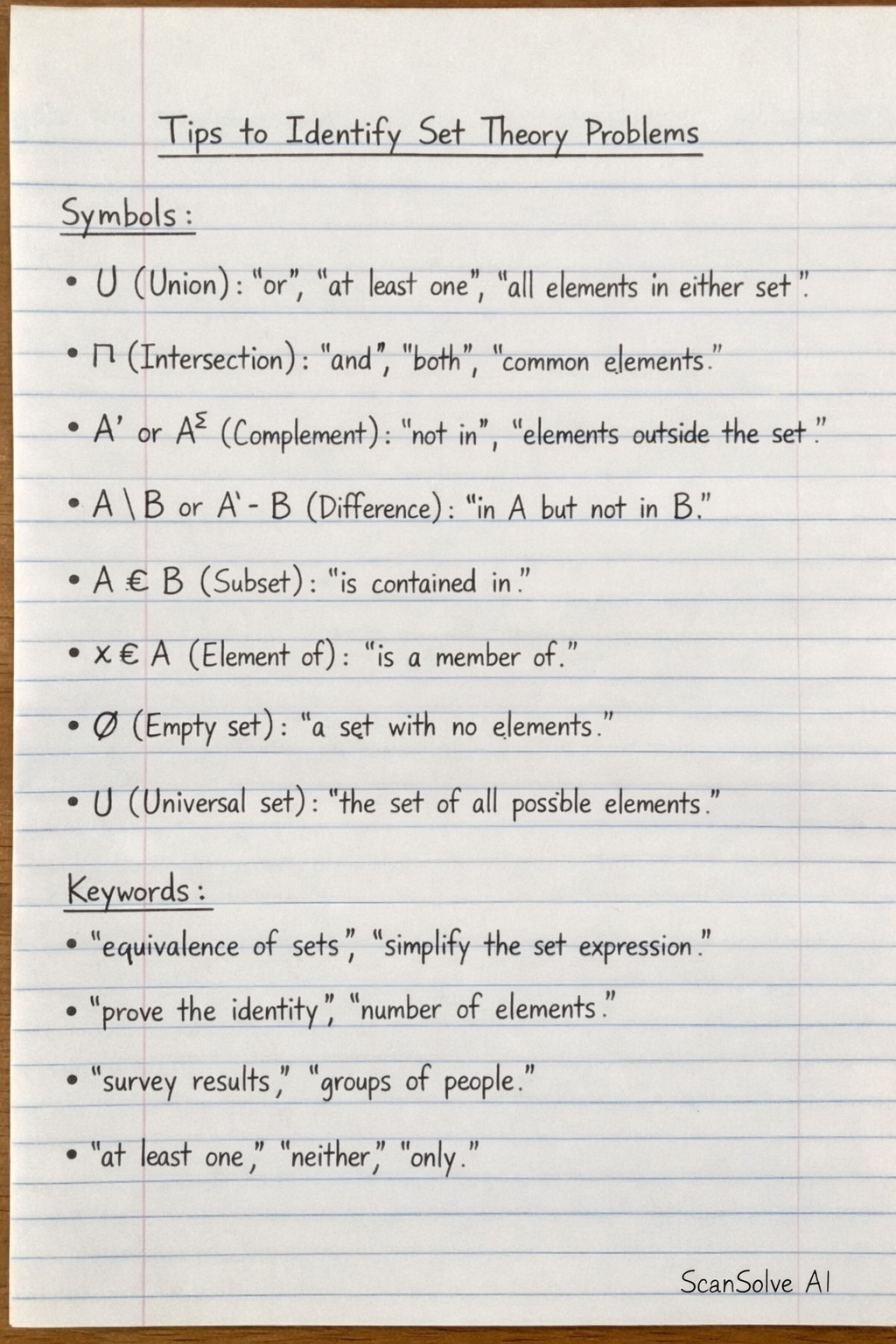
Here are tips for identifying set theory problems and the solutions to the questions:
Tips to Identify Set Theory Problems
Set theory problems deal with collections of objects, called sets, and the relationships and operations between them. Here are some common indicators:
Symbols: Look for specific set notation symbols:
$\cup$ (Union): "or", "at least one", "all elements in either set".
$\cap$ (Intersection): "and", "both", "common elements".
$'$ or $^c$ (Complement): "not in", "elements outside the set".
$\setminus$ or $-$ (Difference): "in A but not in B".
$\subseteq$ (Subset): "is contained in".
$\in$ (Element of): "is a member of".
$\emptyset$ (Empty set): A set with no elements.
$U$ (Universal set): The set of all possible elements under consideration.
Keywords: Phrases like "equivalence of sets," "simplify the set expression," "prove the identity," "number of elements," "survey results," "groups of people," "at least one," "neither," "only."
Context: Problems involving grouping, categorization, or relationships between different collections of items (e.g., students taking different subjects, people with different hobbies).
Venn Diagrams: If the problem mentions or can be easily visualized with overlapping circles, it's likely a set theory problem.
Solutions to the Questions
4. The equivalence of $A \cap (B \cup C)$ is:
a) $(A \cup B') \cup (A \cup C)$
b) $(A \cap B) \cup C$
c) $(A \cap B) \cup (A \cap C)$
d) $(A \cup B) \cap (A \cup C)$
This question asks for an equivalent expression using the Distributive Law of set operations.
The Distributive Law states that for any sets A, B, and C:
$$A \cap (B \cup C) = (A \cap B) \cup (A \cap C)$$
This law is analogous to distributing multiplication over addition in algebra, e.g., $a \times (b + c) = (a \times b) + (a \times c)$.
Comparing the given expression with the options, option (c) directly matches the Distributive Law.
The correct option is $\boxed{\text{c) } (A \cap B) \cup (A \cap C)}$.
5. For an AP, $a=25, d=-3$ find the value of $n$ if $S_n = 112$.
Step 1: Identify the given values for the Arithmetic Progression (AP).
First term: $a = 25$
Common difference: $d = -3$
Sum of the first $n$ terms: $S_n = 112$
Step 2: Use the formula for the sum of the first $n$ terms of an AP.
The formula is:
$$S_n = \frac{n}{2} [2a + (n-1)d]$$
Step 3: Substitute the given values into the formula.
$$112 = \frac{n}{2} [2(25) + (n-1)(-3)]$$
Step 4: Simplify the equation.
$$112 = \frac{n}{2} [50 - 3(n-1)]$$
$$112 = \frac{n}{2} [50 - 3n + 3]$$
$$112 = \frac{n}{2} [53 - 3n]$$
Multiply both sides by 2 to eliminate the fraction:
$$2 \times 112 = n(53 - 3n)$$
$$224 = 53n - 3n^2$$
Step 5: Rearrange the equation into a standard quadratic form ($Ax^2 + Bx + C = 0$).
$$3n^2 - 53n + 224 = 0$$
Step 6: Solve the quadratic equation for $n$ using the quadratic formula $n = \frac{-B \pm \sqrt{B^2 - 4AC}}{2A}$.
Here, $A=3$, $B=-53$, $C=224$.
$$n = \frac{-(-53) \pm \sqrt{(-53)^2 - 4(3)(224)}}{2(3)}$$
$$n = \frac{53 \pm \sqrt{2809 - 2688}}{6}$$
$$n = \frac{53 \pm \sqrt{121}}{6}$$
$$n = \frac{53 \pm 11}{6}$$
This gives two possible values for $n$:
$$n_1 = \frac{53 + 11}{6} = \frac{64}{6} = \frac{32}{3}$$
$$n_2 = \frac{53 - 11}{6} = \frac{42}{6} = 7$$
Since the number of terms ($n$) must be a positive integer, $n = \frac{32}{3}$ is not a valid solution.
Therefore, the value of $n$ is 7.
The value of $n$ is $\boxed{7}$.
Tips to identify the kind of prob In set theory
|Mathematics
Tips to identify the kind of prob In set theory
ScanSolve AI Answer
Here are tips for identifying set theory problems and the solutions to the questions:
Tips to Identify Set Theory Problems
Set theory problems deal with collections of objects, called sets, and the relationships and operations between them. Here are some common indicators:
Symbols: Look for specific set notation symbols:
∪ (Union): "or", "at least one", "all elements in either set".
′ or c (Complement): "not in", "elements outside the set".
∖ or − (Difference): "in A but not in B".
⊆ (Subset): "is contained in".
∈ (Element of): "is a member of".
∅ (Empty set): A set with no elements.
U (Universal set): The set of all possible elements under consideration.
Keywords: Phrases like "equivalence of sets," "simplify the set expression," "prove the identity," "number of elements," "survey results," "groups of people," "at least one," "neither," "only."
Context: Problems involving grouping, categorization, or relationships between different collections of items (e.g., students taking different subjects, people with different hobbies).
Venn Diagrams: If the problem mentions or can be easily visualized with overlapping circles, it's likely a set theory problem.
Solutions to the Questions
4. The equivalence of A∩(B∪C) is:
a) (A∪B′)∪(A∪C)
b) (A∩B)∪C
c) (A∩B)∪(A∩C)
d) (A∪B)∩(A∪C)
This question asks for an equivalent expression using the Distributive Law of set operations.
The Distributive Law states that for any sets A, B, and C:
A∩(B∪C)=(A∩B)∪(A∩C)
This law is analogous to distributing multiplication over addition in algebra, e.g., a×(b+c)=(a×b)+(a×c).
Comparing the given expression with the options, option (c) directly matches the Distributive Law.
The correct option is c)(A∩B)∪(A∩C).
5. For an AP, a=25,d=−3 find the value of n if Sn=112.
Step 1: Identify the given values for the Arithmetic Progression (AP).
First term: a=25
Common difference: d=−3
Sum of the first n terms: Sn=112
Step 2: Use the formula for the sum of the first n terms of an AP.
The formula is:
Sn=2n[2a+(n−1)d]
Step 3: Substitute the given values into the formula.
112=2n[2(25)+(n−1)(−3)]
Step 4: Simplify the equation.
112=2n[50−3(n−1)]112=2n[50−3n+3]112=2n[53−3n]
Multiply both sides by 2 to eliminate the fraction:
2×112=n(53−3n)224=53n−3n2
Step 5: Rearrange the equation into a standard quadratic form (Ax2+Bx+C=0).
3n2−53n+224=0
Step 6: Solve the quadratic equation for n using the quadratic formula n=2A−B±B2−4AC.
Here, A=3, B=−53, C=224.
n=2(3)−(−53)±(−53)2−4(3)(224)n=653±2809−2688n=653±121n=653±11
This gives two possible values for n:
n1=653+11=664=332n2=653−11=642=7
Since the number of terms (n) must be a positive integer, n=332 is not a valid solution.
Therefore, the value of n is 7.
The value of n is 7.
Need help with your own homework?
Get instant step-by-step solutions to any question. Free to start.