
We read your photo as:
To apply the concept of pervasiveness and the fraud triangle to explain why the described cycle of corruption is difficult to break.
ScanSolve AI Answer
Answer
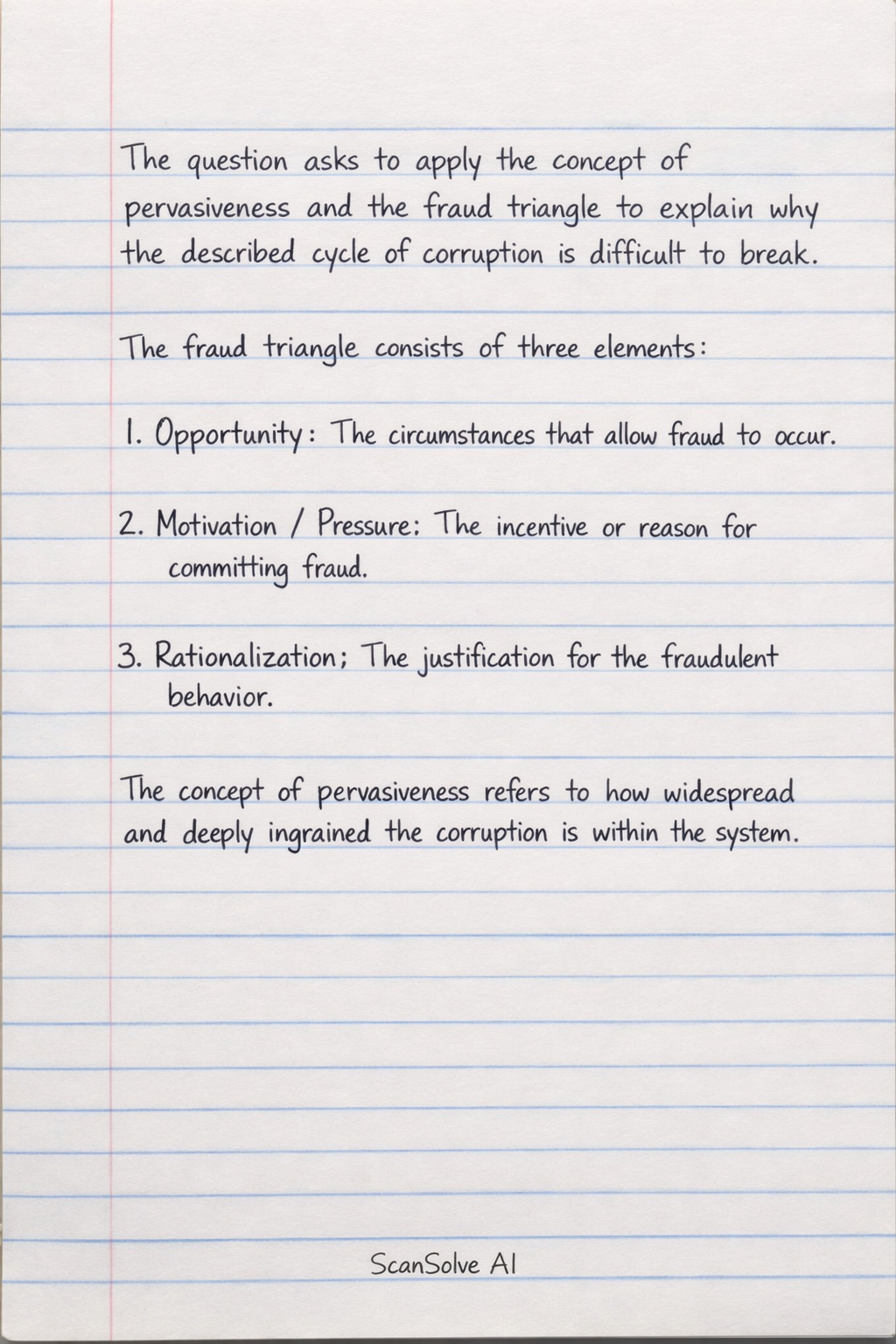
The question asks to apply the concept of pervasiveness and the fraud triangle to explain why the described cycle of corruption is difficult to break.
The fraud triangle consists of three elements:
- Opportunity: The circumstances that allow fraud to occur.
- Motivation/Pressure: The incentive or reason for committing fraud.
- Rationalization: The justification for the fraudulent behavior.
The concept of pervasiveness refers to how widespread and deeply ingrained the corruption is within the system.
Let's analyze option a):
- "Throughout, opportunity is maintained by institutional capture of procurement systems": This directly addresses the opportunity element of the fraud triangle. The system itself is compromised, creating avenues for fraud. This also speaks to the pervasiveness of the problem, as it's embedded in the institutions.
- "greed provides constant motivation": This clearly identifies the motivation for the corrupt acts.
- "and rationalisation is normalised through a culture where corruption is expected": This explains the rationalization element. When corruption becomes expected, individuals can justify their actions more easily. This also highlights the pervasiveness of the issue, as it's part of the organizational culture.
Option a) effectively integrates all three elements of the fraud triangle and implicitly addresses the pervasiveness of the cycle through "institutional capture" and a "culture where corruption is expected," explaining why the cycle is so difficult to break.
The final answer is
Try one yourself
A new problem that tests the same skill.
Still stuck on this one?
Ask a follow-up, and the answer starts from this question.
More Mathematics Questions
Handwritten Step-by-Step Solution
Get this as a handwritten image on WhatsApp — like a tutor wrote it for you.
Try on WhatsApp