This mathematics problem involves applying core mathematical principles and formulas. Below you will find a complete step-by-step solution with detailed explanations for each step, helping you understand not just the answer but the method behind it.
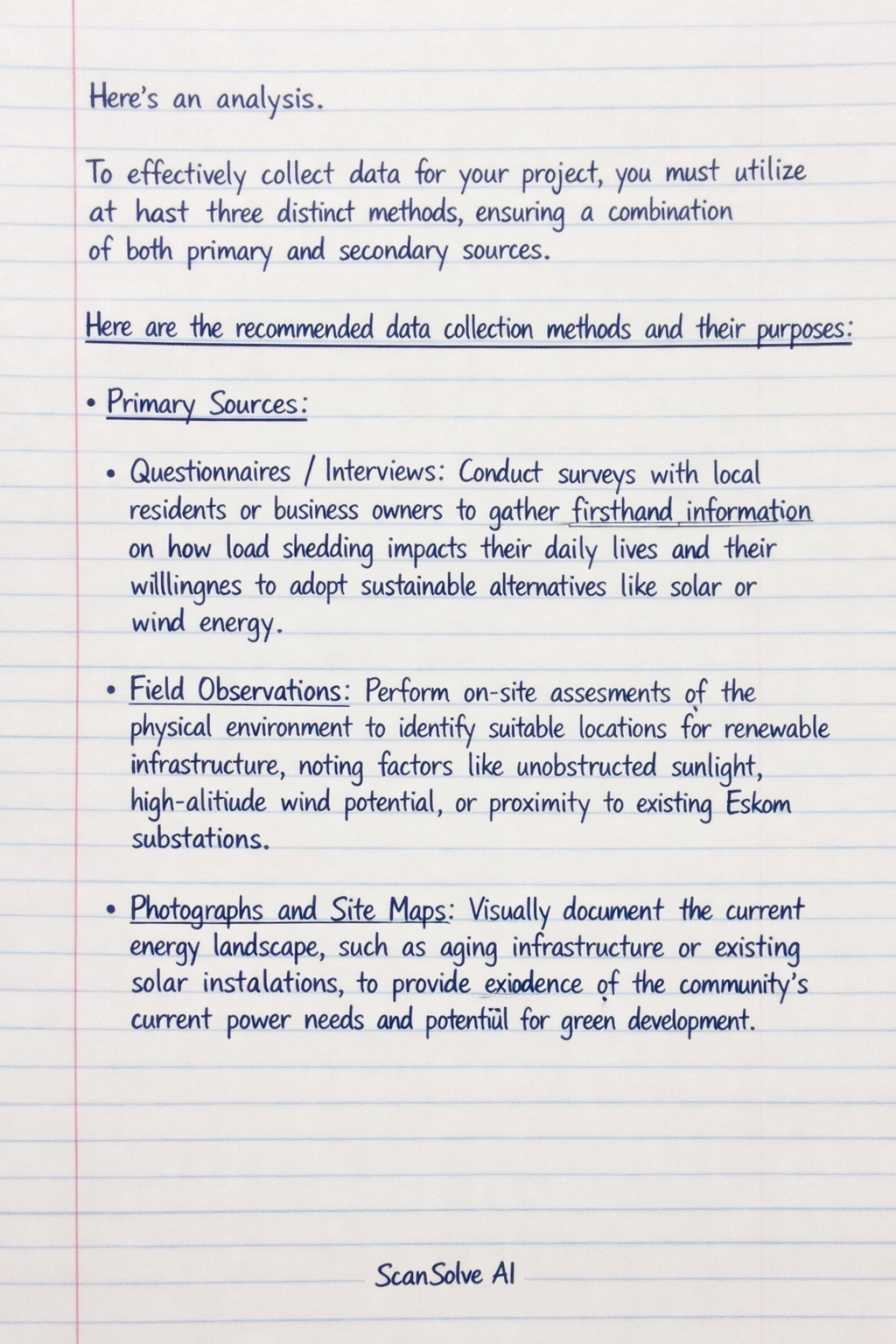
To effectively collect data for your project, you must utilize at least three distinct methods, ensuring a combination of both primary and secondary sources.
Mathematics

ScanSolve AI Answer
To effectively collect data for your project, you must utilize at least three distinct methods, ensuring a combination of both primary and secondary sources.
Here are the recommended data collection methods and their purposes:
-
Primary Sources:
- Questionnaires/Interviews: Conduct surveys with local residents or business owners to gather firsthand information on how load shedding impacts their daily lives and their willingness to adopt sustainable alternatives like solar or wind energy.
- Field Observations: Perform on-site assessments of the physical environment to identify suitable locations for renewable infrastructure, noting factors like unobstructed sunlight, high-altitude wind potential, or proximity to existing Eskom substations.
- Photographs and Site Maps: Visually document the current energy landscape, such as aging infrastructure or existing solar installations, to provide evidence of the community's current power needs and potential for green development.
-
Secondary Sources:
- Literature and Map Analysis: Research existing data from the Integrated Resource Plan (IRP), Eskom's transmission reports, and official Solar/Wind Atlases to provide a scientific foundation for the investigation's findings.
- Literature Review: Analyze existing research studies, academic journals, and government reports to gather information on rural development trends and issues in similar areas.
- Internet Sources: Use reputable online sources such as websites, reports from international organizations, and government publications to collect data on rural development strategies, challenges, and policies relevant to your community.
Send me the next one 📸
Was this helpful?
Need help with your own homework?
Get instant step-by-step solutions to any question. Free to start.
Ask Your Question
Handwritten Step-by-Step Solution
Get this as a handwritten image on WhatsApp — like a tutor wrote it for you.
Try on WhatsAppMore Mathematics Questions
QExample 3. Like terms in polynomials can be added or subtracted. Cannot be so added or subtracted. S…QDraw a table for the mapping defined by the rule x → 2x² - 2 on the domain -1, 0, 1, 2, 3, 4.QUse multi-base materials to represent the number. 161,200,000. 9,300,000.QUse the token currency to model the amount below. 1) GH¢ 190, 2) 6,340, 3) 2,320QExpand the following: (m-2n)5, (3x+y)4, (2y-3x)3
Still have questions?
Quick Answer
To effectively collect data for your project, you must utilize at least three distinct methods, ensuring a combination of both primary and secondary sources.
ScanSolve AI Answer
To effectively collect data for your project, you must utilize at least three distinct methods, ensuring a combination of both primary and secondary sources. Here are the recommended data collection methods and their purposes: Primary Sources: Questionnaires/Interviews: Conduct surveys with local residents or business owners to gather firsthand information* on how load shedding impacts their daily lives and their willingness to adopt sustainable alternatives like solar or wind energy. Field Observations: Perform on-site assessments* of the physical environment to identify suitable locations for renewable infrastructure, noting factors like unobstructed sunlight, high-altitude wind potential, or proximity to existing Eskom substations. Photographs and Site Maps: Visually document the current energy landscape, such as aging infrastructure or existing solar installations, to provide evidence* of the community's current power needs and potential for green development. Secondary Sources: Literature and Map Analysis: Research existing data from the Integrated Resource Plan (IRP), Eskom's transmission reports, and official Solar/Wind Atlases to provide a scientific foundation* for the investigation's findings. Literature Review: Analyze existing research studies, academic journals, and government reports to gather information on rural development trends and issues* in similar areas. Internet Sources: Use reputable online sources such as websites, reports from international organizations, and government publications to collect data on rural development strategies, challenges, and policies* relevant to your community. Send me the next one 📸