
We read your photo as:
To find the equivalent fraction for (1)/(10) with a denominator of 100, determine the factor by which the denominator was multiplied.
ScanSolve AI Answer
Answers
3 partsStep-by-step solution
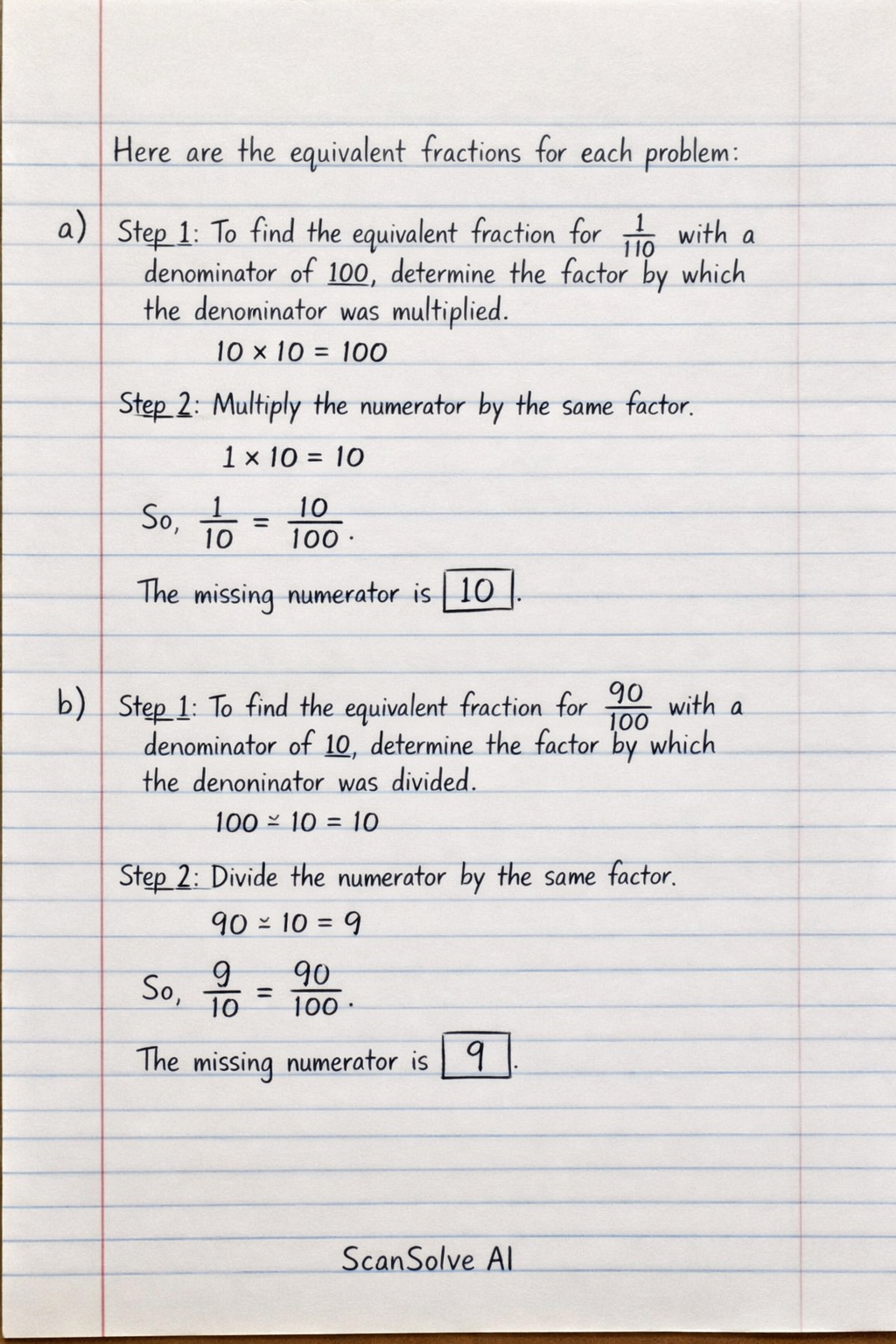
6 stepsHere are the equivalent fractions for each problem:
Part a· 2 steps
To find the equivalent fraction for with a denominator of 100, determine the factor by which the denominator was multiplied.
Multiply the numerator by the same factor.
So, .
The missing numerator is .
Part b9
To find the equivalent fraction for with a denominator of 10, determine the factor by which the denominator was divided.
Divide the numerator by the same factor.
So, .
The missing numerator is .
Part c5
For the first blank, to change to a fraction with a denominator of 10, multiply the denominator by 5 ().
Multiply the numerator by 5.
So, .
For the second blank, to change to a fraction with a denominator of 100, multiply the denominator by 50 ().
Multiply the numerator by 50.
So, .
The missing numerators are and .
Part d
Step
Try one yourself
A new problem that tests the same skill.
Still stuck on this one?
Ask a follow-up, and the answer starts from this question.
More Mathematics Questions
Handwritten Step-by-Step Solution
Get this as a handwritten image on WhatsApp — like a tutor wrote it for you.
Try on WhatsApp