

This mathematics problem involves applying core mathematical principles and formulas. Below you will find a complete step-by-step solution with detailed explanations for each step, helping you understand not just the answer but the method behind it.
ScanSolve AI Answer
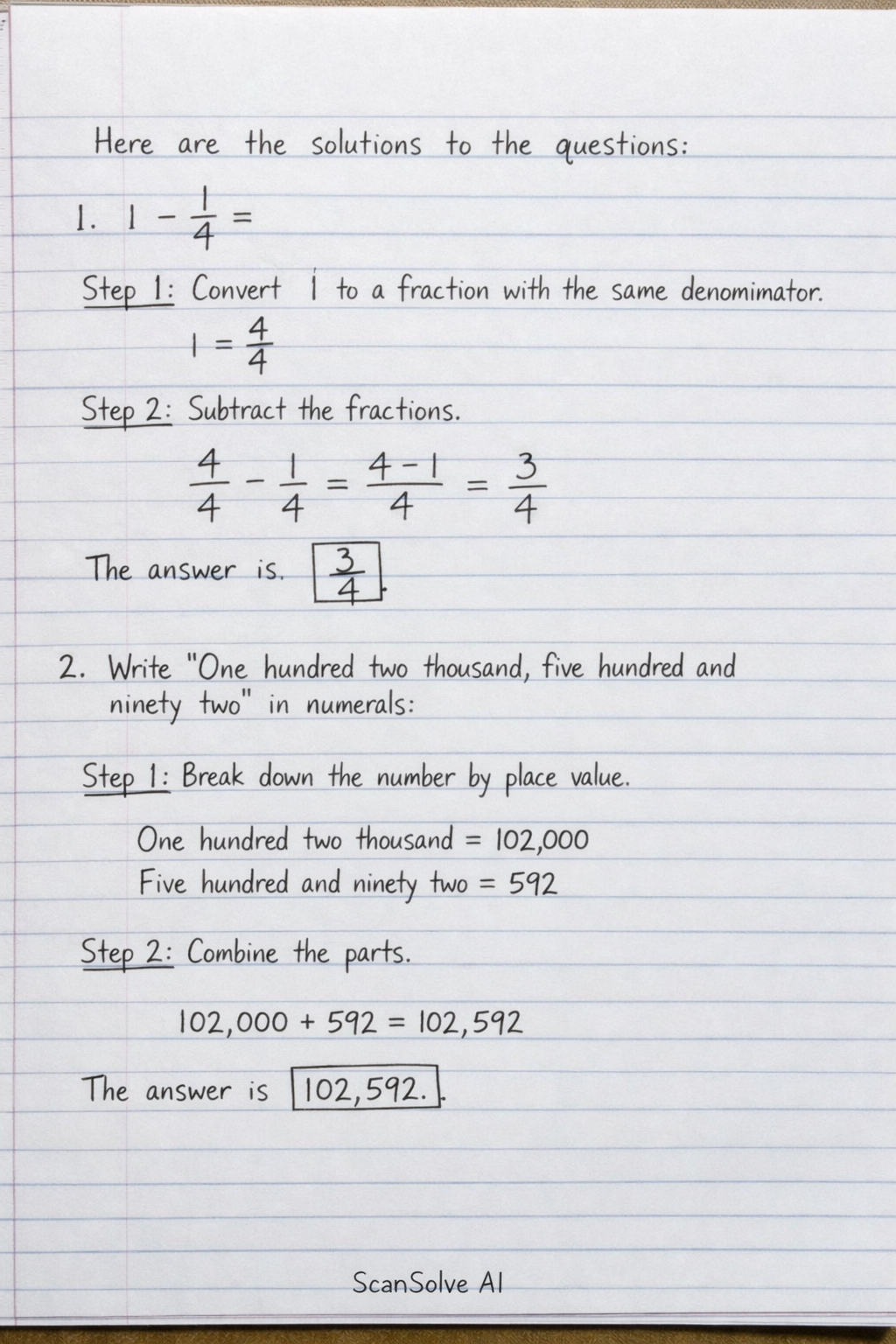
Here are the solutions to the questions: 1. 1 - (1)/(4)= Step 1: Convert the whole number to a fraction with the same denominator as the other fraction. 1 = (4)/(4) Step 2: Subtract the fractions. (4)/(4) - (1)/(4) = (4-1)/(4) = (3)/(4) The answer is (3)/(4). 2. Write "One hundred two thousand, five hundred and ninety two" in numerals. Step 1: Break down the number by place value. One hundred two thousand = 102,000 Five hundred and ninety two = 592 Step 2: Combine the parts. 102,000 + 592 = 102,592 The answer is 102,592. 3. Compare (1)/(2) and (1)/(10) using <, > or =. Step 1: To compare fractions, find a common denominator. The least common multiple of 2 and 10 is 10. Step 2: Convert (1)/(2) to an equivalent fraction with a denominator of 10. (1)/(2) = (1 × 5)/(2 × 5) = (5)/(10) Step 3: Compare (5)/(10) and (1)/(10). Since 5 > 1, it follows that (5)/(10) > (1)/(10). Therefore, (1)/(2) > (1)/(10). The answer is >. 4. Write the operation used in a sequence of number below 123, 129, 135, 141, 147. Step 1: Find the difference between consecutive terms. 129 - 123 = 6 135 - 129 = 6 141 - 135 = 6 147 - 141 = 6 Step 2: Since the difference is constant, the operation is addition. The operation used is addition of 6. 5. Write "CMXXXIX" in words. Step 1: Break down the Roman numeral into its components. CM = 900 (C before M means 1000 - 100) XXX = 30 (10 + 10 + 10) IX = 9 (I before X means 10 - 1) Step 2: Add the values. 900 + 30 + 9 = 939 The number in words is Nine hundred thirty-nine. 6. Write 1005 in Roman numerals. Step 1: Break down the number by place value. 1000 = M 5 = V Step 2: Combine the Roman numerals. 1000 + 5 = MV The Roman numeral is MV. 3 done, 2 left today. You're making progress.