
We read your photo as:
Convert each fraction to its decimal equivalent, add them, and then convert the sum back to a fraction.
ScanSolve AI Answer
Step-by-step solution
5 stepsDecimal Conversion (and back to fraction)
Convert each fraction to its decimal equivalent, add them, and then convert the sum back to a fraction.
Add the decimals:
To convert 0.8333... back to a fraction:
Let
Multiply by 10: (Equation 1)
Multiply by 100: (Equation 2)
Subtract Equation 1 from Equation 2:Simplify the fraction by dividing both numerator and denominator by their greatest common divisor, which is 15:
The simplified answer is .
Factoring out the Common Unit Fraction
First, find the least common multiple (LCM) of the denominators, which is 6. This means the common unit fraction is .
Express each fraction as a multiple of this common unit fraction:Now, add these expressions by factoring out the common unit fraction :
The simplified answer is .
Cross-Multiplication Method (Explicit Steps)
This method involves multiplying the numerator of each fraction by the denominator of the other fraction, adding these products, and placing the sum over the product of the denominators.
For :
Multiply the numerator of the first fraction (1) by the denominator of the second fraction (3): .
Multiply the numerator of the second fraction (1) by the denominator of the first fraction (2): .
Multiply the denominators together: .
Add the cross-products and place over the product of denominators:The simplified answer is .
Area Model (Grid Method)
Imagine a rectangle divided into a grid where one dimension represents the first denominator and the other represents the second. For denominators 2 and 3, create a grid, resulting in 6 small squares.
To represent , shade one row (or column) out of the two. If we shade one row of three squares, we shade 3 out of 6 squares.
To represent , shade one column (or row) out of the three. If we shade one column of two squares, we shade 2 out of 6 squares.
When combining these shaded areas, we have 3 squares from and 2 squares from . In total, we have shaded squares out of the 6 total squares in the grid.
Thus, the sum is .
The simplified answer is .Estimation and Verification
First
Still stuck on this one?
Ask a follow-up, and the answer starts from this question.
More Mathematics Questions
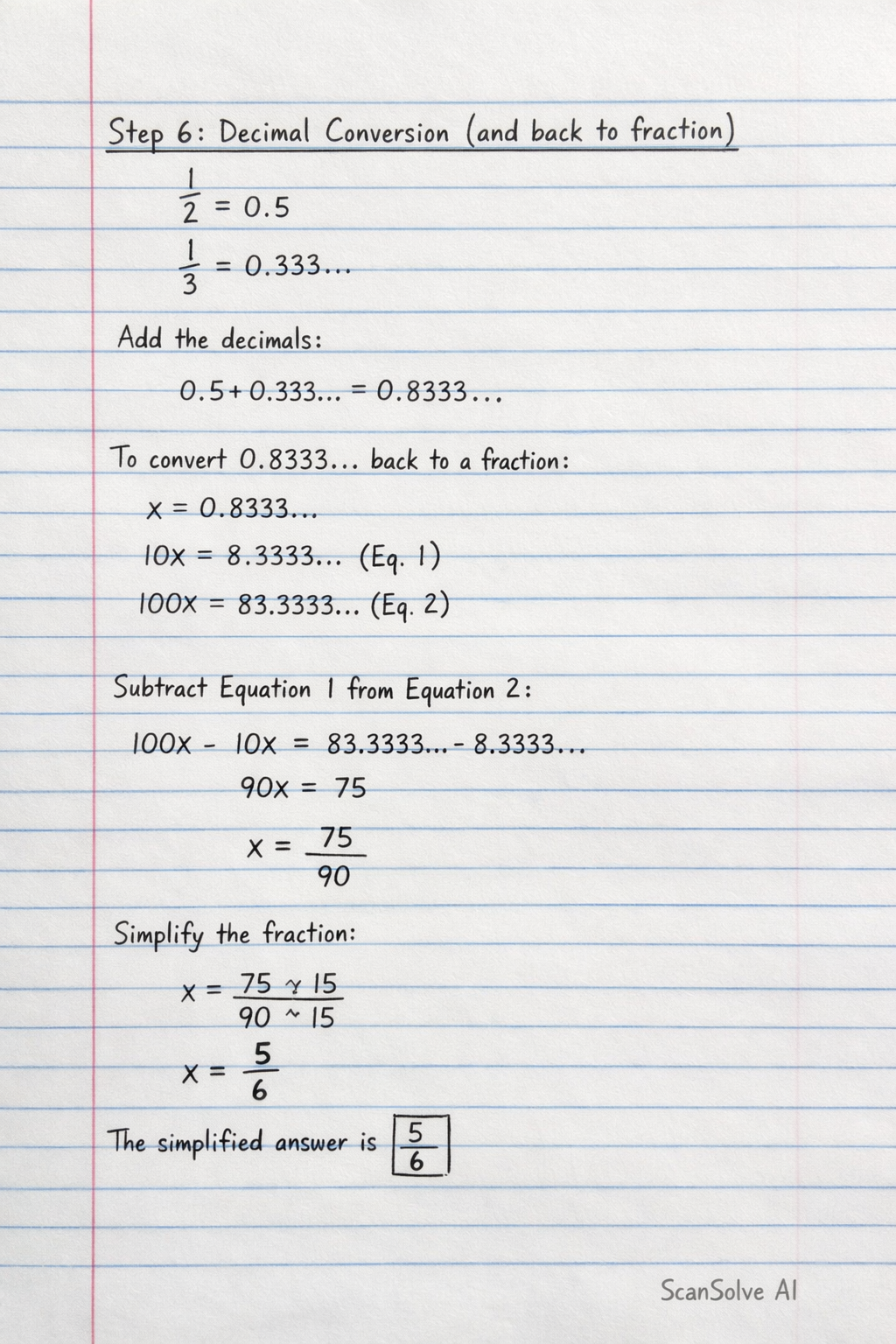
Handwritten Step-by-Step Solution
Get this as a handwritten image on WhatsApp — like a tutor wrote it for you.
Try on WhatsApp