
We read your photo as:
To find the perimeter of the figure, we need to sum the lengths of all its outer edges.
ScanSolve AI Answer
Answer
To find the perimeter of the figure, we need to sum the lengths of all its outer edges.
Let's identify the lengths of the exterior sides:
- The left vertical side of rectangle B:
- The bottom horizontal side of rectangle B:
- The right vertical side of rectangle B:
- The top horizontal side of rectangle B that is exposed (not covered by A):
- The left vertical side of rectangle A:
- The top horizontal side of rectangle A:
- The right vertical side of rectangle A:
Now, we sum these lengths to find the total perimeter:
Alternatively, we can calculate the perimeter of each rectangle and subtract the overlapping internal boundary.
Perimeter of rectangle B:
Perimeter of rectangle A:
The length of the common boundary (where A and B meet) is . This boundary is counted twice when summing the individual perimeters, so we subtract from the sum.
Total perimeter = (Perimeter of B) + (Perimeter of A) -
Both methods yield the same result.
Comparing with the given options:
(a)
(b)
(c)
(d)
(e)
The calculated perimeter matches option (d).
The final answer is .
Try one yourself
A new problem that tests the same skill.
Still stuck on this one?
Ask a follow-up, and the answer starts from this question.
More Mathematics Questions
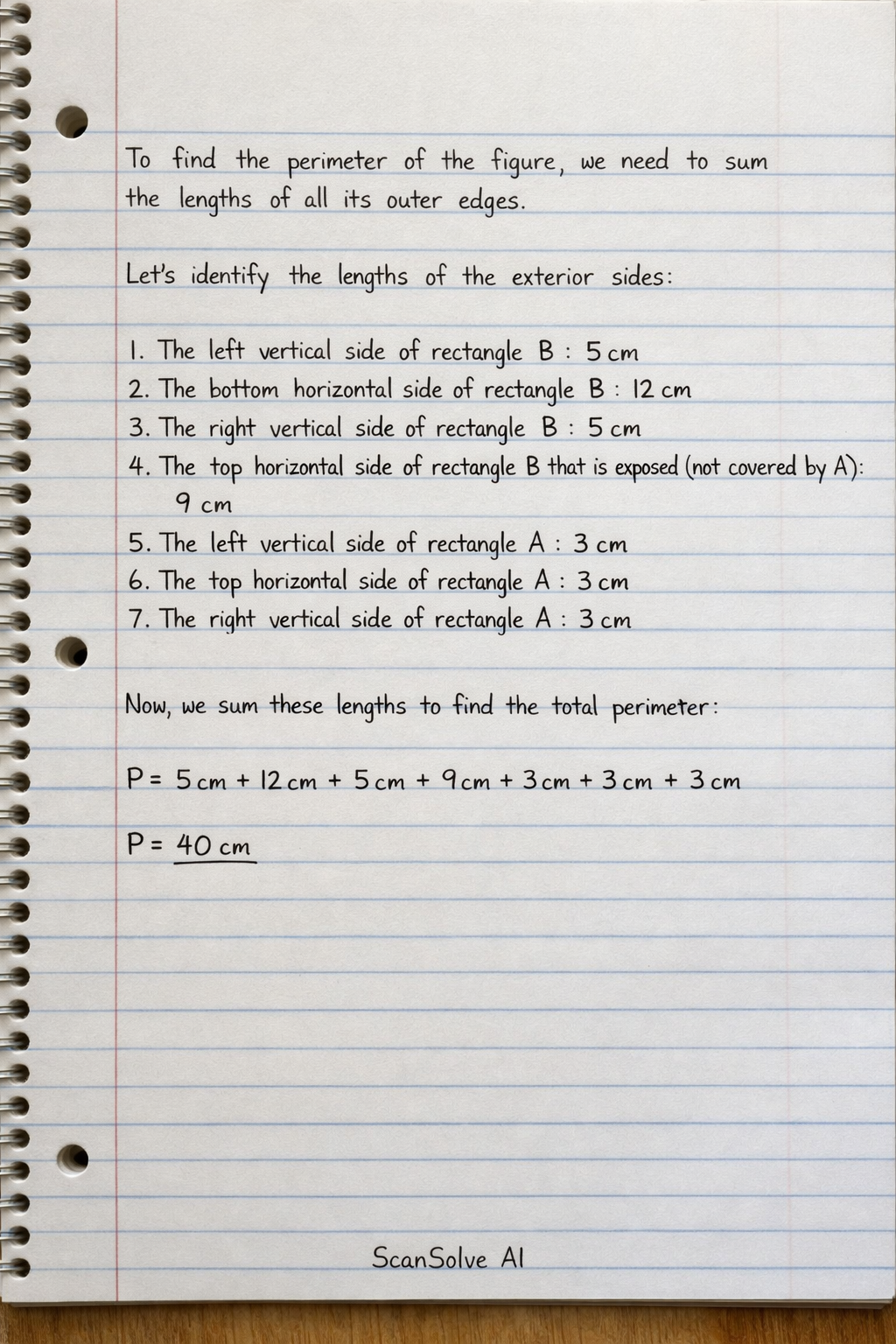
Handwritten Step-by-Step Solution
Get this as a handwritten image on WhatsApp — like a tutor wrote it for you.
Try on WhatsApp