

This mathematics problem involves applying core mathematical principles and formulas. Below you will find a complete step-by-step solution with detailed explanations for each step, helping you understand not just the answer but the method behind it.
ScanSolve AI Answer
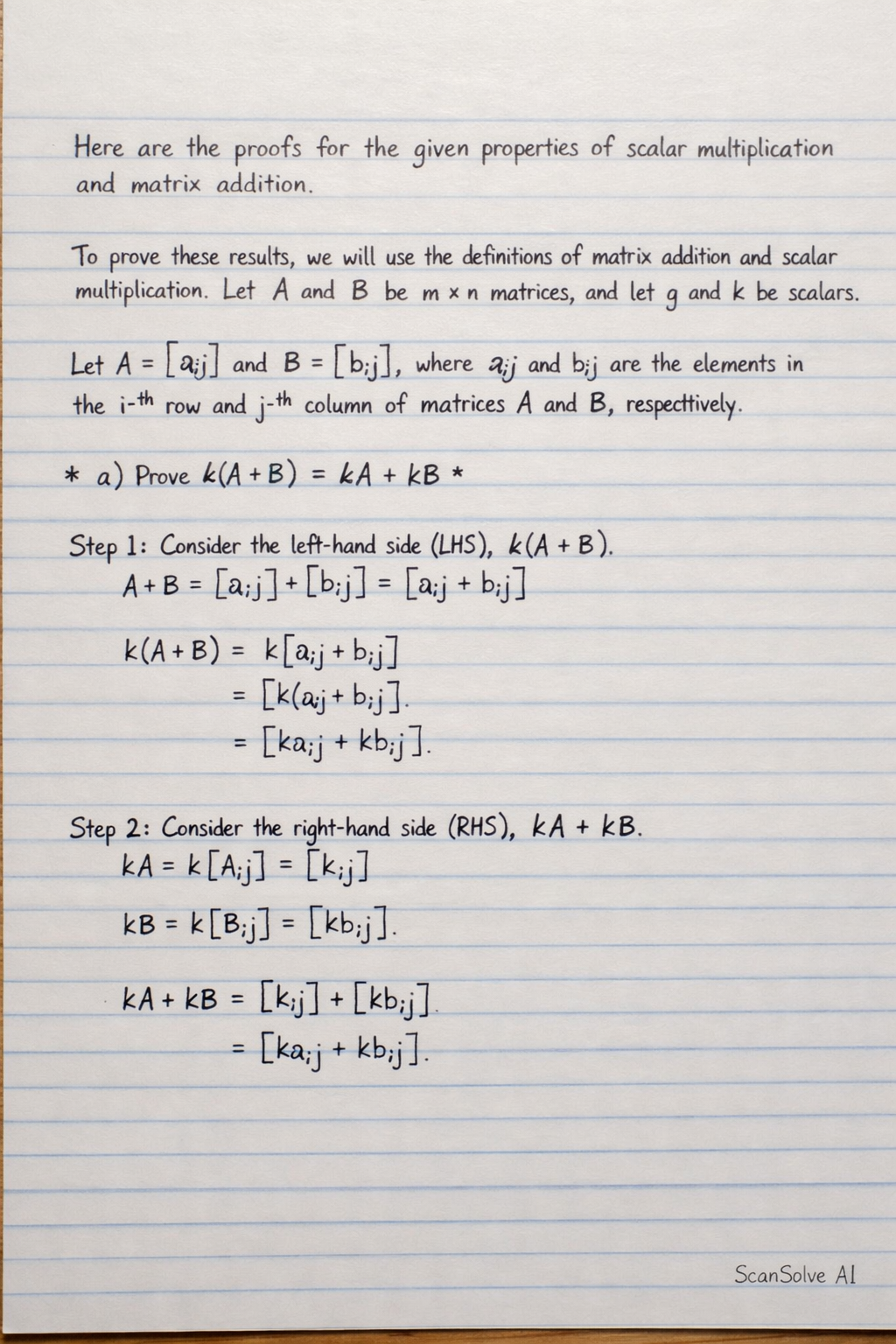
Here are the proofs for the given properties of scalar multiplication and matrix addition. To prove these results, we will use the definitions of matrix addition and scalar multiplication. Let A and B be m × n matrices, and let g and k be scalars. Let A = [a_ij] and B = [b_ij], where a_ij and b_ij are the elements in the i-th row and j-th column of matrices A and B, respectively. a) Prove k(A+B) = kA + kB Step 1: Consider the left-hand side (LHS), k(A+B). First, calculate A+B. A+B = [a_ij] + [b_ij] = [a_ij + b_ij] Now, multiply by the scalar k. k(A+B) = k[a_ij + b_ij] = [k(a_ij + b_ij)] Using the distributive property of scalars over real numbers, k(a_ij + b_ij) = ka_ij + kb_ij. So, k(A+B) = [ka_ij + kb_ij] Step 2: Consider the right-hand side (RHS), kA + kB. First, calculate kA. kA = k[a_ij] = [ka_ij] Next, calculate kB. kB = k[b_ij] = [kb_ij] Now, add kA and kB. kA + kB = [ka_ij] + [kb_ij] = [ka_ij + kb_ij] Step 3: Compare LHS and RHS. Since [ka_ij + kb_ij] = [ka_ij + kb_ij], the LHS equals the RHS. Therefore, k(A+B) = kA + kB is proven. Proven b) Prove (g+k)A = gA + kA Step 1: Consider the left-hand side (LHS), (g+k)A. (g+k)A = (g+k)[a_ij] = [(g+k)a_ij] Using the distributive property of scalars over real numbers, (g+k)a_ij = ga_ij + ka_ij. So, (g+k)A = [ga_ij + ka_ij] Step 2: Consider the right-hand side (RHS), gA + kA. First, calculate gA. gA = g[a_ij] = [ga_ij] Next, calculate kA. kA = k[a_ij] = [ka_ij] Now, add gA and kA. gA + kA = [ga_ij] + [ka_ij] = [ga_ij + ka_ij] Step 3: Compare LHS and RHS. Since [ga_ij + ka_ij] = [ga_ij + ka_ij], the LHS equals the RHS. Therefore, (g+k)A = gA + kA is proven. Proven