
We read your photo as:
Translate the following phrases into algebraic expressions and represent the given inequality on a number line.
ScanSolve AI Answer
Step-by-step solution
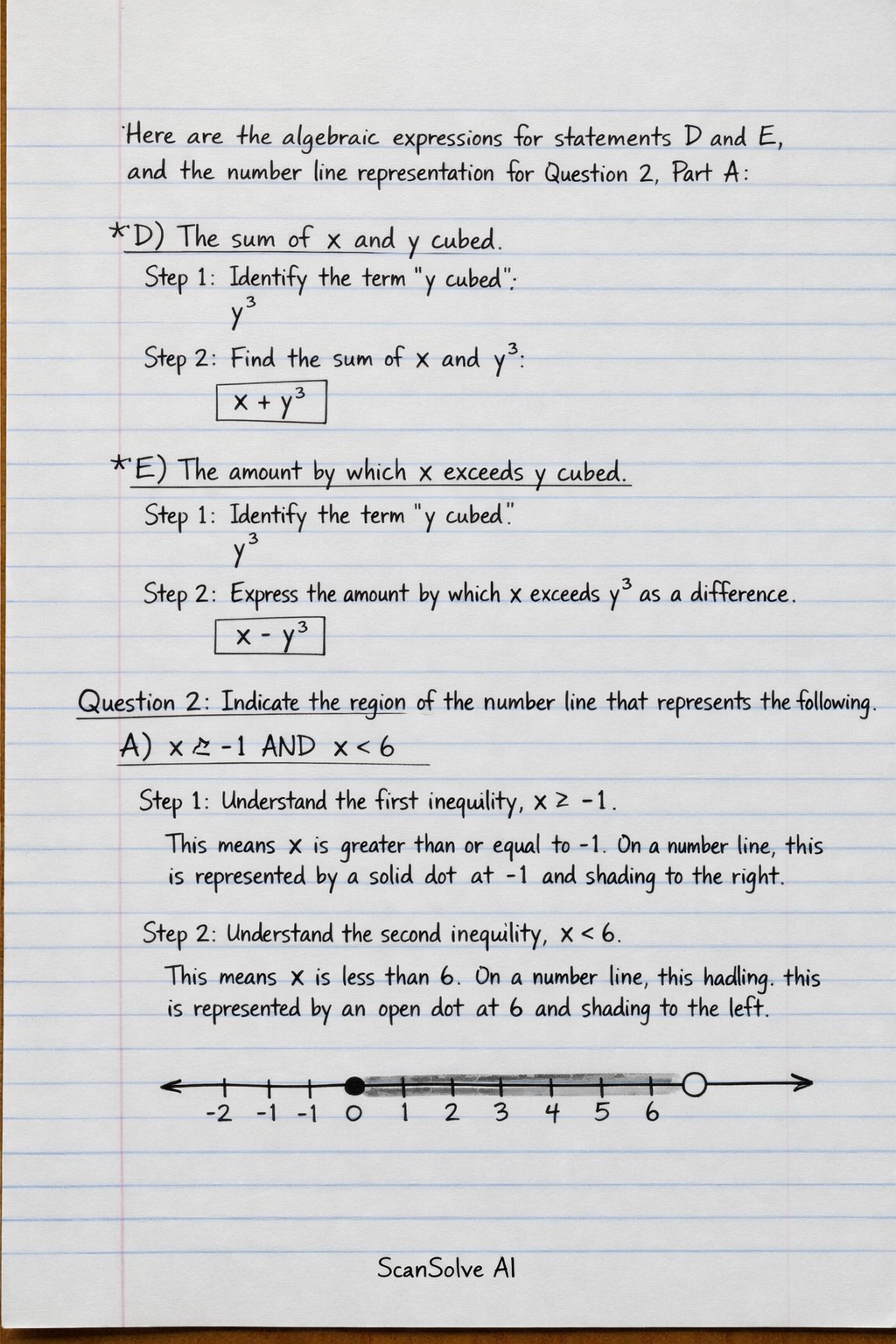
7 stepsHere are the algebraic expressions for statements D and E, and the number line representation for Question 2, Part A:
D) The sum of and cubed.
Identify the term "y cubed".
Find the sum of and .
E) The amount by which exceed cubed.
Identify the term "y cubed".
Express the amount by which exceeds as a difference.
Indicate the region of the number line that represents the following.
A) AND
Understand the first inequality, .
This means is greater than or equal to -1. On a number line, this is represented by a solid dot at -1 and shading to the right.
Understand the second inequality, .
This means is less than 6. On a number line, this is represented by an open dot at 6 and shading to the left.
Combine the inequalities using "AND".
The "AND" condition means that must satisfy both inequalities simultaneously. The region where both are true is between -1 (inclusive) and 6 (exclusive).
Number line representation:
Draw a number line. Place a solid dot (•) at -1. Place an open dot (○) at 6. Shade the region between -1 and 6.
Still stuck on this one?
Ask a follow-up, and the answer starts from this question.
More Mathematics Questions
Handwritten Step-by-Step Solution
Get this as a handwritten image on WhatsApp — like a tutor wrote it for you.
Try on WhatsApp