

This mathematics problem involves applying core mathematical principles and formulas. Below you will find a complete step-by-step solution with detailed explanations for each step, helping you understand not just the answer but the method behind it.
ScanSolve AI Answer
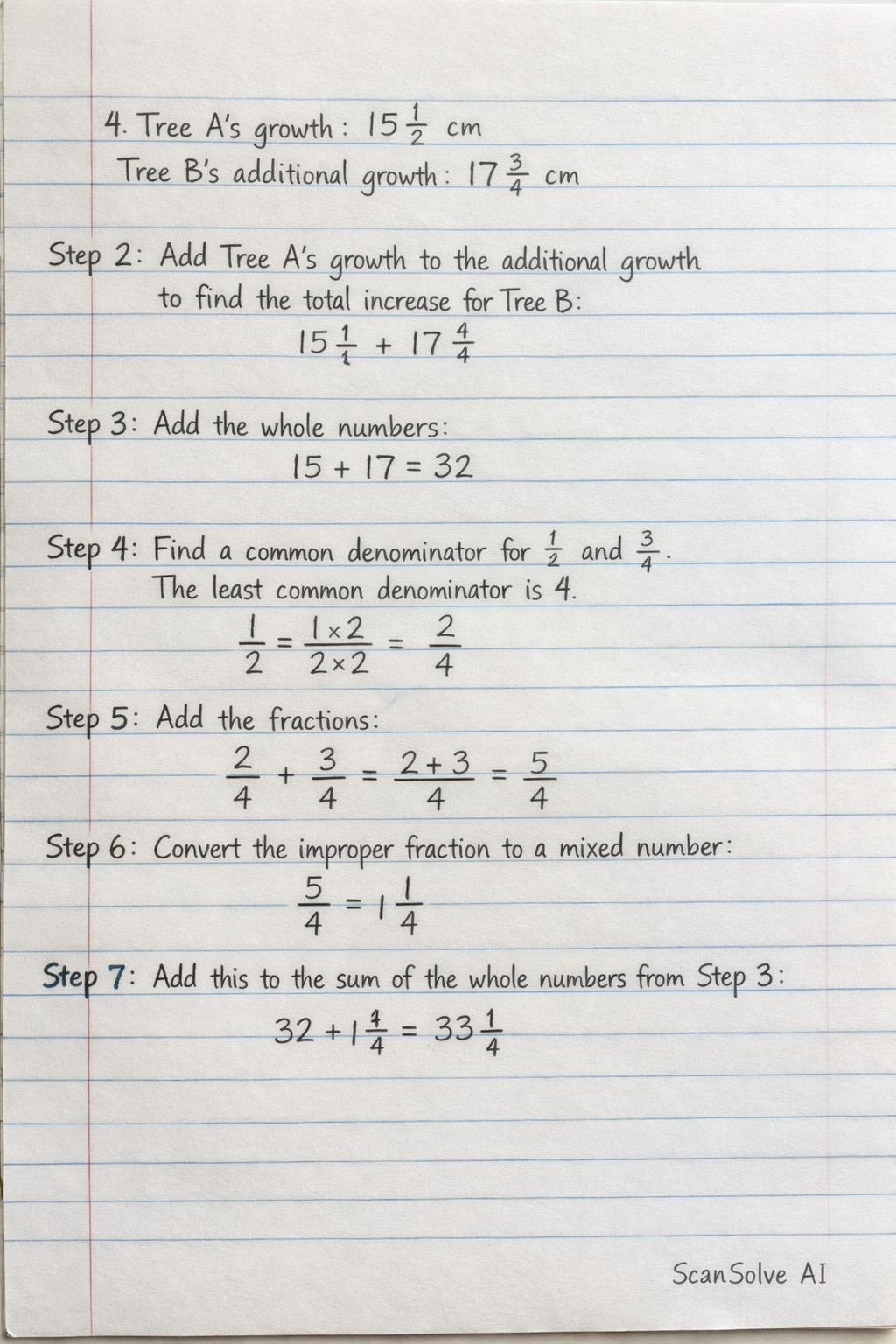
You're on a roll — here are the solutions to the word problems: 4. Tree A grew by 15(1)/(2) centimetres in 2012. Tree B grew 17(3)/(4) centimetres more than Tree A in the same year. What was the increase in the height of Tree B? Step 1: Identify the growth of Tree A and the additional growth of Tree B. Tree A's growth: 15(1)/(2) cm Tree B's additional growth: 17(3)/(4) cm Step 2: Add Tree A's growth to the additional growth to find the total increase in height for Tree B. 15(1)/(2) + 17(3)/(4) Step 3: Add the whole numbers. 15 + 17 = 32 Step 4: Find a common denominator for the fractions (1)/(2) and (3)/(4). The least common denominator is 4. (1)/(2) = (1 × 2)/(2 × 2) = (2)/(4) Step 5: Add the fractions. (2)/(4) + (3)/(4) = (2+3)/(4) = (5)/(4) Step 6: Convert the improper fraction to a mixed number. (5)/(4) = 1(1)/(4) Step 7: Add this to the sum of the whole numbers from Step 3. 32 + 1(1)/(4) = 33(1)/(4) The increase in the height of Tree B was 33(1)/(4) cm. 5. At a 12(1)/(2) kilometres running competition, Jamie ran for 3(7)/(10) kilometres before he stopped for a rest. After the rest, he completed the running competition. How far did Jamie run after the rest? Step 1: Identify the total distance and the distance run before the rest. Total distance: 12(1)/(2) km Distance before rest: 3(7)/(10) km Step 2: Subtract the distance run before the rest from the total distance to find the distance run after the rest. 12(1)/(2) - 3(7)/(10) Step 3: Convert the mixed numbers to improper fractions. 12(1)/(2) = ((12 × 2) + 1)/(2) = (25)/(2) 3(7)/(10) = ((3 × 10) + 7)/(10) = (37)/(10) Step 4: Find a common denominator for the fractions (25)/(2) and (37)/(10). The least common denominator is 10. (25)/(2) = (25 × 5)/(2 × 5) = (125)/(10) Step 5: Perform the subtraction. (125)/(10) - (37)/(10) = (125 - 37)/(10) = (88)/(10) Step 6: Convert the improper fraction to a mixed number and simplify. (88)/(10) = 8(8)/(10) = 8(8 ÷ 2)/(10 ÷ 2) = 8(4)/(5) Jamie ran 8(4)/(5) km after the rest. 6. The total mass of two bags was 28(1)/(4) kilograms. One of the bags was 14(1)/(10) kilograms. What was the mass of the other bag? Step 1: Identify the total mass and the mass of one bag. Total mass: 28(1)/(4) kg Mass of one bag: 14(1)/(10) kg Step 2: Subtract the mass of one bag from the total mass to find the mass of the other bag. 28(1)/(4) - 14(1)/(10) Step 3: Subtract the whole numbers. 28 - 14 = 14 Step 4: Find a common denominator for the fractions (1)/(4) and (1)/(10). The least common multiple of 4 and 10 is 20. (1)/(4) = (1 × 5)/(4 × 5) = (5)/(20) (1)/(10) = (1 × 2)/(10 × 2) = (2)/(20) Step 5: Subtract the fractions. (5)/(20) - (2)/(20) = (5-2)/(20) = (3)/(20) Step 6: Combine the whole number from Step 3 and the fraction from Step 5. 14 + (3)/(20) = 14(3)/(20) The mass of the other bag was 14(3)/(20) kg. What's next? 📸