
We read your photo as:
Two cyclists, A and B, travel 20 km. Cyclist A travels at 30 km/h and Cyclist B travels at 40 km/h. How much longer does Cyclist A take than Cyclist B?
Mathematics
ScanSolve AI Answer
Step-by-step solution
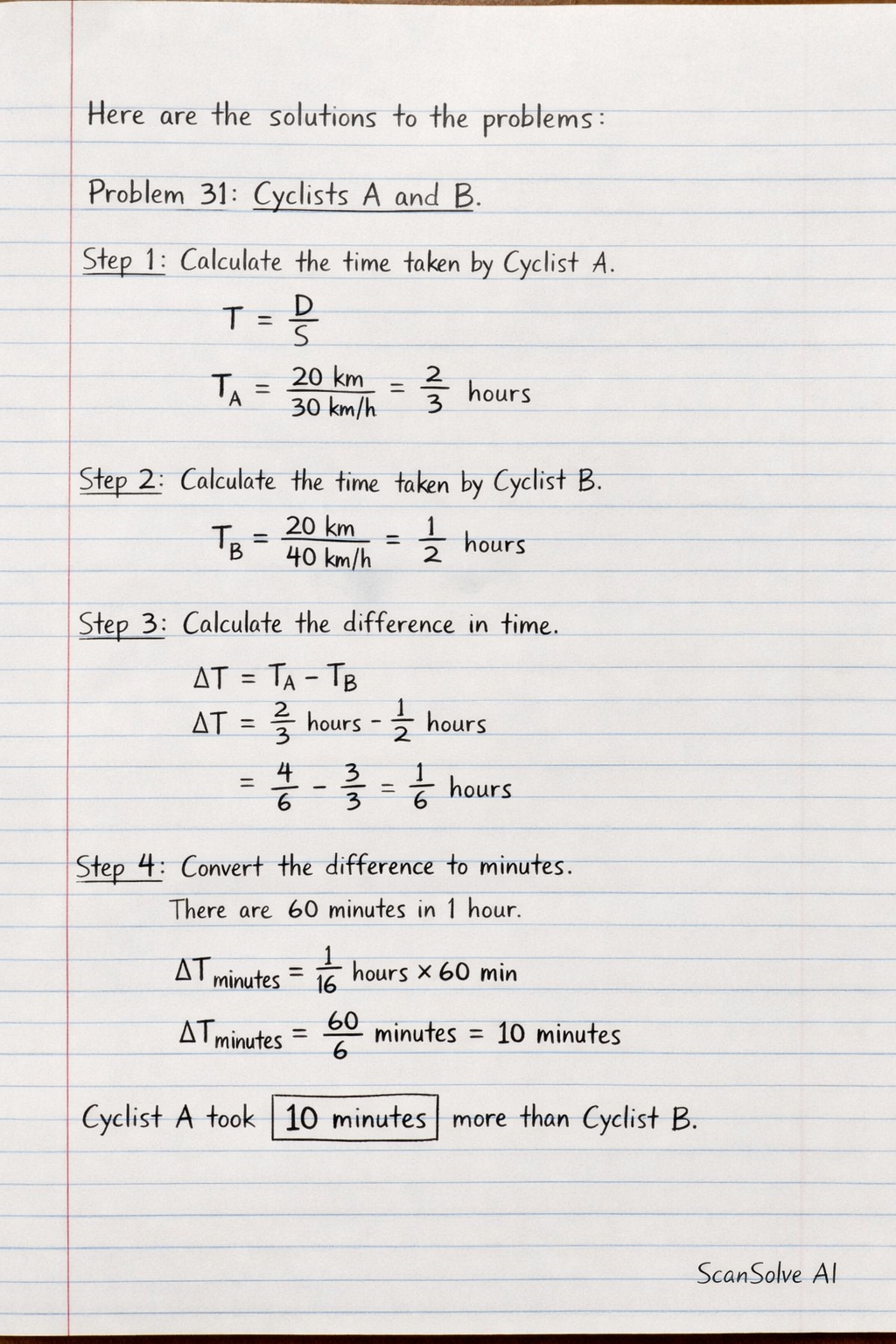
7 stepsHere are the solutions to the problems:
: Cyclists A and B
Calculate the time taken by Cyclist A.
The formula for time is distance divided by speed ().
For Cyclist A:Calculate the time taken by Cyclist B.
For Cyclist B:
Calculate the difference in time in hours.
To subtract, find a common denominator, which is 6.
Convert the difference in time from hours to minutes.
There are 60 minutes in 1 hour.
Cyclist A took more than Cyclist B.
: Capacity of a tank
Identify the dimensions of the tank.
The tank is a rectangular prism (cuboid) with:
Length () = 90 cm
Width () = 80 cm
Height () = 50 cmCalculate the volume of the tank in cubic centimeters.
The formula for the volume of a rectangular prism is .
Convert the volume from cubic centimeters to litres.
We know that .
To convert cubic centimeters to litres, divide by 1000.The capacity of the tank is .
Was this helpful?
Still stuck on this one?
Ask a follow-up, and the answer starts from this question.
Got a different question?Ask your own question
More Mathematics Questions
QA cyclist travels from point A to point B, a distance of 12 km, in 30 minutes. They then stop at…QTwo towns A and B are 400 km apart. A motor cyclist travelling at an average speed of 60km/h left…QA car moving at an average speed of 40km/h left town A at 7:00 a.m for town B which is 40km away…QTwo jets, A and B, leave the same airport at the same time. Jet A travels at 350 km/h and Jet B…QA bike travels 200 km at a speed of 100 km/h. How long does it take?
Handwritten Step-by-Step Solution
Get this as a handwritten image on WhatsApp — like a tutor wrote it for you.
Try on WhatsApp