
We read your photo as:
QUESTION 4: SPACE AND SHAPE. The bridge contains triangular support braces. One triangular brace has two angles of 70° each.
ScanSolve AI Answer
Step-by-step solution
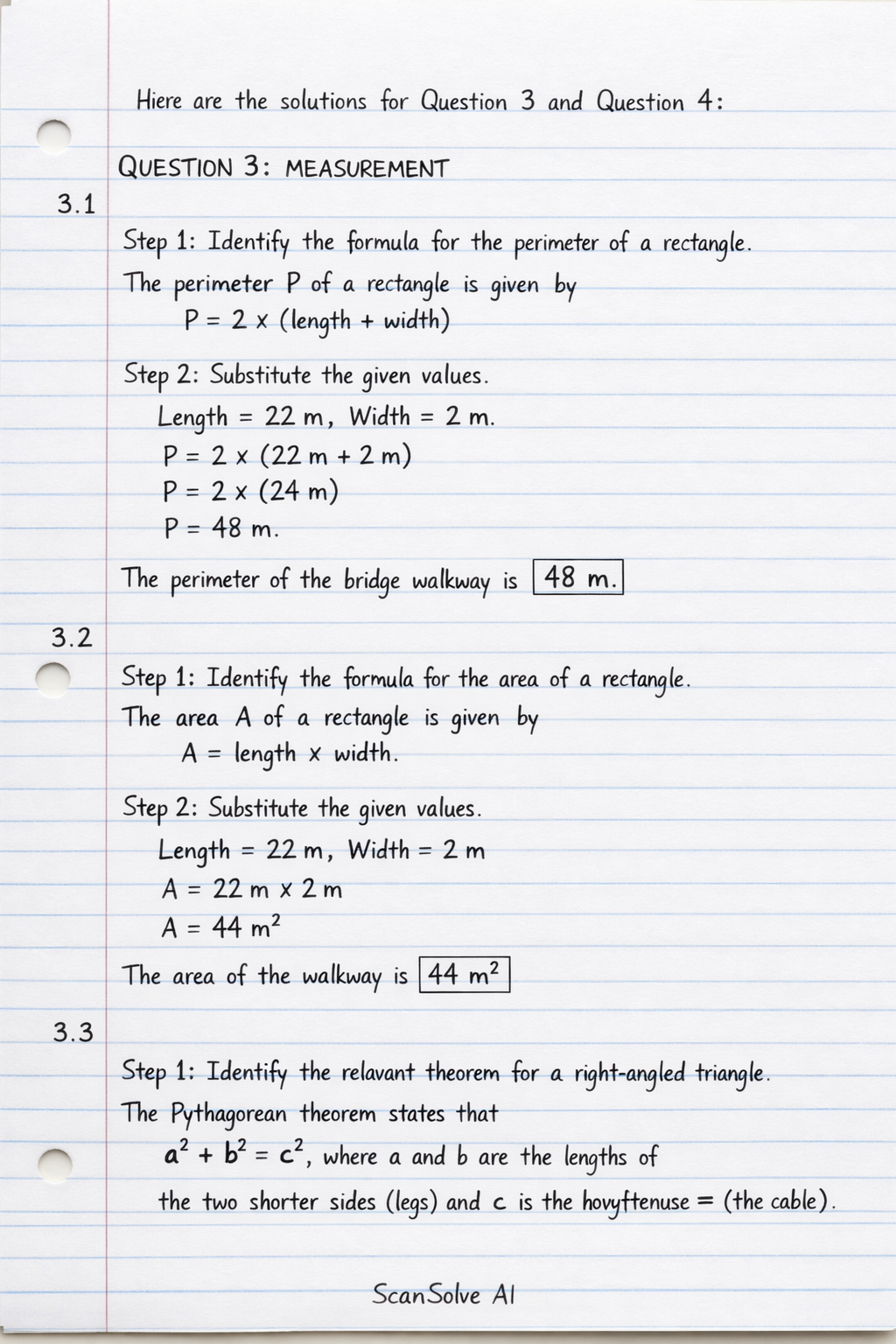
13 stepsHere are the solutions for Question 3 and Question 4:
Part 3
MEASUREMENT
Part 3.1· 2 steps
Identify the formula for the perimeter of a rectangle.
The perimeter of a rectangle is given by .
Substitute the given values.
Length , Width .
The perimeter of the bridge walkway is .
Part 3.2· 2 steps
Identify the formula for the area of a rectangle.
The area of a rectangle is given by .
Substitute the given values.
Length , Width .
The area of the walkway is .
Part 3.3· 3 steps
Identify the relevant theorem for a right-angled triangle.
The Pythagorean theorem states that , where and are the lengths of the two shorter sides (legs) and is the length of the hypotenuse (the cable).
Substitute the given values.
Vertical post () , Horizontal distance () .
Solve for .
The length of the cable is .
Part 3.4· 2 steps
Recall the conversion factor between meters and centimeters.
.
Convert the length of the bridge walkway from meters to centimeters.
Length .
The length of the bridge walkway in centimeters is .
Part 3.5· 2 steps
I cannot draw the sketch for you, but here's how you should approach it:
Determine the dimensions for the sketch using the given scale.
The scale is , which simplifies to (or ).
Original length .
Scaled length .
Original width .
Scaled width .Draw a rectangle with the scaled dimensions.
Draw a rectangle that is long and wide. Label its vertices as P, Q, R, S.
Part 4
SPACE AND SHAPE
Part 4.1
If a triangle has two equal angles, it must also have two equal sides. A triangle with two equal sides is classified as an isosceles triangle.
The triangle is an .
Part 4.2· 2 steps
Recall the sum of angles in a triangle.
The sum of the interior angles in any triangle is .
Calculate the third angle.
Given two angles are each.
Third angle
Third angle
Third angle
The size of the third angle is .
Part 4.3
When a triangle is translated (moved without rotation or reflection), its shape and size remain unchanged. Other properties that remain unchanged include its side lengths, angle measures, area, and perimeter.
Two properties that remain unchanged are:
- The of the triangle.
- The of the triangle.
Part 4.4
To ensure that the triangular braces have equal angles, you would make all three angles equal to . This would result in an equilateral triangle, where all angles and all sides are equal.
You would .
Still stuck on this one?
Ask a follow-up, and the answer starts from this question.
More Mathematics Questions
Handwritten Step-by-Step Solution
Get this as a handwritten image on WhatsApp — like a tutor wrote it for you.
Try on WhatsApp